Nations gather for first-ever conference on fossil fuel exit / Photo: © AFP

 Most Asian stocks track Wall St rally, yen drops after BoJ rate hike

 Russians begin voting in controlled election as war drags on

 Trump 'clearly' wants dialogue with Pyongyang: South Korean President

 Bank of Japan hikes rates to 31-year high to battle inflation

 Thailand's Muslim separatists vow to fight to the end

 Mideast turmoil, AI set to dominate UN gathering of world leaders

 Australia to detain tourists who overstay visa, minister says

 Championship rivals brace for renewal of bitter feuds

 In Brazil's Amazon, the hunt for oil fuels hopes and fears

 Australian athlete who soiled herself apologises for continuing Hyrox race

 Baby orangutans in India expose 'frightening' scale of trafficking
 Doom Loop? Ed Sheeran struggles against Gaza tide
 Sudanese women hold fast to threatened henna body art

 Man Utd misery puts Carrick under pressure, Spurs feeling the heat
 Prized Mexican relic returns on loan, two centuries on

 Venezuela unblocks some censored news sites
 Samba stars on debut in Man City rout of Norwich

 Oversight Board blasts 'inadequate' Meta safeguards for AI deepfakes
 The Easter Island origins of buzzy Malkovich drama 'Wild Horse Nine'

 Third body recovered after Grand Canyon flash flood
 Harry makes first public appearance since return to UK

 Abhishek hits record T20 ton as India sweep series 3-0

 Abhishek hits record T20 ton as India sweep T20 series 3-0

 English FA calls for Infantino to release World Cup sell-off documents

 GM delivers first components for US interceptor missiles

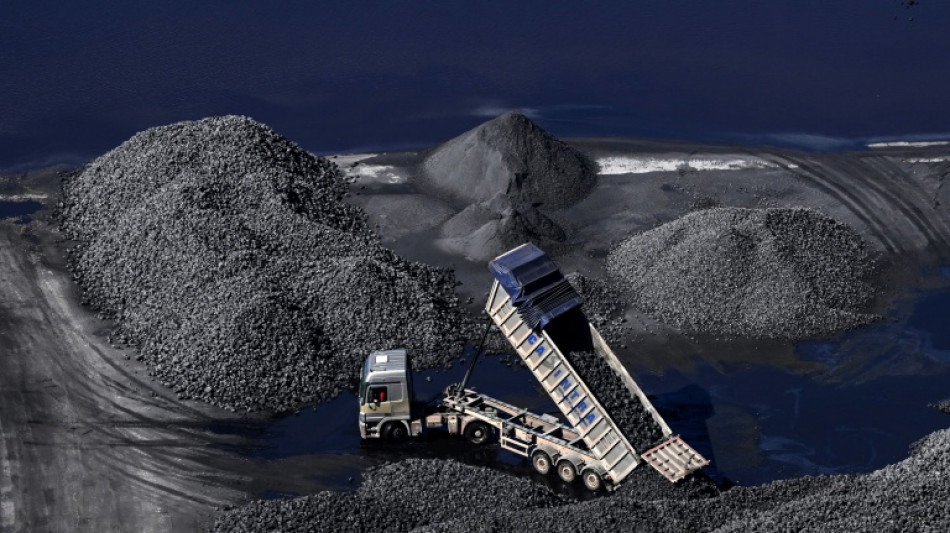
More than 50 nations are attending a world-first conference on phasing out fossil fuels in Colombia next week as the Iran war underscores how dependent countries remain on planet-heating coal, oil and gas.
Ministers arrive in the Caribbean city of Santa Marta against a backdrop of wartime fuel shortages, soaring prices and a scramble for energy security in what the International Energy Agency has called the biggest oil supply shock ever.
The gathering was born out of frustration with consensus-based United Nations climate talks, where efforts to negotiate a fossil fuel exit strategy have stalled.
But organisers say the energy shock caused by Iran's chokehold on the Strait of Hormuz, the key transit point for Gulf oil and gas shipments, has strengthened the case for a fossil fuel phaseout, even as some countries look to coal in the short-term to secure supplies.
Concerns over energy security are expected to shape the high-level discussions over April 28 and 29 as much as climate priorities, analysts say.
The meeting was announced months ago but has taken on "greater relevance" with the energy crisis, said Colombia's environment minister Irene Velez Torres, whose country is co-hosting with the Netherlands.
Major fossil fuel producing nations Australia, Canada and Norway are expected along with developing oil giants Angola, Mexico and Brazil and coal-reliant emerging markets Turkey and Vietnam.
They will join dozens of other countries from small-island developing states to major economies Germany, France and the UK.
However the world's biggest coal, oil and gas producers -- notably the United States, China, Saudi Arabia and Russia -- are skipping the event.
- 'Honest space' -
It will be closely watched for political signals from an emerging coalition of fossil fuel producers and consumers pushing for a phaseout outside the UN process.
Colombia -- a coal and oil exporter -- said the "strategically important" participating countries accounted for one-fifth of global fossil fuel production and nearly one-third of consumption.
Fossil fuel interests have been accused of influencing UN negotiations on climate change and some governments and activists have questioned the involvement of producer nations in Santa Marta.
"The larger the group of countries, the more diffused the interests are and the less chance you've got of getting a sharp outcome," climate scientist Bill Hare, founder of Climate Analytics think tank, told AFP.
Velez Torres said, however, it was a "major step forward" to have producer countries present tackling this "taboo".
"We need to start a more honest space where we can discuss this more openly, and bring all cards to the table. Nobody is saying that the way to eliminating fossil fuels is easy. But we need to bring these people together," she said.
For some, the conference's appeal is partly its distance from the UN climate talks.
"I think the Santa Marta meeting is long overdue," Maina Talia, climate minister of low-lying Tuvalu, told reporters.
- Energy bind -
Roughly twice as much investment goes into clean energy as fossil fuels, which are the primary driver of human-caused climate change.
But heat-trapping emissions from burning coal, oil and gas rose again in 2025 to a record high.
In response to the energy crisis, some countries intend to ramp up coal use to plug short-term supply gaps, underlining the challenge of reducing reliance on fossil fuels even in advanced economies.
Vanuatu's Climate Minister Ralph Regenvanu, whose Pacific Island nation is highly reliant on energy imports, told reporters the crisis was "unequivocally a call to lessen dependence on fossil fuels for everyone".
"We're very much looking forward to being first movers in this space," said Regenvanu.
Nearly 200 countries agreed at COP28 in 2023 to transition away from fossil fuels but efforts to turn that pledge into action have faced strong resistance since.
Tensions boiled over at COP30 in Brazil in November when nations could not even agree to include an explicit reference to fossil fuels in the final deal.
Santa Marta was less a rival to the UN talks than an opportunity for motivated nations "to take concrete steps forward", said Beth Walker, an analyst from the E3G think tank.
"There's a lot of difficult questions and issues to grapple with, but this is an important conversation and I think can start to create its own legitimacy and momentum in the long run," Walker told AFP.
No major announcements are expected but the conference's recommendations will feed into a voluntary "roadmap" away from fossil fuels being led by Brazil.
A.Zbinden--VB