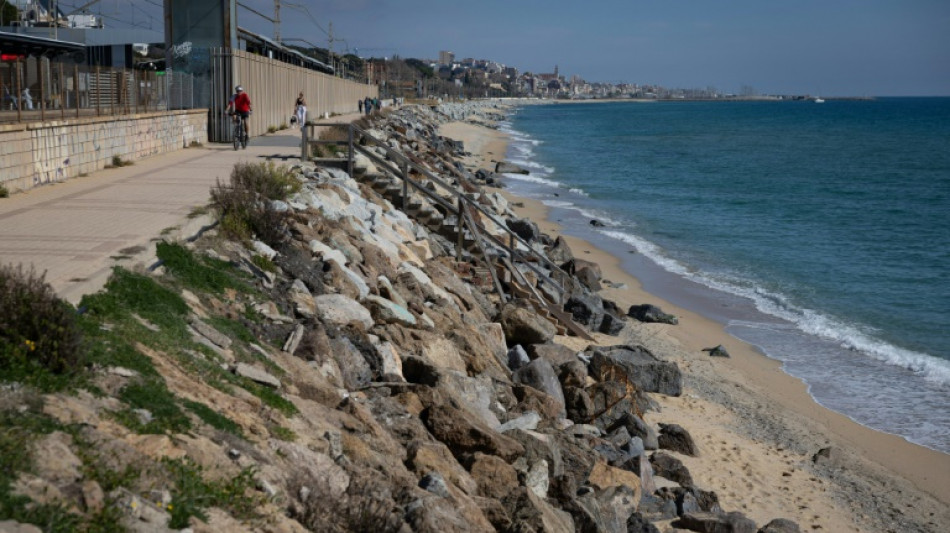
Spain rethinks how to turn tide against beach erosion / Photo: © AFP

 Most Asian stocks track Wall St rally, yen drops after BoJ rate hike

 Russians begin voting in controlled election as war drags on

 Trump 'clearly' wants dialogue with Pyongyang: South Korean President

 Bank of Japan hikes rates to 31-year high to battle inflation

 Thailand's Muslim separatists vow to fight to the end

 Mideast turmoil, AI set to dominate UN gathering of world leaders

 Australia to detain tourists who overstay visa, minister says

 Championship rivals brace for renewal of bitter feuds

 In Brazil's Amazon, the hunt for oil fuels hopes and fears

 Australian athlete who soiled herself apologises for continuing Hyrox race

 Baby orangutans in India expose 'frightening' scale of trafficking

 Doom Loop? Ed Sheeran struggles against Gaza tide

 Sudanese women hold fast to threatened henna body art

 Man Utd misery puts Carrick under pressure, Spurs feeling the heat

 Prized Mexican relic returns on loan, two centuries on

 Venezuela unblocks some censored news sites

 Samba stars on debut in Man City rout of Norwich

 Oversight Board blasts 'inadequate' Meta safeguards for AI deepfakes

 The Easter Island origins of buzzy Malkovich drama 'Wild Horse Nine'

 Third body recovered after Grand Canyon flash flood

 Harry makes first public appearance since return to UK

 Abhishek hits record T20 ton as India sweep series 3-0

 Abhishek hits record T20 ton as India sweep T20 series 3-0

 English FA calls for Infantino to release World Cup sell-off documents

 GM delivers first components for US interceptor missiles

Every winter, storms wipe out swathes of the picturesque Spanish coast, undoing summer reconstruction work and threatening the foundations of the country's vital tourism industry.
Faced with a futile cycle of damage followed by reparations of artificial material, some beach holiday destinations are now turning to natural solutions in a bid to save their landscapes and livelihoods.
In the northeastern region of Catalonia, Montgat beach has all but disappeared -- rocks that had long remained buried by extensive stretches of sand have been laid bare by the elements.
Bruno Cambre enjoys fishing with friends on the tiny patch of surviving sand, planting his rods, a table and a refrigerator next to small homes of former fishermen.
"Four or five years ago, you would go to these beaches and the sand would stretch far, for 500 or 700 metres. Now there are no more than 20 (metres) left," the 37-year-old told AFP.
As waves devour more of the coast, whipped up by storms made fiercer by climate change, he also fears the fishermen's houses "will eventually disappear".
The problem is serious in Catalonia, dotted with idyllic coastal villages and resorts that bathe in Mediterranean sunshine and draw droves of tourists.
A historic railway from Barcelona to the town of Mataro, which runs parallel to the coast, inches ever closer to the sea every winter.
South of Barcelona, part of the problem is the overdevelopment of beachfronts with promenades and apartments, which box in the sand against ferocious waves.
The severity of winter erosion has reached an intensity at which "we will start to lose beaches in the next 10 years," Greenpeace Spain warned in a 2024 report.
- 'Ineffective' -
An hour's drive south of Barcelona, the town of Calafell has tried to harness natural processes to halt its receding beaches.
For Carla Garcia Lozano, a professor of physical geography at the University of Girona, the usual technique of dumping tonnes of sand doomed to be washed away by the next succession of winter storms, or replacing paving stones on promenades, is not a long-term solution.
"Artificial regeneration is no longer possible, partly because it is very expensive economically, but its maintenance is also very expensive and very ineffective," she told AFP.
Garcia Lozano has supervised the regeneration of beaches for the past six years in Calafell, a town of 30,000 residents that depends mainly on tourism.
The beaches regenerate naturally in periods of more clement weather, "especially in summer", but that revival "only happens in spaces that are very natural", she explained.
Calafell has therefore removed 800 square metres (8,600 square feet) of its promenade and two dykes; placed barriers made of reeds along the beach to retain sand and create dunes; replenished eroded areas with nearby sand of the same type; and uses drones to observe the area.
"In an area of 4,500 square metres, 1,000 cubic metres of sand have been gained," she said, calling the result "a significant amount".
"On average it comes to 25 centimetres, but in some areas it reaches one and a half metres high."
Calafell's environment councillor Aron Marcos Fernandez explained that demolishing part of the promenade worked "because before the sea would batter the promenade, and now there is sand".
- 'Part of the history' -
Other Catalan municipalities have tried similar measures, removing car parks, breakwaters and beach stalls, but natural solutions only go so far.
Calafell is considering the demolition of the widest and most modern part of its promenade, but the historic section is untouchable due to the proximity of houses, said councillor Fernandez, arguing for a balance between renaturalisation and tourism.
In Sitges, south of Barcelona, the restoration of dunes has been prioritised, but dismantling the bustling, century-old seafront walk is out of the question.
"It's a part of the history of Sitges and it's part of the citizens. So removing the promenades is a difficult action for us," mayor Aurora Carbonell told AFP.
The shimmering water and pristine sand of sunny Spain's renowned beaches play a fundamental role in the tourism sector.
Almost 100 million foreign visitors flocked to the country last year -- a record -- and tourism is a motor of a fast-growing Spanish economy, sustaining 2.7 million jobs and representing more than 12 percent of GDP.
F.Fehr--VB



