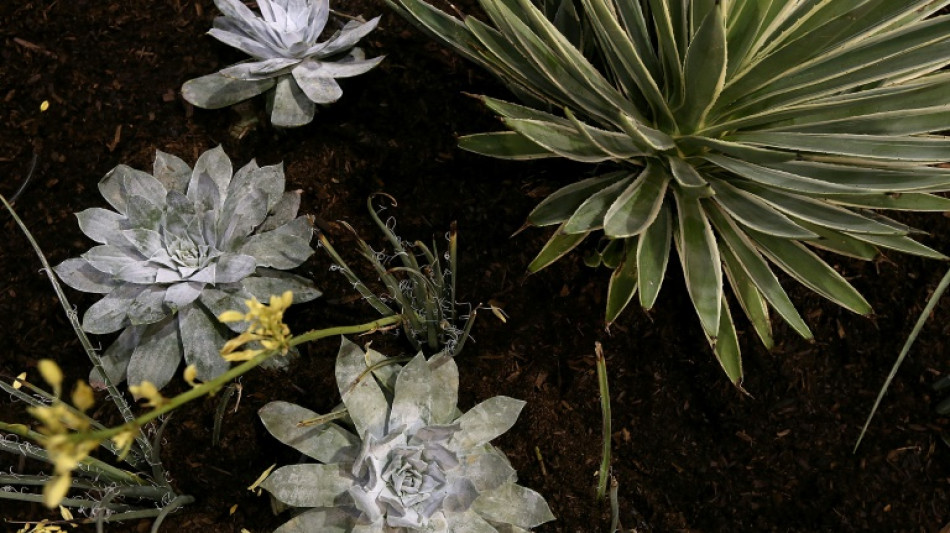
Climate, collectors blamed for S.Africa's succulents decline / Photo: © GETTY IMAGES NORTH AMERICA/AFP/File

 Most Asian stocks track Wall St rally, yen drops after BoJ rate hike
 Russians begin voting in controlled election as war drags on

 Trump 'clearly' wants dialogue with Pyongyang: South Korean President

 Bank of Japan hikes rates to 31-year high to battle inflation
 Thailand's Muslim separatists vow to fight to the end

 Mideast turmoil, AI set to dominate UN gathering of world leaders

 Australia to detain tourists who overstay visa, minister says

 Championship rivals brace for renewal of bitter feuds

 In Brazil's Amazon, the hunt for oil fuels hopes and fears
 Australian athlete who soiled herself apologises for continuing Hyrox race

 Baby orangutans in India expose 'frightening' scale of trafficking
 Doom Loop? Ed Sheeran struggles against Gaza tide

 Sudanese women hold fast to threatened henna body art

 Man Utd misery puts Carrick under pressure, Spurs feeling the heat

 Prized Mexican relic returns on loan, two centuries on

 Venezuela unblocks some censored news sites

 Samba stars on debut in Man City rout of Norwich

 Oversight Board blasts 'inadequate' Meta safeguards for AI deepfakes

 The Easter Island origins of buzzy Malkovich drama 'Wild Horse Nine'

 Third body recovered after Grand Canyon flash flood

 Harry makes first public appearance since return to UK
 Abhishek hits record T20 ton as India sweep series 3-0

 Abhishek hits record T20 ton as India sweep T20 series 3-0

 English FA calls for Infantino to release World Cup sell-off documents

 GM delivers first components for US interceptor missiles

Climate change and collectors of rare plants are decimating succulents in South Africa, government researchers said Wednesday, warning hundreds of these rugged species are at risk of extinction.
Succulents growing in the country's semi-arid regions are experiencing unprecedented rates of decline following a rapid rise in global demand for collectable plants driven by Asia, according to the South African National Biodiversity Institute (SANBI), a government research body.
"Over the past three years plant material confiscated from plant traffickers by law enforcement agencies has increased annually by over 250 percent," the institute said in a statement.
SANBI said more than 200 succulents -- typically thick, fleshy plants that retain water to survive dry weather conditions -- have been added to an International Union for Conservation of Nature (IUCN) Red List of threatened species, which was updated last week.
Unique species growing in the Succulent Karoo -- a region shared between South Africa and Namibia which includes some of the world's most biodiverse desert and semi-desert areas -- are particularly sought after, it said.
The plants are often sold on social media, it added.
"People buying these plants, most of them don't realize that they're breaking the law," said Craig Hilton-Taylor, who heads the IUCN's Red List unit.
"They're completely ignorant or naive about illegal plant trade... they just think, 'Oh, that's a nice thing to buy for my house or my garden'," he said.
Global warming is also contributing to the decline, the institute said.
The region has suffered from a prolonged, severe drought over the past decade.
This has taken a toll on many species in the region, including the critically endangered giant quiver tree. Its population is set to decline 90 percent by 2080, SANBI said.
"A combination of illegal collection, long-term droughts related to climate change, and ongoing land degradation as a result of livestock overgrazing and mining are creating a devastating storm causing unprecedented loss of biodiversity in the world's richest desert ecosystem," it said.
W.Lapointe--BTB