Europe heat sparks harmful ozone pollution, 'extreme' fire risk / Photo: © AFP/File

 Most Asian stocks track Wall St rally, yen drops after BoJ rate hike

 Russians begin voting in controlled election as war drags on

 Trump 'clearly' wants dialogue with Pyongyang: South Korean President

 Bank of Japan hikes rates to 31-year high to battle inflation

 Thailand's Muslim separatists vow to fight to the end

 Mideast turmoil, AI set to dominate UN gathering of world leaders

 Australia to detain tourists who overstay visa, minister says

 Championship rivals brace for renewal of bitter feuds

 In Brazil's Amazon, the hunt for oil fuels hopes and fears

 Australian athlete who soiled herself apologises for continuing Hyrox race

 Baby orangutans in India expose 'frightening' scale of trafficking

 Doom Loop? Ed Sheeran struggles against Gaza tide

 Sudanese women hold fast to threatened henna body art

 Man Utd misery puts Carrick under pressure, Spurs feeling the heat

 Prized Mexican relic returns on loan, two centuries on

 Venezuela unblocks some censored news sites

 Samba stars on debut in Man City rout of Norwich

 Oversight Board blasts 'inadequate' Meta safeguards for AI deepfakes

 The Easter Island origins of buzzy Malkovich drama 'Wild Horse Nine'

 Third body recovered after Grand Canyon flash flood

 Harry makes first public appearance since return to UK

 Abhishek hits record T20 ton as India sweep series 3-0

 Abhishek hits record T20 ton as India sweep T20 series 3-0

 English FA calls for Infantino to release World Cup sell-off documents

 GM delivers first components for US interceptor missiles

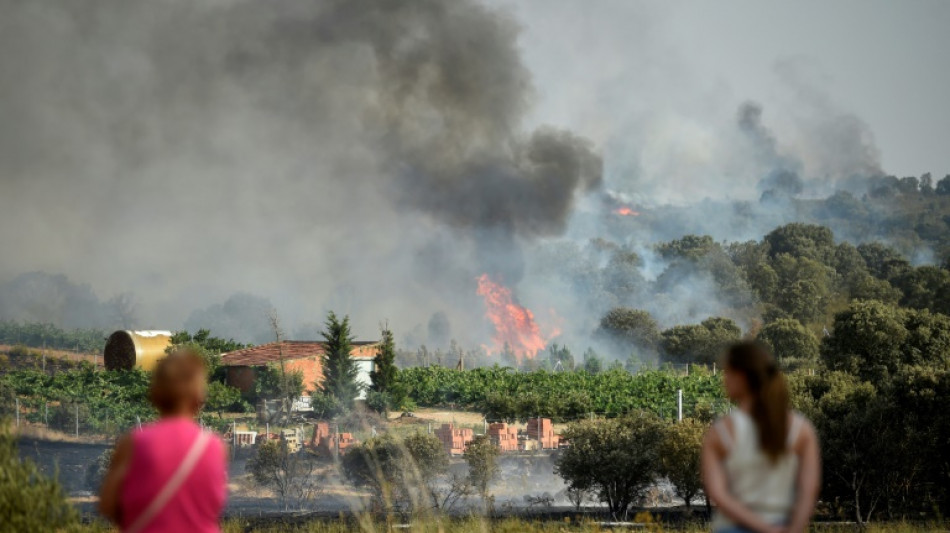
Europe's searing heatwave is generating very high levels of harmful ozone pollution, the region's atmospheric monitoring service warned Tuesday, adding that large areas of western Europe also face "extreme" danger of wildfires.
Record temperatures, which scientists say are driven by climate change, are predicted in France and Britain Tuesday as suffocating heat that has gripped southwest Europe and sparked ferocious wildfires moves northwards.
"Tinder dry conditions and extreme heat are exacerbating the risk of wildfires," according to a statement from the Copernicus monitoring service.
The organisation's emergency management service has warned that a large proportion of western Europe is in "extreme fire danger" with some areas of "very extreme fire danger".
The heatwave is also causing high levels of ground-level ozone, Copernicus said.
Unlike the protective layer in the upper atmosphere, this is a major greenhouse gas and component of urban smog that harms human health and inhibits photosynthesis in plants.
"The potential impacts of very high ozone pollution on human health can be considerable both in terms of respiratory and cardio-vascular illness," said Mark Parrington, Senior Scientist from the Copernicus Atmosphere Monitoring Service.
Ozone is formed as emissions from fossil fuels and other man-made pollutants react in the presence of sunlight and Copernicus said cutting emissions of these pollutants is "crucial".
Scientists have already detected "extremely high surface ozone pollution" across western and southern Europe, particularly over the Iberian Peninsula and parts of northern Italy.
Daily maximum levels of surface ozone, which normally peaks during the middle of the day, reached unhealthy levels in Portugal, Spain and Italy, according to Copernicus.
Scientists now warn that, while the situation is likely to ease across the Iberian Peninsula, very high surface ozone levels are now being seen in areas of northern and western parts of the continent as temperatures rise.
The ozone levels in these regions are forecast to peak in the next few days, before easing.
Copernicus also predicted no relief from the wildfires that have engulfed swathes of forests across parts of southern Europe.
- One million ozone pollution deaths -
In southwest France, two massive fires have created apocalyptic scenes of destruction, despite much of the country's entire firefighting capacity being deployed.
Copernicus said total carbon emissions from the wildfires in Spain so far in July are the highest seen for the June-July period since 2003.
Parrington said high surface ozone can lead to sore throats, coughing, headaches and an increased risk of asthma attacks.
The Clean Air Alliance estimates that ozone pollution causes approximately one million additional deaths per year.
Ozone is also a key concern for agricultural regions and food security.
In January, researchers estimated that persistently high levels of ozone pollution in Asia are costing China, Japan and South Korea an estimated $63 billion annually in lost rice, wheat and maize crops.
P.Anderson--BTB