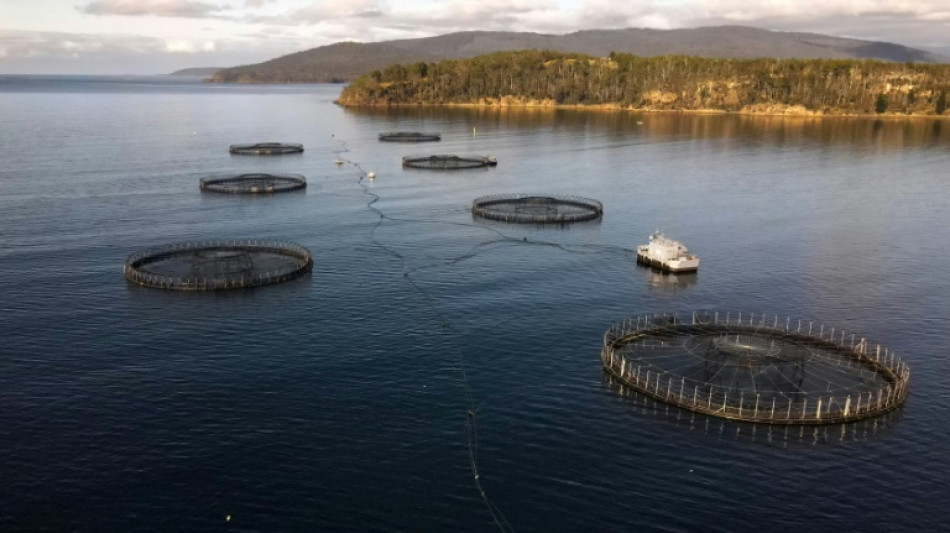
Farmed production of some fish - and seaweed - is soaring / Photo: © AFP/File

 New Zealand Football withdraws support for Infantino, urges review

 Hopes fade in Colombia as window to find quake survivors shuts

 Trump announces tariffs of up to 100% on imported drones

 Spieth among five sharing Memphis lead as PGA playoffs open

 Boats rescue tourists as forest fire flames threaten Greek beaches

 Good vibes powering Djokovic return to Cincinnati

 Britain's Hunt wins 200m for European sprint double

 Draper dumped as Norrie saves face for Britain in Cincinnati

 England opener Gay out for duck in Pakistan warm-up

 Europe swelters under fresh wave of extreme heat

 French Olympic gold medallist Florent Manaudou announces retirement

 Tourists rescued by boat as forest fire threatens Greek beaches
 Indicted Raul Castro reappears after months out of public view

 Italian teen Curtis breaks women's 50m backstroke world record for second time

 Taulagi steps out of 'comfort zone' with code switch to French Top 14 new boys

 Leicester's Thai owners put troubled club up for sale: reports

 Stocks steady as US inflation worries ease, oil slips

 Porsche to end production of flagship electric car: report

 Twitch sparks gamers' wrath with Amazon AI sharing deal

 Blaze forces families to abandon Turkish tour boat

 'If you can, move!' say Rome's viral dancing seniors

 Zambia voters weigh Hichilema's economic record

 SBCFX to Showcase Trading Innovation, Regional Growth Strategy, and Future Vision at iFX EXPO Asia 2026

 Hodgkinson sets up Werro showdown after Euro 800m drama

 'How many will die?': the mysterious ailment killing Kenyan elephants

The amount of farmed seafood we consume -- as opposed to that taken wild from our waters -- is soaring every year, making aquaculture an ever-more important source for many diets, and a response to overfishing.
According to the UN's Food and Agriculture Organization, nearly 99 million tonnes of aquatic animals (fish, molluscs like oysters and mussels and crustaceans like prawns) were farmed around the world in 2023, five times more than three decades ago.
Since 2022, the farming of aquatic animals has been steadily overtaking fishing around the world -- but with large disparities from species to species.
- Fast-growing species -
The two biggest sellers on the market in 2023, carp and tilapia, mainly came from freshwater farming, while other widely-consumed fish, like herring, came just from deep sea fishing
Thierry Laugier, a researcher at Ifremer, France's national institute for ocean science and technology, told AFP that fish farmers choose species that grow quickly and with simple requirements, to be able to control the life cycle.
Sales of the most widely farmed fish in Europe, Atlantic salmon, came to 1.9 million tonnes in 2023, 99 percent of which were farmed.
"We know how to control the ageing or how to launch a reproduction cycle, through injecting hormones," Laugier said.
- Asia main producer -
Asia is by far the biggest producer of farmed fish, accounting for 92 percent of the 136 million tonnes -- of both animal and plant species -- produced under manmade conditions in 2023.
"For carp, it comes down to tradition, it has been farmed for thousands of years on the Asian continent," the Ifremer researcher said.
At the other end of the spectrum, sardines and herring are just fished in the oceans, mainly for profitability reasons as some fish grow very slowly.
"It takes around two years to get an adult-sized sardine," Laugier said.
He said farming of some fish has not yet been started as, "for a long time, we thought the ocean was an inexhaustible resource".
- Seaweed -
Little known in the West, seaweed nevertheless accounts for almost a third of world aquaculture production.
Almost exclusively from Asia, seaweed production increased by nearly 200 percent in two decades, to 38 million tonnes. It is mainly used in industry, in jellies, pharmaceuticals and cosmetics, the expert said.
He said seaweed also has the major advantage of absorbing not just CO2 in the oceans, but also nitrogen and certain pollutants.
"And from an ecological point of view it is better to farm macroalgae than salmon," Laugier said.
D.Bachmann--VB