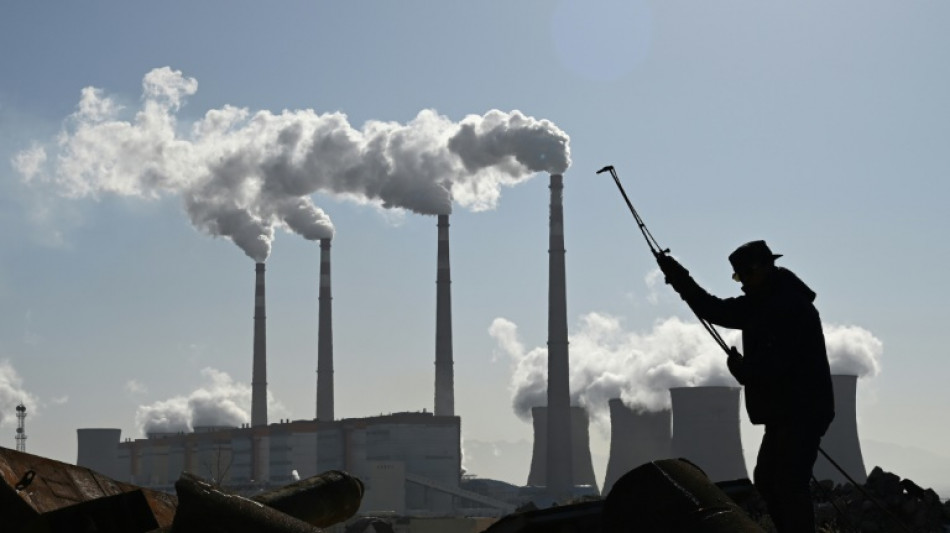
New coal capacity hit 20-year low in 2024: report / Photo: © AFP/File

 Trump Signals Willingness to Work With Democrats After Midterm Defeat

 Qatar media bodies discuss support for humanitarian initiatives

 No. 22 UCLA defeats No. 5 Arizona 84-75 despite Kharchenkov's 38 points

 Vessel operator seeks witnesses after Vancouver grounding

 US Air Force deploys F-16 fighters to remote Aleutian base for readiness drill

 Bezos grant helps Seattle nonprofit move thousands of families toward housing

 Shrini Srivastava joins crew of Varanasi-Delhi Vande Bharat Sleeper service

 Nearly Half of Australian Workers Overqualified, Survey Finds

 RBI eases export-declaration compliance for individual service exporters

 India proposes more import entry points for drugs and medical devices

 Derek Tierney Outlines Ten-Year Strategy for National Digital Health System

 NBC’s Steve Kornacki Reveals Tech Habits Ahead of Midterm Elections
 India and Israel oppose UN draft on regional conventional arms control

 BLS Polymers shares open 65.3% above IPO price

 Capital-markets shares rally as Motilal Oswal and Angel One lead gains

 Latino Voters Defy ICE Fears, Turn Out in Record Numbers for Midterms

 ITC shares rise as analysts anticipate gradual cigarette-business recovery

 Reliance rally puts historical one-year return pattern in focus

 Kuwait edges Oman 1-0 in veterans Gulf Cup in Doha

 Saudi Aramco quarterly profit climbs 34.6% amid elevated oil prices
The world added the smallest amount of new coal capacity in two decades last year, a report said Thursday, but use of the fossil fuel is still surging in China and India.
Coal accounts for just over a third of global electricity production and phasing it out is fundamental to meeting climate change goals.
Just 44 gigawatts (GW) of new coal power capacity was produced globally last year, the lowest figure since 2004, according to the report by a group of energy- and environment-focussed research organisations and NGOs.
"Last year was a harbinger of things to come for coal as the clean energy transition moves full speed ahead," said Christine Shearer of the Global Energy Monitor, which co-authored the report.
But new capacity still outstripped coal closures, meaning a net increase in the global coal fleet, the report noted.
China began construction on a record number of coal plants last year.
Last year also saw a record number of new coal proposals in India, the report warned.
"Work is still needed to ensure coal power is phased out in line with the Paris climate agreement, particularly in the world's wealthiest nations," Shearer said.
- 'Dubious' coal technologies -
The International Energy Agency (IEA) says global coal demand will plateau from 2024-2027, with declining use in developed countries largely off-set by growth in emerging economies.
China's electricity sector accounts for a third of all coal consumed worldwide, according to the IEA, making its transition from the fuel key to global trends.
While coal construction hit record highs in China last year, new permits in the country fell back from the breakneck levels seen the two years prior, the report said.
And in Southeast Asia, where coal has powered emerging economies like Indonesia, new proposals for the fossil fuel have declined.
That is the result of various deals and pledges in Indonesia, Malaysia, the Philippines and Vietnam to phase out the use of coal, the report said.
But among wealthy economies, Japan and South Korea were singled out for their promotion of "dubious 'decarbonisation' coal technologies domestically and abroad."
The report warned these technologies are "expensive and unlikely to deliver the deep emission cuts needed for climate stability."
Chief among them is co-firing with ammonia at coal-powered plants. Substituting ammonia for some of the coal used in a plant can reduce emissions, but ammonia's emissions profile depends on how it is produced.
And even co-firing with low-emissions ammonia still produces more carbon dioxide than many other power generation technologies, the report warned.
The groups also flagged uncertainty over coal commitments in the United States after Donald Trump returned to the presidency.
But they pointed out that more coal plants were shut during Trump's first term than under his predecessor Barack Obama, or successor Joe Biden.
"Trump's first term shows the difficulty of counteracting the declining economic feasibility of coal power in the US, coupled with the advanced age of the country's coal plants," the report said.
S.Gantenbein--VB