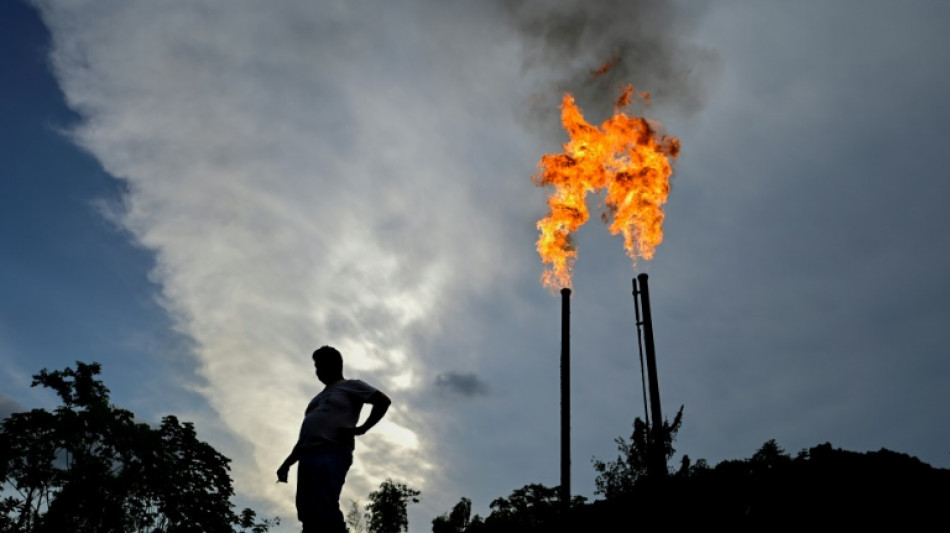
Concern as climate talks stalls on fossil fuels pledge / Photo: © AFP/File

 Bagnaia scorches to Czech MotoGP sprint victory, Bezzecchi crashes
 Trump escalates spat with Italy’s Meloni over G7 photo claim

 Driver killed, 28 in hospital as UK train collision probed
 New Zealand pile on the runs to leave England facing record chase in 2nd Test
 Court bans Spanish PM's wife from leaving country
 Japan's Ogura smashes own track record to take Czech MotoGP pole

 Germany meet Ivory Coast in high-stakes World Cup clash, Sweden face Dutch

 Indian guru urges broader view of yoga

 Paraguay's Almiron sent off under new FIFA 'mouth-covering' rule
 Tunisia ask how Sweden World Cup star Ayari slipped its net
 USA down Australia to reach World Cup knockout rounds, Brazil swat Haiti
 Australia detects first case of contagious H5 bird flu
 Iran's treatment at World Cup 'a dark point' for football: official
 Nagelsmann eyes same German lineup against I. Coast after Curacao trouncing

 Saibari early strike gives Morocco World Cup win over Scotland
 Pochettino backs 'high IQ' players to block out World Cup hype
 Douglass breaks 50m free world record at Indy Pro Swim
 'Like China': Cubans welcome reforms but exiles remain skeptical
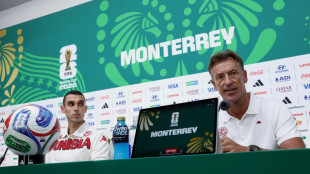
 USA down Australia to reach World Cup knockout rounds

 Imperious Dupont guides record-breaking Toulouse to Top 14 final
 Venezuelan opposition figure heads to US after transition talks

 Canada star Kone to miss rest of World Cup after surgery: team

 Confident Fitzpatrick makes a run at another US Open title

 England captain Stokes strikes for Durham as Test recall looms

 Clark wants to win back fans as well as US Open title
The failure of UN climate negotiations to double down on a global pledge to move away from planet-heating fossil fuels on Sunday was decried by experts as a "worrying" setback to global progress on curbing warming.
Nearly 200 nations spent much of COP29 in Azerbaijan locking horns over a tough-fought finance pact that was finally approved in the early hours of Sunday.
But countries also clashed bitterly over how to build on a landmark pledge at last year's climate talks to "transition away" from fossil fuels.
A text that was supposed to push for ways to put that promise into practice was ultimately not adopted at the close of COP29, with countries lamenting that it had been emptied of substance.
Observers said this meant the meeting in Baku, held in what is expected to be the world's hottest year on record, made virtually no progress on tackling the source of global warming.
Laurence Tubiana, the architect of the landmark 2015 Paris climate accord said the Baku deal was "not as ambitious as the moment demands".
"The impacts of the climate crisis are becoming ever more visible, ever more devastating in both human and economic terms, all over the world, with no region spared," she told AFP.
"The culprits are well known, yet once again fossil fuels have been defended by an ill-prepared COP presidency."
Azerbaijan, an authoritarian state that relies on oil and gas exports, has been accused of lacking the experience and bandwidth to steer such complex negotiations.
Its leader Ilham Aliyev opened the conference by hailing fossil fuels as a "gift of God".
- Fossil fight -
The European Union and other countries tussled with Saudi Arabia over including strong language on the energy transition during the UN talks.
Countries had also discussed ways to measure action, such as tracking progress on the move away from oil, gas and coal.
But a Saudi official told delegates on Thursday that the 22-nation Arab Group would reject any UN climate deal that targeted fossil fuels.
As negotiations wrapped up in the early hours of Sunday, countries and negotiating blocs including vulnerable small island states and Latin American and Caribbean nations said the text had been watered down so much that they could not support it.
"We made historic commitments a year ago, including to transition away from fossil fuels. We came here to translate that commitment into meaningful action and quite simply, we have fallen short," said the delegate from Canada.
The Fiji representative said a failure to agree a strong outcome was "an affront to this process".
Given the objections, the Azerbaijan presidency decided not to adopt the text, which will now be discussed again when negotiators meet next year in June.
Francois Gemenne, a specialist in environmental geopolitics, said the lack of follow up to the fossil fuel pledge was "very worrying" and showed the impact that producers and industry lobbyists can have on climate negotiations.
"We could have expected at least a return to the terms of COP28, but we didn't even get that," he said.
- 'Backward step' -
The international community has agreed that the world should aim to limit global warming to 1.5 degrees Celsius above preindustrial times.
Scientists say carbon dioxide pollution needs to be slashed this decade.
But preliminary research by scientists at the the Global Carbon Project, released during the COP29, found that fossil fuel CO2 emissions continued to rise this year to a new record high.
The failure to progress on emissions at the Baku meeting meant that the 1.5C limit is "very much on life support", said Natalie Jones, a policy advisor at the International Institute for Sustainable Development, a think tank.
"I think it's a backward step," she told AFP, citing concerns that a year of potential progress will be lost and that next year will see "less ambitious leadership" on climate.
Donald Trump, a sceptic of both climate change and foreign assistance, was elected just days before COP29 began and will take office early next year.
With talks mired in acrimony over funding from richer countries, observers said it was difficult for nations to push for more ambition on emissions.
Ultimately, a $300 billion a year pledge from wealthy historic polluters was approved, even as poorer vulnerable countries slammed it as insultingly low.
"The result of this COP is that we haven't really made any new progress on reducing greenhouse gases, but we have saved the process of the Paris Agreement, and we can still hope for better results next year," a European negotiator told AFP.
A.Ammann--VB