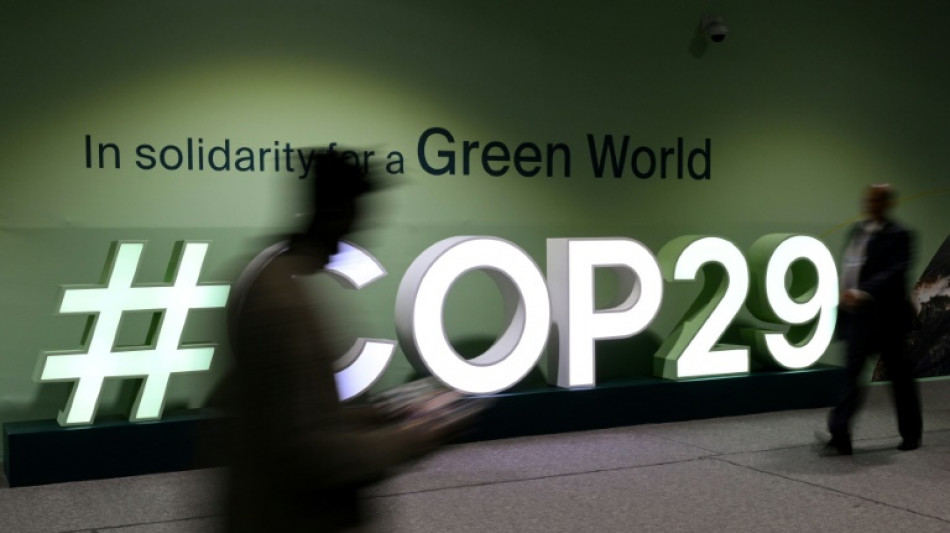
Climate-threatened nations stage protest at COP29 over contentious deal / Photo: © AFP

 Bagnaia scorches to Czech MotoGP sprint victory, Bezzecchi crashes
 Trump escalates spat with Italy’s Meloni over G7 photo claim

 Driver killed, 28 in hospital as UK train collision probed
 New Zealand pile on the runs to leave England facing record chase in 2nd Test

 Court bans Spanish PM's wife from leaving country
 Japan's Ogura smashes own track record to take Czech MotoGP pole

 Germany meet Ivory Coast in high-stakes World Cup clash, Sweden face Dutch

 Indian guru urges broader view of yoga
 Paraguay's Almiron sent off under new FIFA 'mouth-covering' rule
 Tunisia ask how Sweden World Cup star Ayari slipped its net

 USA down Australia to reach World Cup knockout rounds, Brazil swat Haiti

 Australia detects first case of contagious H5 bird flu

 Iran's treatment at World Cup 'a dark point' for football: official

 Nagelsmann eyes same German lineup against I. Coast after Curacao trouncing

 Saibari early strike gives Morocco World Cup win over Scotland

 Pochettino backs 'high IQ' players to block out World Cup hype
 Douglass breaks 50m free world record at Indy Pro Swim

 'Like China': Cubans welcome reforms but exiles remain skeptical
 USA down Australia to reach World Cup knockout rounds

 Imperious Dupont guides record-breaking Toulouse to Top 14 final
 Venezuelan opposition figure heads to US after transition talks

 Canada star Kone to miss rest of World Cup after surgery: team

 Confident Fitzpatrick makes a run at another US Open title

 England captain Stokes strikes for Durham as Test recall looms

 Clark wants to win back fans as well as US Open title
The world's most climate-imperilled nations stormed out of consultations in protest at the deadlocked UN COP29 conference Saturday, as simmering tensions over a hard-fought finance deal erupted into the open.
Diplomats from small island nations threatened by rising seas and impoverished African states angrily filed out of a meeting with summit hosts Azerbaijan over a final deal being thrashed out in a Baku sports stadium.
"We've just walked out. We came here to this COP for a fair deal. We feel that we haven't been heard," said Cedric Schuster, the Samoan chairman of the Alliance of Small Island States (AOSIS).
An unpublished version of the final text circulating in Baku, and seen by AFP, proposes that rich nations raise to $300 billion a year by 2035 their commitment to poorer countries to fight climate change.
COP29 hosts Azerbaijan intended to put a final draft before 198 nations for adoption or rejection on Saturday evening, a full day after the marathon summit officially ended.
But, in a statement, AOSIS said it had "removed" itself from the climate finance discussions, demanding an "inclusive" process.
"If this cannot be the case, it becomes very difficult for us to continue our involvement here at COP29," it said.
Sierra Leone's climate minister Jiwoh Abdulai, whose country is among the world's poorest, said the draft was "effectively a suicide pact for the rest of the world".
An earlier offer from rich nations of $250 billion was slammed as offensively low by developing countries, who have demanded much higher sums to build resilience against climate change and cut emissions.
UK Energy Secretary Ed Miliband said the revised offer of $300 billion was "a significant scaling up" of the existing pledge by developed nations, which also count the United States, European Union and Japan among their ranks.
At sunset, a final text still proved elusive, as harried diplomats ran to-and-fro in the stadium near the Caspian Sea searching for common ground.
"Hopefully this is the storm before the calm," said US climate envoy John Podesta in the corridors as somebody shouted "shame" in his direction.
Earlier, the EU's climate commissioner Wopke Hoekstra said negotiators were not out of the woods yet.
"We're doing everything we can on each of the axes to build bridges and to make this into a success. But it is iffy whether we will succeed," he said.
- 'Ripped off' -
Ali Mohamed, the Kenyan chair of the African Group of Negotiators, told AFP: "No deal is better than a bad deal."
"What we are not up for is going backwards or standing still," he said. "We might as well just have stayed at home then."
The revised offer from rich countries came with conditions in other parts of the broader climate deal under discussion in Azerbaijan.
The EU in particular wants an annual review on global efforts to phase out fossil fuels, which are the main drivers of global warming.
This has run into opposition from Saudi Arabia, which has sought to water down a landmark pledge to transition away from oil, gas and coal made at COP28 last year.
"We will not allow the most vulnerable, especially the small island states, to be ripped off by the new, few rich fossil fuel emitters," said German Foreign Minister Annalena Baerbock.
Wealthy nations counter that it is politically unrealistic to expect more in direct government funding.
The US earlier this month elected former president Donald Trump, a sceptic of both climate change and foreign assistance, and a number of other Western countries have seen right-wing backlashes against the green agenda.
A coalition of more than 300 activist groups accused historic polluters most responsible for climate change of skirting their obligation, and urged developing nations to stand firm.
The draft deal posits a larger overall target of $1.3 trillion per year to cope with rising temperatures and disasters, but most would come from private sources.
Even $300 billion would be a step up from the $100 billion now provided by wealthy nations under a commitment set to expire.
A group of developing countries had demanded at least $500 billion, with some saying that increases were less than met the eye due to inflation.
Experts commissioned by the United Nations to assess the needs of developing countries said $250 billion was "too low" and by 2035 rich nations should be providing at least $390 billion.
The US and EU have wanted newly wealthy emerging economies like China -- the world's largest emitter -- to chip in.
China, which remains classified as a developing nation under the UN framework, provides climate assistance but wants to keep doing so on its own voluntary terms.
R.Fischer--VB