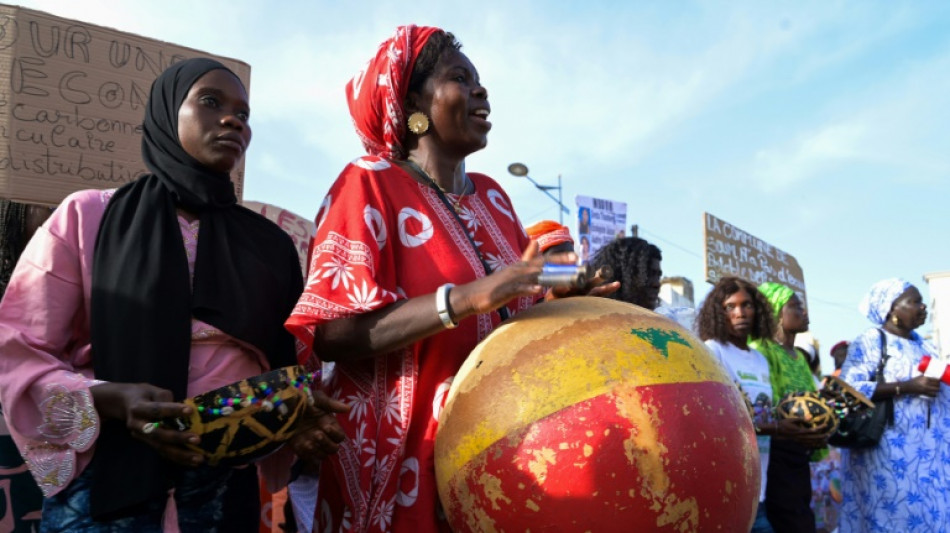
Fears rise of gender setbacks in global climate battle / Photo: © AFP/File

 Philippine ferry fire death toll climbs to 76 as identification process begins
 BRICS nations urge 'maximum restraint' in Middle East war
 Zelensky open to meeting Putin at G20 in Miami
 England survive scare to seal 3-0 sweep against Pakistan
 Trump says Irish unification would be 'fantastic'
 Bodies of Philippines ferry fire victims brought ashore as toll hits 35

 Flick warns Barca stars to keep focus after perfect start

 Trump in Ireland for golf tournament, diplomatic pleasantries

 French police suspect train derailment was sabotage

 Trump lands in Ireland for golf tournament, PM talks

 Xi lands in India for BRICS summit overshadowed by war

 From crime to the Arctic: ultramarathoner film debuts in Toronto

 Back to the drawing board for disappointed Tiafoe

 Lady Gaga welcomes first child with fiance: US media

 Shelton tops Tiafoe to book US Open title clash with Zverev

 Shelton powers past Tiafoe to book US Open title clash with Zverev

 Venice Film Festival: A look back on the highlights

 'Widow's Bay' and 'The Pitt' are favorites for Emmys night

 'Everything different' as Zverev returns to US Open final

 Top seed Zverev holds off Khachanov to reach US Open final

 James McAvoy brings new film 'Faith' to Toronto fest

 Faultless Duplantis, hungry Ingebrigtsen shine at inaugural Ultimate

 Roblox to launch wallet to pay creators faster and will allow off-platform gaming

 Springboks wary of new-look All Blacks in Baltimore test

 Townsend, Siniakova win US Open doubles for career Grand Slam together

As global climate negotiators seek to eke out progress, participants say they are witnessing backsliding in one unexpected area -- gender.
Previous climate summits, like many UN events, have spoken routinely of the need to involve women, who studies say are facing a disproportionate burden from the planet's rising temperatures and disasters.
But at COP29 in Azerbaijan, a draft proposal was stripped in negotiations of references to the experience of women and even of the word "diversity", Ireland's first female president, Mary Robinson, who has been in Baku for the talks, told AFP.
Saudi Arabia has been the key force in opposing gender language and has enjoyed support from Russia, which speaks of promoting traditional values, Robinson and other participants said.
After years of attempts, the opponents of gender language feel "emboldened" now, Robinson said.
"I think they've got a sense of entitlement to do it now, because gender is going backwards. There's a backlash against gender in the United States, for example, and in parts of Europe where you have right-wing governance," said Robinson, who has also served as the UN human rights commissioner and helped form a group of veteran leaders known as The Elders.
A draft text circulated at COP29, where the top priority has been ramping up money to the hardest-hit countries, has maintained one reference to gender, saying that climate finance must be "human rights-based and gender-responsive".
More concretely, COP29 will decide on a proposal to extend by another 10 years an initiative established in 2014 in Lima to incorporate gender systematically in policy work of the UN climate body.
Opponents have refrained from openly campaigning against the gender language.
But a Saudi official speaking on behalf of the Arab Group at COP29 said that human rights matters were "not relevant" to climate finance.
"The final decision must be short, concise and crisp," Albara Tawfiq told delegates.
Decisions at UN climate conferences need to be reached by consensus, although the meaning of consensus is debated.
- 'Not so normal anymore' -
Some 80 percent of people displaced by climate change are women and girls, heightening risks of human trafficking and other abuses, according to a United Nations study.
Yet policymakers are overwhelmingly men. At last year's COP28 in Dubai, which activists credited with forward movement on gender, 34 percent of delegates were women, according to the Women's Environment and Development Organization
At a UN-themed gender day on Thursday, German Foreign Minister Annalena Baerbock brought together fellow female envoys at COP29 for a group photo.
"Normally this is just a normal given thing, but we have realised -- not only at this COP, also before, but especially at this COP -- that somehow normal things are not so normal anymore," she said.
Pointing to climate change's effect on women, Baerbock urged a renewal of the Lima programme and language on gender.
"Fighting the climate crisis, it needs female power, it needs women power, and we can only fight the climate crisis together," she said.
Ayshka Najib, a feminist climate activist at COP29, said that the Azerbaijani hosts did not make gender a priority but credited pressure with restoring some limited language.
"This COP was meant to be as much a gender cap as it is a finance COP, yet what we are witnessing is not progress, but an alarming backslide on gender across agenda items," she said.
Canada's climate negotiator, Catherine Stewart, said that preserving a focus on gender was bowing to reality.
"We are concerned," she said. "A text that brings us back 10 years is unacceptable."
R.Kloeti--VB