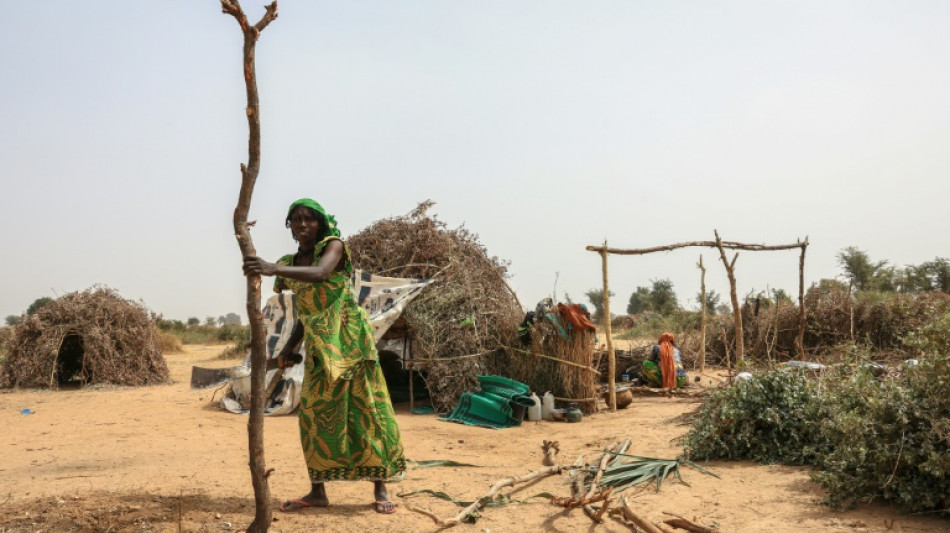
Climate crisis worsening already 'hellish' refugee situation: UN / Photo: © AFP/File

 Yamal double helps Barca beat Levante, Atletico triumph

 Sassuolo stun Juve, Lobotka eases pressure on Allegri with Napoli winner

 Bills beat Texans and Ravens roll Colts in NFL openers

 US fight off spirited France to win 12th World Cup

 Drivers give cool reception to new Madring circuit

 Maresca makes flawless Man City start to leave Man Utd trailing

 Dozens arrested in major anti-LGBTQ raids in Turkey

 Leftwing opposition seen leading Sweden election, far-right losing ground

 Senegal goalkeeper Mendy retires from international football

 Carrick 'worried' by decision to award Man City winner

 Lobotka eases pressure on Allegri with Napoli winner

 Trump watches as Lowry wins Irish Open in record-breaking style

 Poland, Ukraine slam Russian strikes near border as 'escalation'

 Haaland fires 10-man Man City to memorable win over Man Utd

 I miss the adrenaline, but it's not my moment - Bolt

 Championship leader Antonelli to 'keep pushing' for title

 Yamal double helps Barca edge Levante thriller

 Brighton run rampant against 10-man Coventry

 Late Mbappe goal sends Lille top of Ligue 1

 Five-star Brighton crush 10-man Coventry

 Team Europe beat United States to reclaim Solheim Cup

 US House Speaker warns curbing AI too sharply could leave China ahead

 張國榮70歲誕辰音樂會西九舉行 唐鶴德錄音致意

 Iran's economic ties to Dubai hard to break despite war

 iPhone 18預購後出現可疑扣款 四間銀行調查未授權交易
Climate change is contributing to record numbers of people being uprooted from their homes globally, while worsening the often already "hellish" conditions of displacement, the United Nations said Tuesday.
With international climate talks under way in Baku, the UN refugee agency highlighted how soaring global temperatures and extreme weather events are impacting displacement numbers and conditions, as it called for more and better investment in mitigating the risks.
In a fresh report, UNHCR pointed to how climate shocks in places like Sudan, Somalia and Myanmar were interacting with conflict to push those already in danger into even more dire situations.
"Across our warming world, drought, floods, life-threatening heat and other extreme weather events are creating emergencies with alarming frequency," UNHCR chief Filippo Grandi said in the foreword to the report.
"People forced to flee their homes are on the front lines of this crisis," he said, pointing out that 75 percent of displaced people live in countries with high-to-extreme exposure to climate-related hazards.
"As the speed and scale of climate change increase, this figure will only continue to rise."
- 120 million displaced -
A record 120 million people already live forcibly displaced by war, violence and persecution -- most of them inside their own countries, UNHCR figures from June showed.
"Globally, the number of people that have been displaced by conflict has doubled over the last 10 years," Andrew Harper, UNHCR's special advisor on climate action, pointed out to AFP.
At the same time, UNHCR pointed to recent data from the Internal Displacement Monitoring Centre indicating that weather-related disasters have displaced some 220 million people inside their countries over the past decade alone -- equivalent to approximately 60,000 displacements per day.
"We're just seeing more and more and more people being displaced," Harper said, lamenting a dire lack of the funds needed to support those who flee and the communities that host them.
"We are seeing across the board, a hellish situation become even tougher."
Most refugee settlement areas, he pointed out, are found in lower-income countries, frequently "in the desert, in areas which are prone to flooding, in places without necessary infrastructure to deal with the increasing impacts of climate change".
This is set to get worse. By 2040, the number of countries in the world facing extreme climate-related hazards is expected to rise from three to 65, UNHCR said, with the vast majority of them hosting displaced populations.
- Dangerous heat -
And by 2050, most refugee settlements and camps are projected to experience twice as many days of dangerous heat as they do today, the report cautioned.
That could not only be uncomfortable and a health hazard to the people living there, but could also lead to crop failures and livestock dying off, Harper warned.
"We're seeing increasing loss of arable land in places exposed to climate extremes, like Niger, Burkina Faso, Sudan, Afghanistan, but at the same time we've got the massive increase in populations," he said.
UNHCR is urging decision-makers gathered for the COP29 in Baku to ensure that far more of international climate financing reaches refugees and host communities most in need.
Currently, UNHCR pointed out, extremely fragile states receive only around $2 per person in annual adaptation funding, compared to $161 per person in non-fragile states.
Without more investment in building climate resilience and adaptation in such communities, more displacement towards countries less impacted by climate change will be inevitable, Harper said.
"If we don't invest in peace, if we don't invest in climate adaptation in these areas, then people will move," he said.
"It's illogical to expect them to do anything different."
F.Wagner--VB