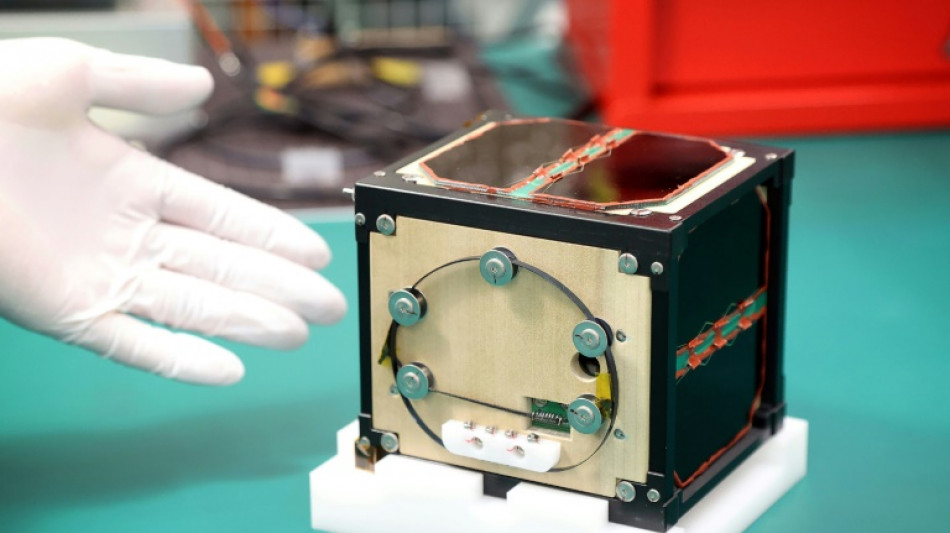
World's first wooden satellite launched into space / Photo: © JIJI PRESS/AFP/File

 Equitas Small Finance Bank rebounds after naming interim chief executive

 Titan quarterly profit seen rising as jewellery business drives growth

 Kuwait finance minister holds economic cooperation talks at COMCEC

 82-Year-Old American Transforms 2003 Mercedes Sprinter into Permanent Home

 Abdul El-Sayed declares victory in Michigan Senate contest

 Democrats capture US Congress in sweeping midterm victory

 Manchester United rallies past Roma as PSG dominates in Champions League

 Qatar prime minister advances mediation through diplomatic calls

 Greenland parliament approves security agreement with United States

 Qatar envoy meets incoming UN General Assembly president

 Trump Signals Willingness to Work With Democrats After Midterm Defeat

 Pitches and Keynote Speakers Are Confirmed for Blue Magic Netherlands on November 17
The world's first wooden satellite has blasted off on a SpaceX rocket, its Japanese developers said Tuesday, part of a resupply mission to the International Space Station.
Scientists at Kyoto University expect the wooden material to burn up when the device re-enters the atmosphere -- potentially providing a way to avoid generating metal particles when a retired satellite returns to Earth.
These particles may negatively impact both the environment and telecommunications, the developers say.
Each side of the box-like experimental satellite, named LignoSat, measures just 10 centimetres (four inches).
It was launched on an unmanned rocket from NASA's Kennedy Space Center in Florida, Kyoto University's Human Spaceology Center said.
The satellite, installed in a special container prepared by the Japan Aerospace Exploration Agency, "flew into space safely", it said in a post on X.
A spokeswoman for LignoSat's co-developer Sumitomo Forestry told AFP the launch had been "successful".
It "will arrive at the ISS soon, and will be released to outer space about a month later" to test its strength and durability, she said.
Data will be sent from the satellite to researchers who can check for signs of strain and determine if the satellite can withstand extreme changes in temperature.
"Satellites that are not made of metal should become mainstream," Takao Doi, an astronaut and special professor at Kyoto University, said at a press conference earlier this year.
S.Leonhard--VB