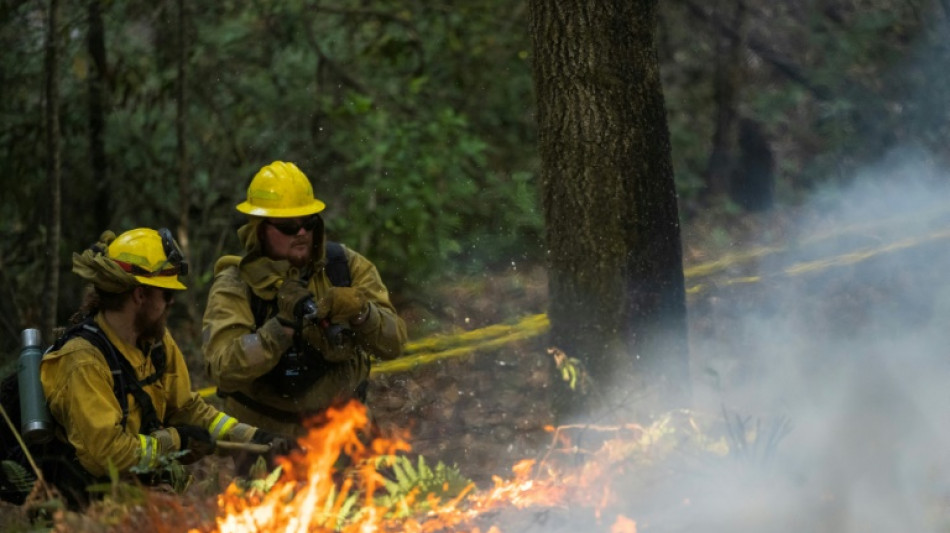
Fight fire with fire: controlled burns stem California blazes / Photo: © AFP

 Inter Milan and Italy icon Mazzola dies aged 83

 Saudi capital issues first air raid alert since renewed fighting in Yemen

 Martin edges title rival Marquez for Austrian MotoGP pole

 Indonesia accepts Malaysia's help to tackle wildfires

 Indians living in Japan on stand-by to house Asian Games athletes
 Trump signs bill authorizing sweeping Russia sanctions

 Protesters form human chain at Kennedy Center after Trump threat

 Death toll from attack at police HQ in Pakistan rises to 31

 Trump says Denmark to give US 'permanent control' over Greenland security
 Kennedy Center: future unclear for iconic Washington arts hub

 Trump claims 'infinite' Greenland security deal with Denmark

 Helicopters battle wildfire threatening Ecuador's capital

 Brentford batter Chelsea to undo Alonso's promising start

 Kane hits Bundesliga century as Bayern rout Union
 Trump says CNN, MS NOW, Politico banned from White House
 Hushing and hedging: US companies retreat on climate

 Springboks to face Fiji before 2027 Rugby World Cup

 Nigeria miners struggled to breathe in cell before 37 died: survivors

 McIlroy on the charge at PGA Championship as Reed withdraws

 McIlroy on the charge at PGA Championship

 Crisis-wracked Volkswagen warns of 10-bn-euro hit to profits

 Costa Rica's Grynspan tops third informal poll for UN chief: diplomat

 Stock markets retreat after central bank rate hikes

 Russia labels director of Cannes Grand Prix winner a 'foreign agent'

 Macron warns of Russian 'hybrid' threat after meeting presidential hopefuls

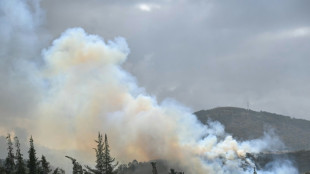
In a forest in northern California, a line of people spread out through the trees, setting fire to shrubs and fallen branches in an act of intentional arson aimed at making the woodland better able to cope with future conflagrations.
The operation near Santa Cruz is part of a growing number of prescribed burns intended to reduce the amount of fuel that can feed natural wildfires in an era when human-caused climate change is increasing the likelihood of devastating blazes.
"The best way to fight fire is with fire," says Portia Halbert, senior environmental scientist with California State Parks, who is supervising the burn.
"It's not a matter of it burns, but it burns: it's going to burn eventually. And so we want to burn it... when it's not going to be so extreme that it burns down people's homes and causes loss of life and property."
Before the undergrowth is ignited, the earth is turned with shovels to create a containment line.
Branches and shrubs too close to fully grown trees are removed, and hoses are deployed to stop flames from getting out of control.
The idea is to encourage the fire to consume only the forest floor, without spreading to the oaks and redwoods that loom over it.
When wildfire breaks out in the future -- as it certainly will -- it will have less fuel and will burn cooler and slower, without spreading to the tree tops.
- Native American practice -
After around 20 years of drought and in a climate that is slowly aridifying, California has seen an alarming number of megafires over the last decade.
These blazes have destroyed millions of acres (hectares) of forest, killed over 200 people and wrought hundreds of millions of dollars of damage.
The scale and cost of these blazes has brought about an understanding that California's long-established policy of stamping out wildfires as soon as they break out is wrongheaded and counterproductive.
With firefighters having rushed to quell blazes as soon as they could, forests have been transformed into fuel-stuffed tinderboxes -- with disastrous consequences when fires inevitably get out of control.
Forest managers now understand what Native Americans long knew -- controlled burns are key to successful management.
Around 20 different organizations are now aiming to burn a total of 160,000 hectares a year by 2025.
But, says Jared Childress of the Central Coast Prescribed Burn Association, which is involved in the Santa Cruz controlled fire, that figure is nowhere near enough.
"We need to scale this up," he said. "We need to be doing burns exactly like this, all throughout California, throughout the fall, throughout the winter, throughout the spring, even in early summer.
"We're nowhere near the level that we need to be, both ecologically and also from changing the wildfire dynamic."
- 'Artful' -
At present, the windows granted by the authorities for these operations remain very narrow.
The nervousness to fully embrace a practice that many land managers see as vital could stem from perceived risk.
While most controlled burns go off without a hitch, they occasionally go wrong -- like one in New Mexico in the autumn of 2022 that ended up destroying hundreds of homes.
Lenya Quinn-Davidson, a specialist in controlled fire at the University of California, says it is a specialized area,
"Prescribed fire is a very artful, thoughtful practice," she told AFP.
"So it's not the kind of thing where you can just hire someone and then they can come in and just start prescribed burning, you have to really have a lot of training and experience."
Nonetheless, the amount of land burned each year has to rise dramatically, if the catastrophic wildfires that have torn through parts of California and other western states in recent years are to be avoided.
"There have been some historical reconstructions of fire regimes and pre-European settlement, (showing) anywhere from four to 11 million acres burned every year" in California, Quinn-Davidson said.
In comparison, "our landscapes are starved for fire."
In the forest outside Santa Cruz, ecology student Ian Cook was among those learning how best to use this powerful tool, working on weather reports to help teams understand how the flames will move when they are set.
For him, it's a huge collaborative effort that is needed to sieze control of the issue and to try to prevent the vast destructive blazes of recent years.
"We'll have to work together," he says.
"Because this is a problem that affects all of us."
D.Schaer--VB