Elusive Attenborough echidna rediscovered in Indonesia / Photo: © EXPEDITION CYCLOPS/AFP

 Inter Milan and Italy icon Mazzola dies aged 83

 Saudi capital issues first air raid alert since renewed fighting in Yemen

 Martin edges title rival Marquez for Austrian MotoGP pole

 Indonesia accepts Malaysia's help to tackle wildfires

 Indians living in Japan on stand-by to house Asian Games athletes

 Trump signs bill authorizing sweeping Russia sanctions

 Protesters form human chain at Kennedy Center after Trump threat

 Death toll from attack at police HQ in Pakistan rises to 31

 Trump says Denmark to give US 'permanent control' over Greenland security

 Kennedy Center: future unclear for iconic Washington arts hub

 Trump claims 'infinite' Greenland security deal with Denmark

 Helicopters battle wildfire threatening Ecuador's capital

 Brentford batter Chelsea to undo Alonso's promising start

 Kane hits Bundesliga century as Bayern rout Union

 Trump says CNN, MS NOW, Politico banned from White House

 Hushing and hedging: US companies retreat on climate

 Springboks to face Fiji before 2027 Rugby World Cup

 Nigeria miners struggled to breathe in cell before 37 died: survivors

 McIlroy on the charge at PGA Championship as Reed withdraws

 McIlroy on the charge at PGA Championship

 Crisis-wracked Volkswagen warns of 10-bn-euro hit to profits

 Costa Rica's Grynspan tops third informal poll for UN chief: diplomat

 Stock markets retreat after central bank rate hikes

 Russia labels director of Cannes Grand Prix winner a 'foreign agent'

 Macron warns of Russian 'hybrid' threat after meeting presidential hopefuls

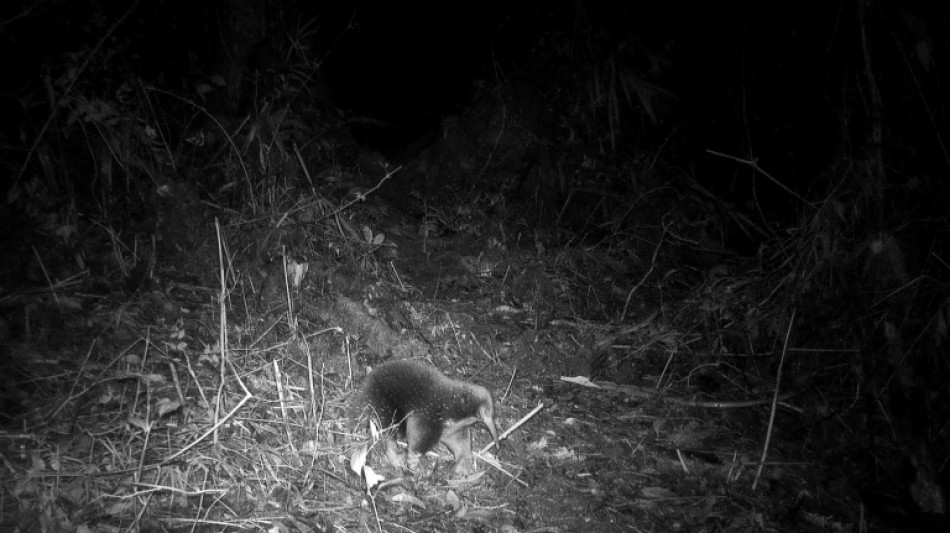
An elusive echidna feared extinct after disappearing for six decades has been rediscovered in a remote part of Indonesia, on an expedition that also found a new kind of tree-dwelling shrimp.
The Zaglossus attenboroughi, a kind of long-beaked echidna named for famed British naturalist David Attenborough, had last been seen in 1961.
Echidnas are nocturnal and shy, making them difficult to find at the best of times, and the Attenborough long-beaked echidna has never been recorded outside the extremely remote Cyclops Mountains of Indonesia's Papua region.
They are the last vestiges of an ancient animal line, explained James Kempton, a biologist from the University of Oxford who led the expedition.
"The reason it appears so unlike other mammals is because it is a member of the monotremes –- an egg-laying group that separated from the rest of the mammal tree-of-life about 200 million years ago."
It took a team of scientists and experts from Britain and Indonesia four weeks and 80 camera traps to find the echidna, and it was only on the last day, and the final memory card of the trip, that the creature made an appearance.
Just a few seconds of black and white footage shows the slightly ungainly creature ambling through the undergrowth, apparently unaware of the excitement its very existence is likely to elicit.
"The discovery is the result of a lot of hard work and over three-and-a-half years of planning," said Kempton.
The team relied heavily on guidance from the local community, who helped them navigate difficult terrain and granted them access to areas regarded as sacred.
In addition to the rediscovered echidna, the team found a kind of honeyeater bird not recorded since 2008, and a slew of underground species that are new to science.
Blind spiders, blind harvestman and a whip scorpion were all recorded in a previously unexplored cave system that was revealed only when a team member fell through a moss-covered entrance.
Among the more unusual findings was a new kind of tree-dwelling shrimp.
"We were quite shocked to discover this shrimp in the heart of the forest," said Leonidas-Romanos Davranoglou, the team's lead entomologist, theorising that the region's heavy rainfall creates an environment humid enough for the shrimps to live on land.
The discoveries came despite perilous conditions, with Davranoglou breaking his arm on the trip and another researcher enduring a leech attached to his eye for a day and half before it was removed at a hospital.
For all the hardships, Kempton described the landscape as "magical," and the team hopes their findings will highlight the desperate need for conservation of the region and Indonesia's remaining forests elsewhere.
"Tropical rainforests are among the most important and most threatened terrestrial ecosystems," said Davranoglou.
O.Schlaepfer--VB