Australia offers Tuvalu citizens climate refuge / Photo: © AFP

 Inter Milan and Italy icon Mazzola dies aged 83

 Saudi capital issues first air raid alert since renewed fighting in Yemen

 Martin edges title rival Marquez for Austrian MotoGP pole

 Indonesia accepts Malaysia's help to tackle wildfires

 Indians living in Japan on stand-by to house Asian Games athletes

 Trump signs bill authorizing sweeping Russia sanctions

 Protesters form human chain at Kennedy Center after Trump threat

 Death toll from attack at police HQ in Pakistan rises to 31

 Trump says Denmark to give US 'permanent control' over Greenland security
 Kennedy Center: future unclear for iconic Washington arts hub

 Trump claims 'infinite' Greenland security deal with Denmark

 Helicopters battle wildfire threatening Ecuador's capital

 Brentford batter Chelsea to undo Alonso's promising start

 Kane hits Bundesliga century as Bayern rout Union
 Trump says CNN, MS NOW, Politico banned from White House
 Hushing and hedging: US companies retreat on climate

 Springboks to face Fiji before 2027 Rugby World Cup

 Nigeria miners struggled to breathe in cell before 37 died: survivors

 McIlroy on the charge at PGA Championship as Reed withdraws

 McIlroy on the charge at PGA Championship

 Crisis-wracked Volkswagen warns of 10-bn-euro hit to profits

 Costa Rica's Grynspan tops third informal poll for UN chief: diplomat

 Stock markets retreat after central bank rate hikes

 Russia labels director of Cannes Grand Prix winner a 'foreign agent'

 Macron warns of Russian 'hybrid' threat after meeting presidential hopefuls

Citizens of climate-threatened Tuvalu will have the right to live in Australia under a landmark pact unveiled Friday -- an offer of refuge as their Pacific homeland is lost beneath the seas.
Prime ministers Kausea Natano and Anthony Albanese inked a treaty to help Tuvalu's 11,000 residents tackle climate change, and to take up sanctuary should the worst fears materialise.
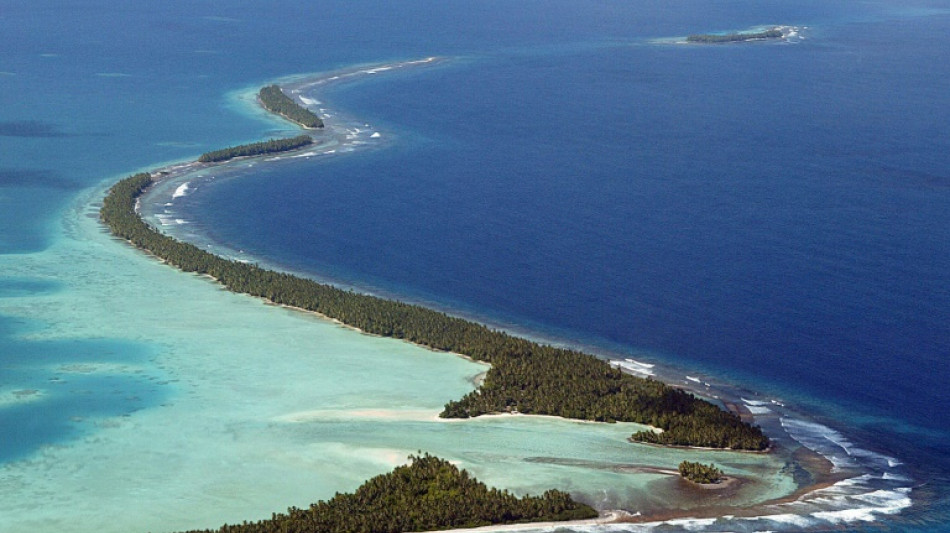
Tuvalu is among the world's most vulnerable nations due to rising sea levels.
Two of Tuvalu's nine coral islands have already largely disappeared under the waves, and climate scientists fear the entire archipelago will be uninhabitable within the next 80 years.
Natano said the agreement was a "beacon of hope" for his imperilled nation, and an offer of support that "has touched our hearts profoundly".
According to the pact, Tuvalu's citizens would be able to "live, study and work in Australia" and gain access to "Australian education, health, and key income and family support on arrival."
Refugee law expert Jane McAdam described the pact as "groundbreaking."
"It's the first agreement to specifically deal with climate-related mobility," the University of New South Wales professor told AFP.
"Most people don't want to leave their homes, they have very deep ancestral ties to their land and sea -- but this offers a lifeline."
To avoid a damaging "brain drain", the number of Tuvaluans able to move to Australia will initially be capped at 280 per year.
New Zealand had previously floated the idea of offering Pacific Island nations a "climate visa", but the idea was scrapped amid opposition from islands fearing mass economic emigration.
Under the agreement unveiled on Friday, Australia has also pledged to spend AUD$16 million (US$10 million) buttressing the country's shrinking shorelines and reclaiming lost land.
But there is also an acknowledgement that action has not come fast enough, and the impact of climate change is already being felt.
"At the same time, we believe the people of Tuvalu deserve the choice to live, study and work elsewhere, as climate change impacts worsen," a joint statement said.
Albanese said Australia could be open to offering Pacific neighbours similar agreements.
"We're open to approaches from other countries on how we can enhance our partnerships." he said, stressing they would have to be tailored to each country.
- Geopolitical win -
The pact will likely be seen as a significant strategic win for Australia, which is competing with China to cement its influence in the Pacific region.
The treaty also commits Australia to defending Tuvalu in the face of natural disasters, health pandemics and "military aggression".
And it offers Australia a say in any defence pacts Tuvalu signs with other countries.
Australia had been shocked when the neighbouring Solomon Islands signed a defence pact with Beijing that would allow the deployment of Chinese forces on the islands.
"Quite clearly this is a groundbreaking agreement," Albanese told reporters on the sidelines of the Pacific Islands Forum in the Cook Islands.
"The Australia-Tuvalu union will be regarded as a significant day in which Australia acknowledged that we are part of the Pacific family."
Australia's economic reliance on coal and gas exports has long been a point of friction with its many Pacific neighbours, who face massive economic and social costs from wilder weather and rising sea levels.
Albanese said developed nations needed to start shouldering more responsibility as developing countries copped the brunt of the climate crisis.
The pact will have to be ratified by each country before coming into effect.
F.Mueller--VB