The Dnipro river, a 'rampart' winding through Ukraine war / Photo: © AFP

 Inter Milan and Italy icon Mazzola dies aged 83

 Saudi capital issues first air raid alert since renewed fighting in Yemen

 Martin edges title rival Marquez for Austrian MotoGP pole

 Indonesia accepts Malaysia's help to tackle wildfires

 Indians living in Japan on stand-by to house Asian Games athletes
 Trump signs bill authorizing sweeping Russia sanctions

 Protesters form human chain at Kennedy Center after Trump threat

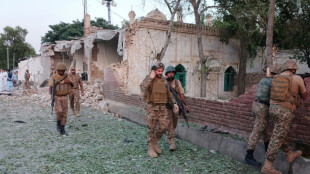 Death toll from attack at police HQ in Pakistan rises to 31

 Trump says Denmark to give US 'permanent control' over Greenland security

 Kennedy Center: future unclear for iconic Washington arts hub

 Trump claims 'infinite' Greenland security deal with Denmark

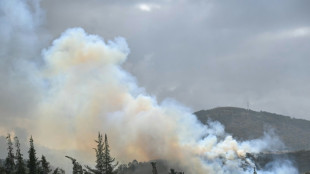 Helicopters battle wildfire threatening Ecuador's capital

 Brentford batter Chelsea to undo Alonso's promising start

 Kane hits Bundesliga century as Bayern rout Union

 Trump says CNN, MS NOW, Politico banned from White House
 Hushing and hedging: US companies retreat on climate

 Springboks to face Fiji before 2027 Rugby World Cup

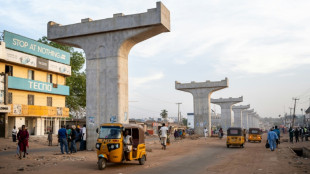 Nigeria miners struggled to breathe in cell before 37 died: survivors

 McIlroy on the charge at PGA Championship as Reed withdraws

 McIlroy on the charge at PGA Championship

 Crisis-wracked Volkswagen warns of 10-bn-euro hit to profits

 Costa Rica's Grynspan tops third informal poll for UN chief: diplomat

 Stock markets retreat after central bank rate hikes

 Russia labels director of Cannes Grand Prix winner a 'foreign agent'

 Macron warns of Russian 'hybrid' threat after meeting presidential hopefuls

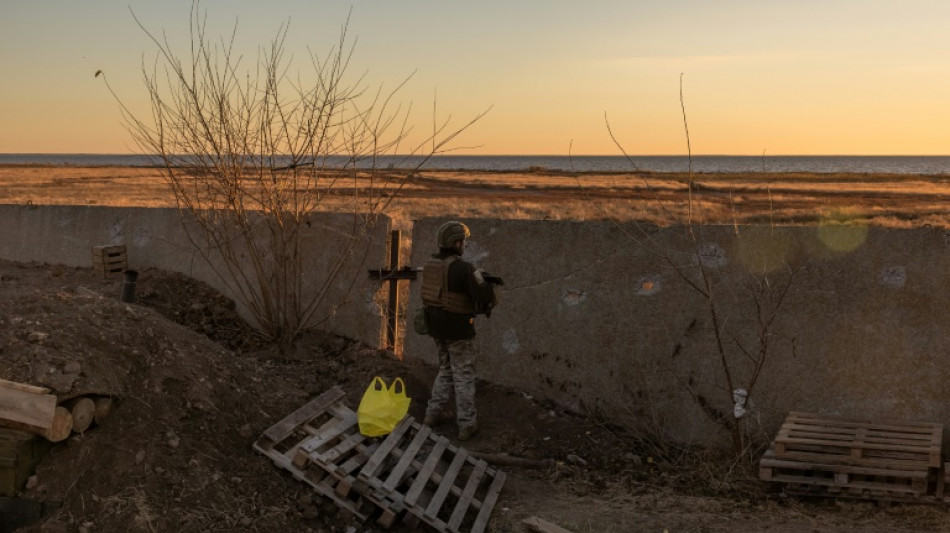
A sweeping plain dotted with ruined houses stretched into the horizon and towards the blue expanse of the Dnipro river, where a clutch of Ukrainian forces were poised for Russian attacks.
The Dnipro, Europe's fourth-longest river and a historic trading route, has become a key front since Ukrainian troops pushed Russian forces back over its banks in the south last year.
The river winds the length of the country from north to south, eventually flowing into the Black Sea from the Kherson region, where it separates the two armies.
While Ukraine's recapture of Kherson city last November was a shock defeat for the Kremlin, Russian forces on the opposing bank still control swathes of territory and shell towns and villages they retreated from.
"The Russians are throwing everything they have at us: artillery, attack drones, phosphorus," an army sergeant with the call sign Vozhd, or Leader, told AFP.
His unit was keeping watch on the riverbank southwest of Kherson city, ready to alert artillery units if Russian forces made an incursion across the river.
Wearing a balaclava and carrying a gun, the 38-year-old serviceman said the good weather the region had been enjoying was playing in their favour.
"Rain is the enemy. When the sky is clear, you can see boats arriving much better," he said.
- 'Solid' Russian defences -
Kyiv launched a major counteroffensive in the south and east in June but the front line has barely moved and the two sides have continually bombarded each other with heavy weaponry.
"We have the advantage on this side," Vozhd said, standing on a small promontory topped with tufts of dry grass.
This position is higher than the opposite bank sheltering the Russian lines, around 10 kilometres (six miles) across the water.
This autumn, Ukrainian forces appeared to have established several small bridgeheads on the left bank northeast of the city of Kherson.
Vozhd's 45-year-old commander, whose call sign is Armyanchik, said his men also sometimes cross to the Dnipro's left bank.
"The Russians are well prepared. They have solid lines of defence. It won't be easy but on the other hand, this is our homeland and we know the terrain," Armyanchik told AFP, conceding his forces lacked armoured boats.
Karamba, a moustachioed 35-year-old, participated in operations on the opposite bank.
His work was to clear mines before assault brigades arrive, a task made more difficult by the breach of the dam in June, which sent a torrent of floodwater downstream and dislodged landmines.
"Because of the flooding, there are mines everywhere: inside ruined houses, in thickets and caught in dead branches," he said.
At another position near the Dnipro, a unit of the 123rd territorial brigade was using a large abandoned building as a mortar position and to hide boats.
"We have to be discreet here," said one soldier, referring to pro-Russian informers among the local population.
- Barrier between two camps -
Nearby a 31-year-old gunner with the call sign Vitamin was tasked with firing mortar rounds at coordinates provided by scouts like Vozhd.
"The Russians have had faster boats for two months now," he said, making adjustments to his mortar.
His main target was a network of small islands scattered across the river, where he said the Russians were "trying to set up positions".
"I'm here to stop them," said the gunner, who claimed to have sunk six Russian boats with their crews. He said he did not know the number of Ukrainian boats sunk in turn.
"The river is a natural rampart. It makes it more difficult for the enemy to position itself, but also for us to land on the other side," he said.
Between his legs, a small dog called Zhulka barks. The Ukrainian soldiers rescued her from one of the islands during an operation.
She has since become a kind of "alarm signal": she always runs away from approaching drones -- a serious hazard on the plains.
"Drones are always flying over our heads, our mortars and tanks. They constantly fire down at you -- and that's on top of the aviation," Karamba said.
"The Russians have more drones than us," Vitamin added.
"I'm sure they are watching us right now."
S.Spengler--VB