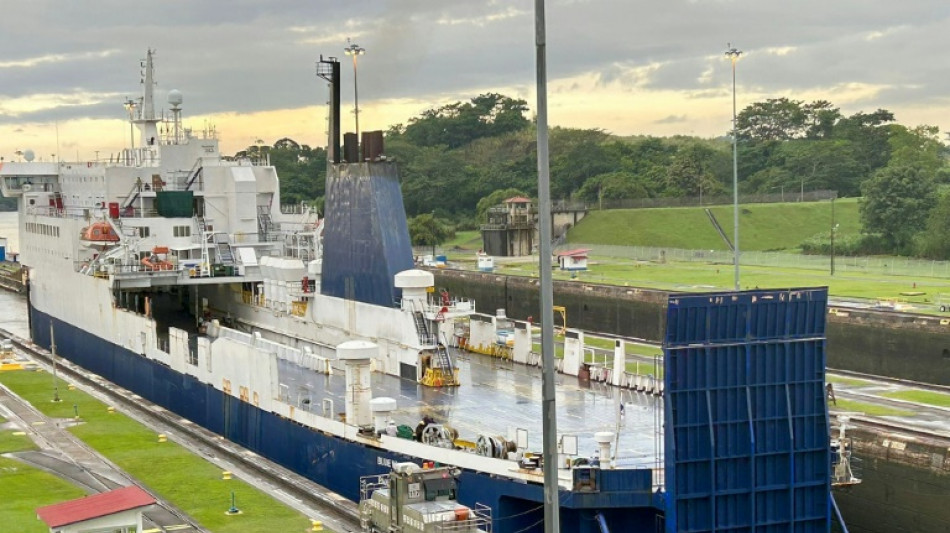
Drought-hit Panama Canal must 'adapt or die' as water levels drop / Photo: © Autonomous Executive Port Commission of El Salvador/AFP/File

 Drone owners rush to offload devices ahead of Beijing ban

 Trump's beef policies irk Texas ranchers, testing their loyalty

 Nvidia, OpenAI CEOs to attend Xi dinner at White House

 Anthropic picks Accenture for in-house AI safety evaluation
 Balogun returns as Monaco beat Lens to continue strong Ligue 1 start

 'Pause' on overt repression in Venezuela, but reforms still needed: HRW

 Global stocks mixed as yen falls despite Bank of Japan rate hike

 Cuba hit with seventh major blackout of the year

 Murray out with concussion so Wentz will start for Vikings

 UN chief 'deeply regrets' US visa refusal to Abbas for annual meeting
 England quick Carse to face no charges over alleged nightclub assault

 Mancini brings nine newcomers into the first squad of his Italy comeback

 Czechs level Davis Cup tie against USA as South Korea eye Finals

 New France boss Zidane confirms Mbappe as captain after naming first squad
 California governor signs order to explore AI 'kill switch'
 Head leads run spree as Australia win Zimbabwe ODI series

 In-form Raphinha wants to finish career at Barcelona

 Warren Buffett steps down as Berkshire Hathaway chairman
 Carrick confident Man Utd can 'work through' tough time

 Mbappe ends Nike partnership to join Swiss brand On

 Liverpool boss Iraola puts Bournemouth love affair on hold

 'A disaster' if Man City do not win says Maresca after flawless start

 Kerry James Marshall: American 'blackness' painter celebrated in Europe

 Spain coach De la Fuente offers 'full support' to people of Ceuta

 Russia seizes assets of Nestle, French firms over West's Ukraine support
The Panama Canal, an engineering wonder allowing ships to travel between two oceans, is seeking to adapt to climate change after a biting drought has seen traffic and income dry up.
The canal relies on rainwater to move ships through a series of locks that function like water elevators, raising the vessels up and over the continent between the Atlantic and Pacific Oceans.
However, a water shortage due to low rainfall has forced operators to restrict the number of vessels passing through, which is likely to result in a $200 million drop in earnings in 2024 compared to this year, canal administrator Ricaurte Vasquez said Thursday.
The Pacific warming phenomenon known as El Nino, which can cause drought in some nations and flooding in others, is making the situation worse, meteorologists say.
"The big disadvantage that the Panama Canal has as a maritime route, is that we operate with freshwater, while others use seawater," said Vasquez during a presentation to the media.
"We have to find other solutions to remain a relevant route for international trade. If we don't adapt, we are going to die."
The 50-mile (80-kilometer) byway moves some six percent of all global maritime commerce, and 2023 revenue is forecast at $4.9 billion, said Vasquez.
The canal opened in 1914 after a monumental construction project through dense jungles and mountains, with workers suffering tropical diseases, intense heat and rain.
Since then, more than a million vessels have transited through the canal, saving them a lengthy journey around the tip of South America.
- 'Unusually severe' crisis -
Meteorologist Alcely Lau told AFP that the country has "observed considerable deficits" in rainfall this year, boosted by El Nino.
The drought has forced canal administrators to restrict the waterway to ships with a draft of 13,11 meters (43 feet) -- which refers to how deep they sit in the water.
In 2022, an average of 40 ships crossed through the canal a day, a number which has now dropped to 32 to save water.
For each ship, 200 million liters of freshwater is used to move it through the locks before being dumped into the sea.
"This crisis is unusually severe," said Vasquez, adding that the "significant restrictions" would be in place until September next year.
Due to the draft restrictions, some merchant ships are forced to unload their containers and send the lighter vessel through the canal, while the goods traverse Panama by rail before being reloaded for shipping.
If the drought and resulting restrictions continue, Vasquez fears shipping companies will "opt for other routes."
This includes the Strait of Magellan -- a natural passage at the tip of South America between the mainland and the Tierra del Fuego archipelago.
"We think that if we find a solution relatively soon, not necessarily an immediate solution but one customers know is on the way, it should alleviate long-term concern," said Vasquez.
- Saltier water going to cities -
The lack of rain has also increased the salinity of the lakes and rivers that make up the canal's watershed -- which also provides water to three cities, including the capital Panama City.
"Every time we open the gate that leads to the sea, seawater is mixed with fresh water," said Vasquez.
"We have to keep that level of salt water within a certain range, because the water treatment plants do not have desalination capacity," he added.
The dwindling freshwater cannot be replaced with sea water -- as used by the Suez Canal which connects the Mediterranean with the Red Sea -- as this would require massive excavations.
"Suez was much flatter and it was sand. In our case it is rock and there is a mountain range which is not very high, but it is there and it is a challenge," said Vasquez.
J.Fankhauser--BTB



