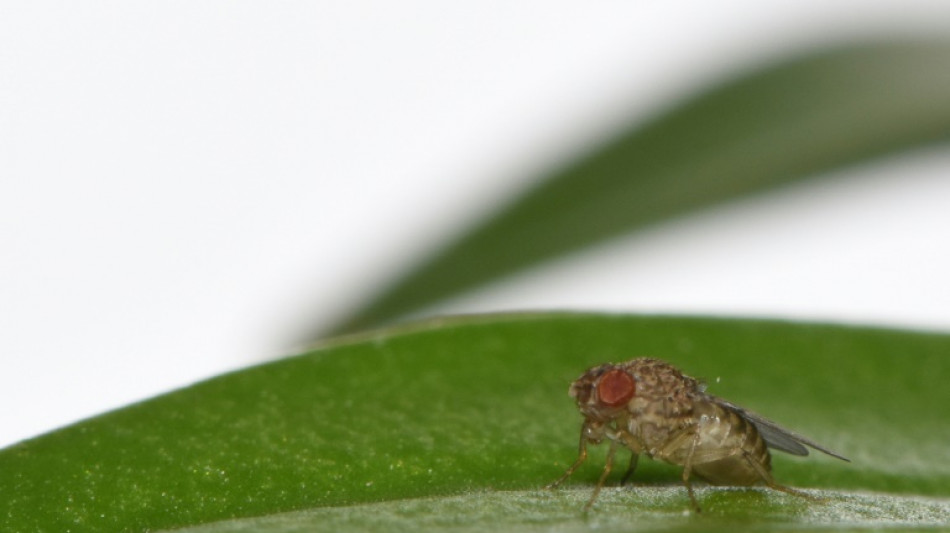
Scientists engineer fruit flies capable of 'virgin birth' / Photo: © University of Cambridge/AFP

 Drone owners rush to offload devices ahead of Beijing ban

 Trump's beef policies irk Texas ranchers, testing their loyalty

 Nvidia, OpenAI CEOs to attend Xi dinner at White House

 Anthropic picks Accenture for in-house AI safety evaluation

 Balogun returns as Monaco beat Lens to continue strong Ligue 1 start

 'Pause' on overt repression in Venezuela, but reforms still needed: HRW

 Global stocks mixed as yen falls despite Bank of Japan rate hike

 Cuba hit with seventh major blackout of the year

 Murray out with concussion so Wentz will start for Vikings

 UN chief 'deeply regrets' US visa refusal to Abbas for annual meeting

 England quick Carse to face no charges over alleged nightclub assault

 Mancini brings nine newcomers into the first squad of his Italy comeback

 Czechs level Davis Cup tie against USA as South Korea eye Finals

 New France boss Zidane confirms Mbappe as captain after naming first squad

 California governor signs order to explore AI 'kill switch'

 Head leads run spree as Australia win Zimbabwe ODI series

 In-form Raphinha wants to finish career at Barcelona

 Warren Buffett steps down as Berkshire Hathaway chairman

 Carrick confident Man Utd can 'work through' tough time

 Mbappe ends Nike partnership to join Swiss brand On

 Liverpool boss Iraola puts Bournemouth love affair on hold

 'A disaster' if Man City do not win says Maresca after flawless start

 Kerry James Marshall: American 'blackness' painter celebrated in Europe

 Spain coach De la Fuente offers 'full support' to people of Ceuta

 Russia seizes assets of Nestle, French firms over West's Ukraine support

Scientists said on Friday they have genetically engineered female fruit flies that can have offspring without needing a male, marking the first time "virgin birth" has been induced in an animal.
The offspring of the flies were also able to give birth without mating, showing that the trait could be passed down generations, in another first revealed in a study in the journal Current Biology.
Virgin birth, also called parthenogenesis, is rare but not unheard of in the animal kingdom.
The females of some egg-laying animals -- such as lizards and birds -- are capable of giving birth without mating, usually later in life when no males are available.
"For the first time, scientists have managed to induce virgin birth in an animal that usually reproduces sexually: the fruit fly Drosophila melanogaster," Cambridge University said.
Scientists revealed last month that a female crocodile in a Costa Rican zoo who had never been near a male laid an egg containing a fully formed foetus, the first recorded virgin birth for the reptile.
Sexual reproduction usually involves a female's egg being fertilised by sperm from a male. But for parthenogenesis, the female develops the egg into an embryo all on her own.
Alexis Sperling, a researcher at the UK's Cambridge University and lead author of the new study, told AFP that she had wanted to study virgin births ever since her pet praying mantis had one.
Seeking to find a genetic cause for the phenomenon, Sperling and several US-based researchers decided to experiment on the fruit fly Drosophila melanogaster.
The fly, which sexually reproduces normally, is one of the most studied animals for genetic research, meaning they could take advantage of more than a century's worth of knowledge.
- 'Exciting' -
First the team sequenced the genomes of two strains of another fruit fly, Drosophila mercatorum. One strain reproduces solely via virgin birth, while the other needs a male.
The researchers then compared the results, aiming to pinpoint the genes behind virgin births.
They then manipulated the genes of the Drosophila melanogaster to match what they saw in its close relative.
The result was "fully parthenogenetic flies, which was much to my delight", Sperling said.
The research, which took six years, involved more than 220,000 fruit flies.
If the genetically engineered flies had access to males, they would reproduce as normal.
But among those kept in isolation, one to two percent seemingly gave up on ever seeing a male around halfway through their life -- around 40 days -- and had a virgin birth.
Their offspring -- which were all female, as is the case with all virgin births -- had young of their own at around the same rate.
Sperling said that the feat would have been almost impossible to achieve in any other animal because of the wealth of data about fruit flies -- and because of how difficult parthenogenesis is to study.
Mammals -- including humans -- are not capable of having virgin births anyway because their reproduction requires certain genes from sperm.
But Sperling said that more animals are probably capable of virgin births than is currently known, pointing to the recent crocodile discovery.
And while virgin births are thought to be "a last-ditch effort" to keep a species going, that theory has not been proven, she said.
Herman Wijnen, a researcher at the UK's University of Southampton not involved in the study, said it was "exciting because it demonstrates how parthenogenesis can evolve in a sexually reproducing species as a back-up strategy for females that are unable to find a partner."
"The genes that were manipulated in the fruit fly are ones that are shared with humans, but there are substantial differences between early development in flies and humans."
K.Brown--BTB