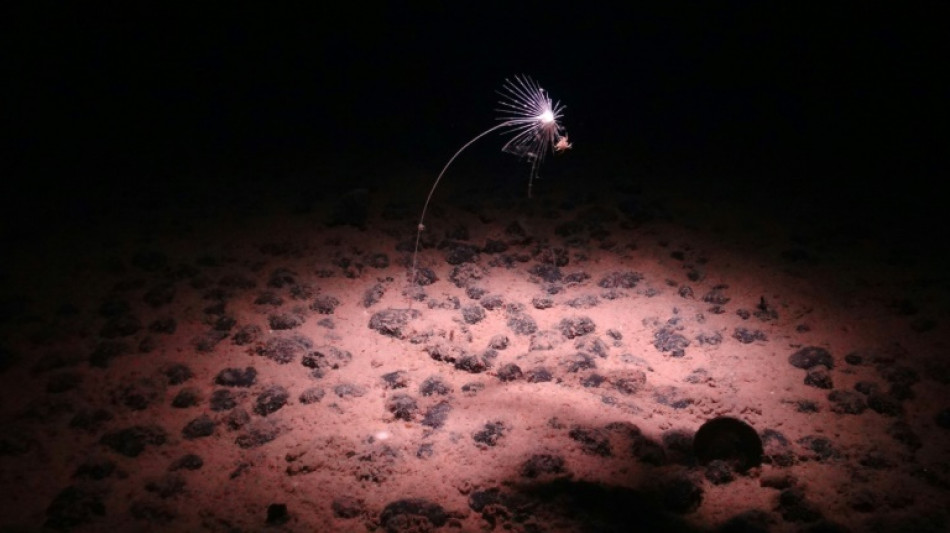
Mineral-rich nodules and the battle over mining the deep sea / Photo: © National Oceanography Centre / Smartex project (NERC)/AFP

 Trump Signals Willingness to Work With Democrats After Midterm Defeat

 Qatar media bodies discuss support for humanitarian initiatives

 No. 22 UCLA defeats No. 5 Arizona 84-75 despite Kharchenkov's 38 points

 Vessel operator seeks witnesses after Vancouver grounding

 US Air Force deploys F-16 fighters to remote Aleutian base for readiness drill

 Bezos grant helps Seattle nonprofit move thousands of families toward housing

 Shrini Srivastava joins crew of Varanasi-Delhi Vande Bharat Sleeper service

 Nearly Half of Australian Workers Overqualified, Survey Finds

 RBI eases export-declaration compliance for individual service exporters

 India proposes more import entry points for drugs and medical devices

 Derek Tierney Outlines Ten-Year Strategy for National Digital Health System

 NBC’s Steve Kornacki Reveals Tech Habits Ahead of Midterm Elections

 India and Israel oppose UN draft on regional conventional arms control

 BLS Polymers shares open 65.3% above IPO price

 Capital-markets shares rally as Motilal Oswal and Angel One lead gains

 Latino Voters Defy ICE Fears, Turn Out in Record Numbers for Midterms

 ITC shares rise as analysts anticipate gradual cigarette-business recovery

 Reliance rally puts historical one-year return pattern in focus

 Kuwait edges Oman 1-0 in veterans Gulf Cup in Doha

 Saudi Aramco quarterly profit climbs 34.6% amid elevated oil prices
They might look like pebbles strewn across the seafloor, but to the unique animals of the ocean deep, polymetallic nodules are a crucial habitat.
To the mining firms vying to extract them, on the other hand, they promise to be a "battery in a rock."
These nodules, found on the seafloor several kilometers below the surface, are to be the subject of the first submarine mining contract application, which the government of Nauru is expected to soon submit to the International Seabed Authority (ISA).
The contract is for Nori, Nauru Ocean Resources Inc, a subsidiary of Canada's The Metals Company.
This has caused concern among conservationists and scientists, who fear the severe impacts of mining a relatively untouched region of the planet that is rich in life, much of which remains unknown to science.
- Ancient -
Polymetallic nodules are most abundant in the Clarion-Clipperton Zone (CCZ) -- off the west coast of Mexico in the Pacific -- as well as in the central Indian Ocean and in the Peruvian Basin, according to the ISA.
The nodules were probably formed over millions of years.
They likely started off as solid fragments -- perhaps a shark tooth -- that sank down to the soft muddy seabed, then grew slowly through the accumulation of minerals present in the water in extremely low concentrations.
Today, they reach up to 20 centimeters (nearly 8 inches) in size: "metal pebbles," according to the French Research Institute for Exploitation of the Sea.
Adrian Glover, of Britain's Natural History Museum, thinks of them as like "potatoes" scattered on the seabed, roughly 15 to 20 kilograms (33 to 44 pounds) of them per square meter.
One of the reasons why the nodules have never been buried under the mud in the Pacific is because the sea is food poor, with fewer dead organisms -- known as "marine snow" -- drifting down to the depths to eventually become part of the seafloor mud.
Sedimentation rates in some areas of the CCZ are "almost zero", Glover said, amounting to just a centimeter per thousand years.
The nodules were first recovered from the Pacific deep in the 1870s by the Challenger expedition, which used thousands of meters of hemp rope, a steam-powered winch and plenty of manpower to dredge the westerly part of the CCZ.
"Straightaway they realized they were very interesting, it was actually one of the biggest discoveries of the voyage for them," said Glover.
But they were not considered to be a "resource," he added.
- 'Clean' power? -
Some 20 companies or research centers have been awarded exploration contracts by the ISA for these nodules. One of these is Nori, whose contract covers four zones totalling some 75,000 square kilometers (about 30,000 square miles) in the CCZ.
These nodules are mainly composed of manganese and iron, but they also contain strategic minerals such as cobalt, nickel and copper.
According to the ISA, the CCZ contains around 21 billion metric tons of nodules, which could correspond to a reserve of six billion metric tons of manganese, 270 million metric tons of nickel and 44 million metric tons of cobalt, exceeding the known totals of these three minerals on land.
Advocates of undersea mining point to their potential use for green technology, particularly for electric vehicles.
"A battery in a rock," says The Metals Company.
"Polymetallic nodules are the cleanest path toward electric vehicles."
But that is an argument rejected by environmental NGOs and some scientists.
This claim is "more public relations than scientific fact", Michael Norton, of the European Academies' Science Advisory Council, told AFP, calling it "rather misleading" to say that demand cannot be met without undersea minerals.
- Impact fears -
Unlike the other two types of subsea mining resources regulated by the ISA -- including the mining of hydrothermal vents -- nodules do not require digging or cutting.
In tests carried out at the end of 2022, Nori lowered a collector vehicle to a depth of 4.3 kilometers (about 2.7 miles).
It swallowed nodules and sediment and then separated them, transporting the nodules to the surface vessel via a giant pipe and discharging the sediment into the water.
Catherine Weller, global policy director at the conservation organization Fauna & Flora, said that while the nodules are lying on the seafloor, they cannot just be "plucked" individually.
The impacts on the wider ocean system of churning up sediment and releasing wastewater was "simply unknown," she added.
Weller said the unique composition of the nodules which attracts mining firms is also what makes them such a special habitat for the creatures that live in the ocean depths.
"So they themselves are a really important part of the deep sea system."
H.Seidel--BTB