From soup stock to supercrop: Japan shows off its seaweed savvy / Photo: © AFP

 Trump's beef policies irk Texas ranchers, testing their loyalty

 Nvidia, OpenAI CEOs to attend Xi dinner at White House

 Anthropic picks Accenture for in-house AI safety evaluation
 Balogun returns as Monaco beat Lens to continue strong Ligue 1 start

 'Pause' on overt repression in Venezuela, but reforms still needed: HRW

 Global stocks mixed as yen falls despite Bank of Japan rate hike

 Cuba hit with seventh major blackout of the year

 Murray out with concussion so Wentz will start for Vikings

 UN chief 'deeply regrets' US visa refusal to Abbas for annual meeting

 England quick Carse to face no charges over alleged nightclub assault

 Mancini brings nine newcomers into the first squad of his Italy comeback

 Czechs level Davis Cup tie against USA as South Korea eye Finals

 New France boss Zidane confirms Mbappe as captain after naming first squad

 California governor signs order to explore AI 'kill switch'

 Head leads run spree as Australia win Zimbabwe ODI series

 In-form Raphinha wants to finish career at Barcelona

 Warren Buffett steps down as Berkshire Hathaway chairman

 Carrick confident Man Utd can 'work through' tough time

 Mbappe ends Nike partnership to join Swiss brand On

 Liverpool boss Iraola puts Bournemouth love affair on hold

 'A disaster' if Man City do not win says Maresca after flawless start

 Kerry James Marshall: American 'blackness' painter celebrated in Europe

 Spain coach De la Fuente offers 'full support' to people of Ceuta

 Russia seizes assets of Nestle, French firms over West's Ukraine support

 England can build on World Cup 'spirit', says Tuchel

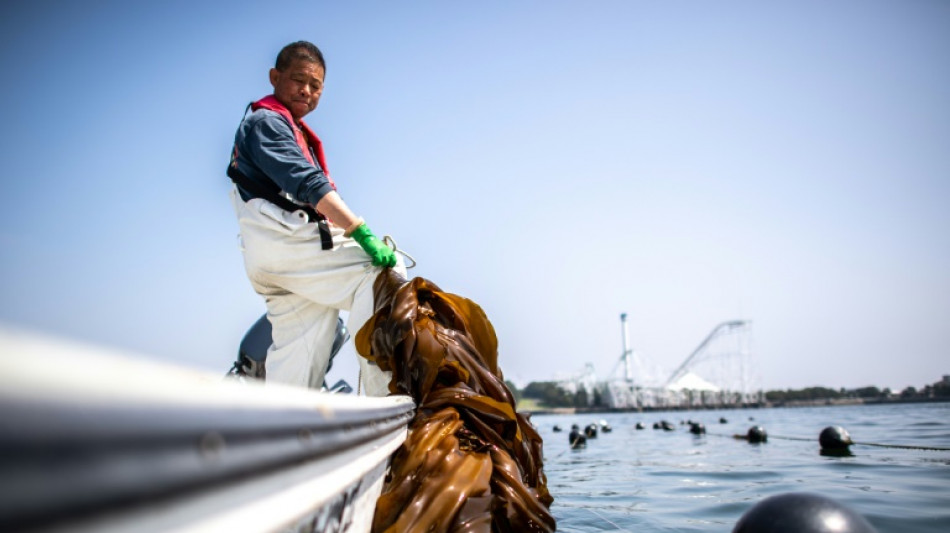
Seaweed has long been a staple food in Japan, but the chunky, slimy kelp hauled into fisherman Ryoichi Kigawa's boat is also starting to attract international attention for its potential as an eco-friendly supercrop.
Research into new applications for the marine plant -- from carbon absorption to reducing methane emissions from cattle -- is flourishing, and countries are looking to Asia's seaweed savvy to develop their own industries.
Most of the kelp harvested by Kigawa and his colleagues at their port in Yokohama is sold to be boiled in soup stock and added to healthy salads.
But some will go to projects run by the organisation Sachiumi Heroes "to preserve the ecosystem and tackle global warming", said the group's founder, Tatsunori Tomimoto.
"The Japanese have a history of eating seaweed, but we haven't ever really thought of farming it from an environmental or ecological point of view," he told AFP.
That is now changing, and Sachiumi Heroes is one of several new initiatives in Japan, from fisheries selling "blue carbon" credits to efforts to restore wild seaweed forests.
The brown strands of kelp take just four months to grow long and thick, and are then pulled up and cut from ropes submerged in the harbour.
They are washed and dried, with some chopped up to be sent to businesses, including green tea plantation Matoba-en, which uses it as organic fertiliser.
Studies have found that seaweed can help plants grow faster and stronger, and farmer Ryutaro Matoba is excited to see the benefits on his land in nearby Saitama.
"It will take two or three years before we start seeing the effect of the seaweed fertiliser on the quality of tea," he said, inspecting the tips of the bright bushes.
"But I can already feel the difference when I touch the soil, it feels softer now."
- 'Huge potential' -
Sachiumi Heroes also provides kelp to an aquarium to feed sea turtles, and to a livestock farm where it is added to cow feed in a bid to make their burps less planet-warming.
A 2021 study by the University of California, Davis found that replacing a small part of a cow's diet with a type of red seaweed reduced methane emissions by over 80 percent.
Tomimoto's organisation has even ventured into beauty treatments -- selling seaweed to bathhouses to put in their tubs, and to cosmetics company Lush to make bath bombs.
Overseas interest has grown quickly, "especially in the past two years", he said.
British researcher Henry Alexander is studying seaweed in Japan and other countries including South Korea and Canada, "with the aim of bringing that learning back to the UK".
"We don't yet have a significant seaweed farming industry," said Alexander, whose work is funded by a Nuffield Farming Scholarship.
"But in Asia they've been growing seaweed for hundreds of years, and growing it at a commercial scale since the 1950s."
With its long coastline and cold water, which helps seaweed grow faster, Britain has "huge potential" to produce more seaweed for human and animal consumption, he said.
That could take pressure off the land and create jobs, while allowing the nation to explore the environmental benefits, from carbon capture to deacidifying water.
- Blue carbon -
The world's seaweed industry doubled in size between 2005 and 2015, according to the UN Food and Agriculture Organization (FAO).
"It's a big deal. People love it," said Simon Funge-Smith, the FAO's senior fishery officer.
"People outside of Asia are now getting familiar with seaweed and looking to get hold of it."
The region accounts for the vast majority of seaweed production -- especially China and Indonesia, where it is farmed on an industrial scale for products including gels and thickeners.
One oft-touted use is in carbon offset projects, which take advantage of how quick-growing seaweed can rapidly absorb carbon dioxide.
Japan began a nationwide "J Blue Credit" scheme in 2020, with 16 of the 21 demonstration projects involving seaweed, including at Kansai and Kobe airports, where the runways are surrounded by water.
But despite a rush by governments and companies to fund such schemes, scientists have warned that there may not be enough ocean space to remove significant quantities of CO2 from the air.
And rising water temperatures are already making seaweed farming more difficult in countries like Japan, fuelling a push to cultivate more hardy strains.
Funge-Smith warns there is plenty of hype around seaweed and cautions about the "need to apply a bit of common sense".
But he sees potential in mass offshore farming and expects the field to continue developing.
"We're farming a handful of species, basically, out of hundreds of species that are out there," he said.
"It's an area where there's lots of research going on, lots of interest to try and find these applications, and who knows what we're going to turn up."
R.Adler--BTB