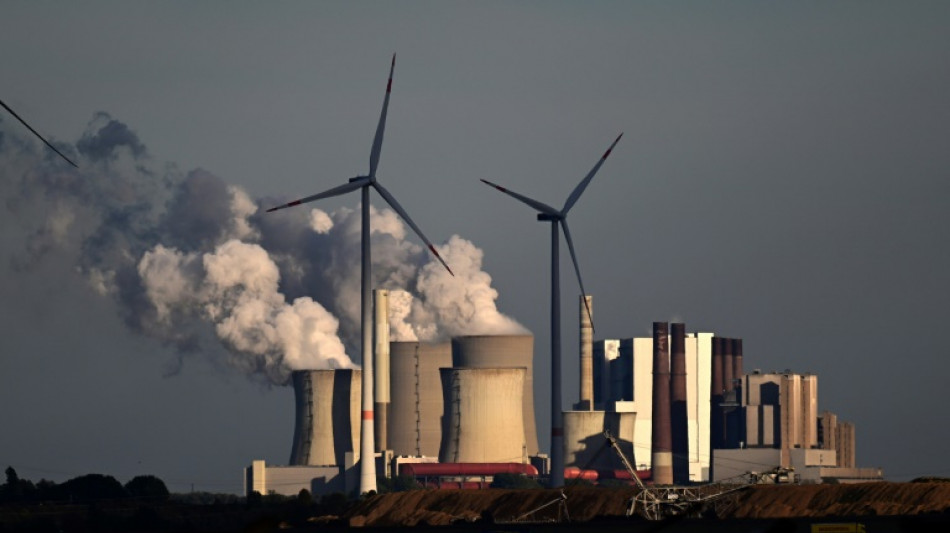
Climate: Corporate 'net zero' pledges lack credibility / Photo: © AFP/File

 Kennedy Center: future unclear for iconic Washington arts hub

 Trump claims 'infinite' Greenland security deal with Denmark

 Helicopters battle wildfire threatening Ecuador's capital

 Brentford batter Chelsea to undo Alonso's promising start

 Kane hits Bundesliga century as Bayern rout Union

 Trump says CNN, MS NOW, Politico banned from White House

 Hushing and hedging: US companies retreat on climate

 Springboks to face Fiji before 2027 Rugby World Cup

 Nigeria miners struggled to breathe in cell before 37 died: survivors

 McIlroy on the charge at PGA Championship as Reed withdraws

 McIlroy on the charge at PGA Championship

 Crisis-wracked Volkswagen warns of 10-bn-euro hit to profits

 Costa Rica's Grynspan tops third informal poll for UN chief: diplomat
 Stock markets retreat after central bank rate hikes

 Russia labels director of Cannes Grand Prix winner a 'foreign agent'

 Macron warns of Russian 'hybrid' threat after meeting presidential hopefuls
 UN holds third informal poll for new chief
 Kulusevski return can spark Spurs: De Zerbi

 Shakira to cap off world tour with Madrid 12-gig run

 Isolated Syrian-Druze city blames Damascus for shortages
 Isolated Syrian-Druze city shortages

 Dutch drop Depay for Germany match in Xavi's first pick

 Ronaldo named in Portugal squad for Nations League

 Stock markets diverge after central bank rate hikes
 Anti-Assad music star makes triumphant return to Syria

Nearly half the world's biggest companies have pledged to erase their carbon footprints by around mid-century, but only a handful have credible game plans for doing so, climate policy research groups said Monday.
Without tangible action from firms, the Net Zero Stocktake 2023 report warned, capping global warming at tolerable levels will likely remain out of reach.
Barely one degree Celsius of warming to date has made extreme weather more destructive and deadly, and UN climate experts have said the world could breach the Paris treaty limit of 1.5C above the preindustrial benchmark within a decade.
"The big question is whether existing net zero targets will acquire the measures of credibility quickly enough to keep the Paris Agreement's temperature goals within reach," co-author John Lang from the Energy & Climate Intelligence Unit told AFP.
Taking into account national, regional and corporate pledges, some 90 percent of the global economy has climbed on board the 'net zero' bandwagon, up from 15 percent four years ago.
In business, 929 companies on the Forbes 2000 list have set targets to eliminate their emissions by around 2050, more than twice as many as in December 2020.
But measuring these CO2-purging pledges against the yardstick of half-a-dozen standards for assessing net zero claims shows that almost all fall down badly on the details.
"Most entities that have pledged net zero do not meet minimum requirements for what good net zero looks like," said Lang.
Only four percent of corporate commitments are in line with five "starting line" criteria set out in the UN Race to Zero guidelines, one of the voluntary standards.
These basic benchmarks include setting a specific net zero target; covering greenhouse gases other than CO2, such as methane and nitrous oxide; very limited use of carbon offsets, such as planting trees, instead of emissions reductions; and annual reporting on progress toward both interim and long-term targets.
Arguably no sector is under more pressure to decarbonise than fossil fuel companies, and 75 of the 112 largest of these firms have net zero targets today, 50 percent more than a year ago.
But most of these targets are "largely meaningless," the report said, because they do not include so-called scope three emissions -- downstream impacts such as CO2 released by the burning of the oil, gas or coal.
Overall, barely a third of corporate net zero targets examined included scope three.
- 'No rowing back' -
As pressure mounts, signs of a backlash against net zero commitments has emerged across the corporate landscape.
Last month half-a-dozen members of the Net Zero Insurance Alliance, launched in 2021, backed out of the group, and some large institutional investors have softened their net zero pledges as well.
"People are realising that it's not a fad, and as they turn their attention to the 'how' of net zero we are seeing pushback," said Lang.
"But there's no rowing back from where we are now," he added. "This is now a norm for the corporate world."
Gradually, voluntary compliance schemes will give way to regulations and shifts in market-based incentives, Lang predicted.
Already today, the Inflation Reduction Act (IRA) in the United States and the Net Zero Industry Act in the European Union are shifting hundreds of billions of dollars from carbon-polluting to clean energy.
Even the fossil fuel industry is not immune to mounting pressure as decarbonisation of the global economy accelerates.
In 2023, more than $1.7 trillion will be invested in carbon-free energy, compared to $1 trillion going into energy and power from oil, gas and coal, according to the International Energy Agency (IEA). For the first time this year, investment in solar power will outstrip that in oil.
And some incumbent energy firms, such Danish multinational Orsted, have successfully transitioned from fossil fuels to renewables.
"Slowly but surely the narrative is changing," said Lang. "I do think we will live to see the day where the social license to operate of fossil fuel companies will be withdrawn."
The NewClimate Institute, Oxford Net Zero, and Driven EnviroLab also contributed to the Net Zero Stocktake 2023 report.
K.Brown--BTB