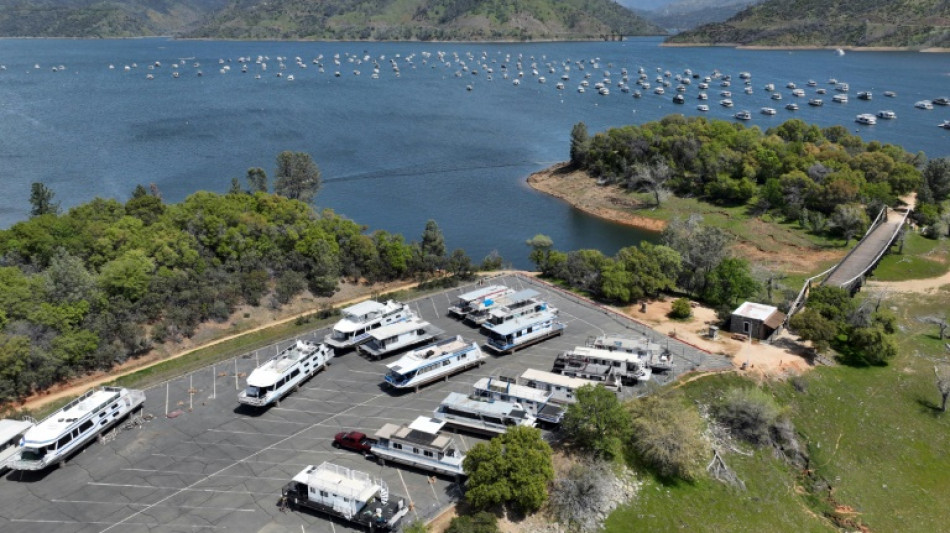
Water, water everywhere: Wet winter boosts California's reservoirs / Photo: © AFP

 Helicopters battle wildfire threatening Ecuador's capital

 Brentford batter Chelsea to undo Alonso's promising start

 Kane hits Bundesliga century as Bayern rout Union
 Trump says CNN, MS NOW, Politico banned from White House

 Hushing and hedging: US companies retreat on climate

 Springboks to face Fiji before 2027 Rugby World Cup

 Nigeria miners struggled to breathe in cell before 37 died: survivors

 McIlroy on the charge at PGA Championship as Reed withdraws

 McIlroy on the charge at PGA Championship

 Crisis-wracked Volkswagen warns of 10-bn-euro hit to profits

 Costa Rica's Grynspan tops third informal poll for UN chief: diplomat

 Stock markets retreat after central bank rate hikes

 Russia labels director of Cannes Grand Prix winner a 'foreign agent'

 Macron warns of Russian 'hybrid' threat after meeting presidential hopefuls

 UN holds third informal poll for new chief

 Kulusevski return can spark Spurs: De Zerbi

 Shakira to cap off world tour with Madrid 12-gig run

 Isolated Syrian-Druze city blames Damascus for shortages

 Isolated Syrian-Druze city shortages

 Dutch drop Depay for Germany match in Xavi's first pick

 Ronaldo named in Portugal squad for Nations League

 Stock markets diverge after central bank rate hikes

 Anti-Assad music star makes triumphant return to Syria

 In-form Fernandez included in Spain Nations League squad

 Arteta buries hatchet with Hurzeler ahead of Brighton clash

A very wet winter has left California's reservoirs looking healthier than they have for years, as near-record rainfall put a big dent in a lengthy drought.
A series of atmospheric rivers -- high altitude ribbons of moisture -- chugged into the western United States, dousing a landscape that had been baked dry by years of below-average rain.
The state's 40 million residents had chafed under repeated warnings to save water, with restrictions on irrigating gardens that left lawns dead or dying.
Vegetation dried up, with hillsides a parched brown, and ripe for wildfires.
Reservoirs held just a fraction of their capacity, with shorelines retreating to reveal dust, rocks and the remains of sunken boats.
But then the winter of 2022-23 roared into action, and trillions of gallons of water fell from the skies.
Rivers and creeks that had slowed to a trickle or even vanished entirely sprang to life.
Lake Tulare, in the Central Valley, which had dried up 80 years earlier, began to re-emerge, as all that rain had to find somewhere to go.
Mountains were buried under hundreds of inches (many meters) of snow, and the state's ski resorts began talking about a bumper season that could last all the way into July.
Official statistics from the US Drought Monitor released last week show around two-thirds of California is completely out of the drought.
Less than 10 percent of the state is still technically in a drought, with the remainder classed as "abnormally dry."
A year ago the entire state was in a drought.
California's Department of Water Resources says major reservoirs are overtopping their average capacity.
Lake Oroville, one of the most important bodies of water in the state, is now around 88 percent full, storing almost twice the amount of water as it did a year ago.
AFP photographs show the once shriveled reservoir looking much closer to its original shoreline.
Pictures taken almost exactly a year apart show a marked contrast -- in April 2022, a puny stream trickles through a valley, but this year the valley is full of water.
A photograph taken in September last year shows a boat ramp hanging uselessly, high above the water line, while the same boat ramp seen in a picture taken Sunday has water lapping half way up.
The Enterprise Bridge now spans a body of water, where last year its footings stood starkly in the dusty bank, with just a small creek passing underneath.
Wet winters are not new in California, but scientists say human-cause climate change is exacerbating the so-called "weather whiplash" that sees very hot and dry periods give way to extremely soggy months.
And water managers caution that while there is a lot of wet around at the moment, Californians cannot afford to waste water.
Adel Hagekhalil of the Metropolitan Water District that serves Southern California told Spectrum News 1 that people should still conserve their supplies.
"We need to save and build the savings... so when we have another dry year, and hot days and dry days, we can respond," he said.
O.Bulka--BTB