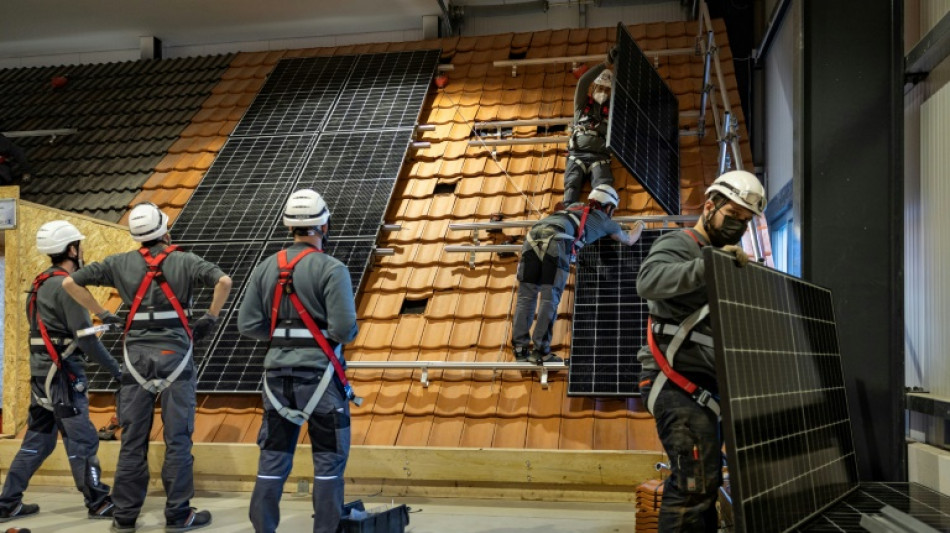
Manpower shortage dims solar panel boom in Germany / Photo: © AFP

 Hushing and hedging: US companies retreat on climate

 Springboks to face Fiji before 2027 Rugby World Cup

 Nigeria miners struggled to breathe in cell before 37 died: survivors

 McIlroy on the charge at PGA Championship as Reed withdraws
 McIlroy on the charge at PGA Championship

 Crisis-wracked Volkswagen warns of 10-bn-euro hit to profits

 Costa Rica's Grynspan tops third informal poll for UN chief: diplomat
 Stock markets retreat after central bank rate hikes

 Russia labels director of Cannes Grand Prix winner a 'foreign agent'

 Macron warns of Russian 'hybrid' threat after meeting presidential hopefuls

 UN holds third informal poll for new chief

 Kulusevski return can spark Spurs: De Zerbi

 Shakira to cap off world tour with Madrid 12-gig run

 Isolated Syrian-Druze city blames Damascus for shortages
 Isolated Syrian-Druze city shortages

 Dutch drop Depay for Germany match in Xavi's first pick

 Ronaldo named in Portugal squad for Nations League
 Stock markets diverge after central bank rate hikes
 Anti-Assad music star makes triumphant return to Syria
 In-form Fernandez included in Spain Nations League squad
 Arteta buries hatchet with Hurzeler ahead of Brighton clash
 Alexander-Arnold and Palmer return to England squad for Nations League
 Russians vote as Ukraine war drags on for fifth year
 Backpackers fret over Australian visa crackdown
 Most Asian stocks track Wall St rally, yen drops after BoJ rate hike
Balancing on a sloping tiled roof, apprentice Pascal Ode installs a solar panel under the watchful eye of his trainer.
Hopes are high that Ode may soon be able to install the systems on both homes and businesses.
When he is trained, he will be a much-needed new pair of hands in the industry that is crucial to Germany's energy transition -- but is suffering from an acute worker shortage.
Demand for new photovoltaic panels soared as Europe's biggest economy was forced to ramp up the share of energy produced by renewables in the wake of Russia's invasion of Ukraine which hit energy supplies, lifting prices.
The conflict has led Germany to end its reliance on Russian energy, at a time when the country was also accelerating its plan to become carbon neutral.
Compared with 2021, the installed photovoltaic capacity in the residential sector has leapt by 40 percent.
"Since the Russian invasion of Ukraine, many people wanted to free themselves from fossil energy and the high costs of energy," said Wolfgang Gruendinger, spokesman for Enpal, one of many companies benefitting from soaring demand.
The Berlin start-up offers long-term solar panel rentals, complete with installation and maintenance.
The formula is proving attractive. Enpal, which began business in 2017, said it has rented 40,000 kits to individuals, including 18,000 last year alone.
It currently installs 2,000 kits a month.
"Demand is very strong. We have to install many units in the shortest possible time, while at the same time, we are seeing huge shortages in qualified workers," said Alexander Friedrich, who was hired by the company to train new employees.
To cope with the demand, Enpal set up its own training school last year in Blankenfelde, in the south of Berlin, to train workers to install panels, as well as train specialised electricians to work on photovoltaic panels.
"We are recruiting people from all backgrounds -- former pizza workers, cooks, delivery riders, taxi drivers," said Gruendinger.
The company puts about 100 new hires through the school each month.
Among them is Ode, 19, who responded to an advertisement on Instagram offering the four-week training.
- 'Something new' -
Learning "something new" had attracted him to take on the challenge, he told AFP.
"I really enjoy the fact that it is a job that comes with fresh air and that you're always on the road," he added.
Enpal does not have prohibitive education criteria for their new hires. But one key requirement is for new recruits to climb a high ladder reaching at least two storeys up to screen out those with a fear of heights.
The sound of drills, screwdrivers and metal components being handled by groups of apprentices reverberated around the training hangar.
Wearing helmets and attached to ropes, the trainees were practising on roof replicas mounted on the ground.
Their task is urgent.
Germany is aiming for 80 percent of its energy needs to be covered by renewables by 2030, against 46 percent a year ago.
To do so, lawmakers have set a target of installing 215 gigawatts (GW) of photovoltaic capacity by 2030 -- meaning that annual rate of installation has to be tripled from last year's effort of 7.2 GW.
The plan is for roofs of factories and commercial buildings, as well as fields, to be covered with them, according to draft legislation promoting their installation.
But "the shortage of qualified workers threatens to slow down the energy transition", warned the Cologne-based think-tank German Economic Institute (IW) in a recent report.
The worker gap is so wide that the Federation of Solar Industries BSW said it was looking to Chancellor Olaf Scholz's ambitious immigration reform to provide some relief.
The law, expected to be passed this year, is aimed at easing immigration issues.
The BSW cites the example of a recent agreement that aims to attract Indian workers trained in solar energy installations.
IW estimates that there is a shortfall of 216,000 electricians, heating and air-conditioning experts, and IT specialists necessary to develop the solar and wind energy sector in Germany.
The figure does not take into account plans to bring back production of solar panels to Germany.
- Bring production back -
Currently, 80 percent of the panels' components come from China, according to the International Energy Agency.
The massive reliance on the Asian giant for the supply chain for materials such as polysilicon, wafers, cells and modules has come to the fore for Germany after it was recently stung by its dependency on Russian energy.
Once a leader in producing photovoltaic cells, with market heavyweights in the 2000s like Solarworld, Q-Cells and Centrotherm, Germany has seen its market share plunge after state subsidies dried up and China ramped up its production.
Over the past two decades, some 100,000 jobs in the sector have been lost.
But the trend may be starting to reverse.
Swiss specialist in the sector, Meyer Burger, built a factory at Thalheim, east Germany, in 2021, spurred by lower production costs and growing homegrown demand.
C.Kovalenko--BTB