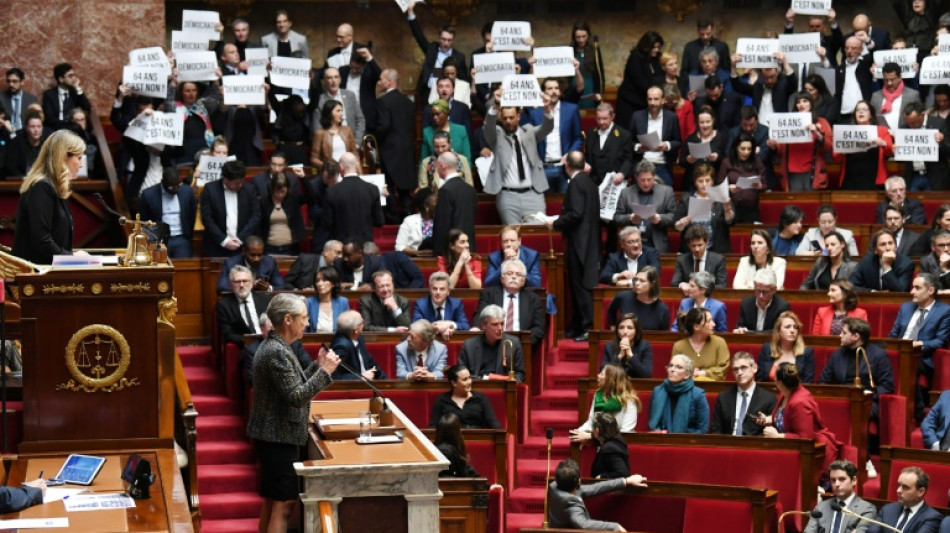
Macron rams through pension change without parliament vote / Photo: © AFP

 Hushing and hedging: US companies retreat on climate

 Springboks to face Fiji before 2027 Rugby World Cup

 Nigeria miners struggled to breathe in cell before 37 died: survivors

 McIlroy on the charge at PGA Championship as Reed withdraws

 McIlroy on the charge at PGA Championship

 Crisis-wracked Volkswagen warns of 10-bn-euro hit to profits

 Costa Rica's Grynspan tops third informal poll for UN chief: diplomat

 Stock markets retreat after central bank rate hikes

 Russia labels director of Cannes Grand Prix winner a 'foreign agent'

 Macron warns of Russian 'hybrid' threat after meeting presidential hopefuls

 UN holds third informal poll for new chief

 Kulusevski return can spark Spurs: De Zerbi

 Shakira to cap off world tour with Madrid 12-gig run

 Isolated Syrian-Druze city blames Damascus for shortages

 Isolated Syrian-Druze city shortages

 Dutch drop Depay for Germany match in Xavi's first pick

 Ronaldo named in Portugal squad for Nations League

 Stock markets diverge after central bank rate hikes

 Anti-Assad music star makes triumphant return to Syria

 In-form Fernandez included in Spain Nations League squad
 Arteta buries hatchet with Hurzeler ahead of Brighton clash

 Alexander-Arnold and Palmer return to England squad for Nations League

 Russians vote as Ukraine war drags on for fifth year

 Backpackers fret over Australian visa crackdown
 Most Asian stocks track Wall St rally, yen drops after BoJ rate hike

French President Emmanuel Macron on Thursday rammed a controversial pension reform through parliament without a vote, deploying a rarely used constitutional power that risks inflaming protests.
The move was an admission that his government lacked a majority in the National Assembly to pass the legislation to raise the retirement age from 62 to 64.
The Senate adopted the bill earlier on Thursday morning, but misgivings in the ruling party and reluctance by right-wing opposition MPs to side with Macron meant the government risked losing a vote in the lower house.
"We can't take the risk of seeing 175 hours of parliamentary debate come to nothing," Prime Minister Elizabeth Borne told MPs, shouting through the jeers and boos from the opposition benches who also loudly sang the French national anthem the Marseillaise in protest.
Trade unions and political analysts had warned beforehand that passing the legislation by decree, using the controversial article 49.3 of the constitution, risked radicalising opponents and would deprive the government of democratic legitimacy.
"It's a total failure for the government," far-right leader Marine Le Pen told reporters afterwards, adding that Borne should resign.
"From the beginning the government fooled itself into thinking it had a majority," she said.
Polls show that two thirds of French people oppose the reform and the government had insisted that it did not want to use article 49.3, which is viewed by critics as undemocratic.
"When a president has no majority in the country, no majority in the National Assembly, he must withdraw his bill," said Socialist Party chief Olivier Faure.
The government is set to face a confidence vote in the next 24 hours which could lead it to fall. Le Pen said her far-right party would file such a motion.
- Second mandate -
After trying and failing to push through pension reform during his first term, Macron returned to the issue while campaigning for re-election last April.
He defeated Le Pen running on a pro-business platform that promised to lower unemployment and make the French "work more" in order to finance the country's social security system.
But political analysts say his mandate is weak and his party lost its parliamentary majority in elections in June which saw the far-right become the biggest opposition party.
Despite warnings from allies about the timing of the pension reform so soon after the Covid-19 pandemic and in the middle of a cost-of-living crisis, the 45-year-old has pressed ahead.
Opposition to the changes has been particularly strong in small and midsize towns, where Le Pen draws much of her support.
The government's biggest fear has been re-igniting violent anti-government demonstrations, with memories still fresh of the 2018 revolt by so-called "Yellow Vest" protesters who took to the streets to denounce Macron's policies and governing style.
Macron himself had promised a "new method" for his second term that he suggested would be less top-down.
- Garbage piles -
Trains, schools, public services and ports have been affected by strikes over the last six weeks, while some of the biggest protests in decades have taken place.
An estimated 1.28 million people hit the streets on March 7.
A rolling strike by municipal garbage collectors in Paris has also seen around 7,000 tonnes of uncollected trash pile up in the streets, attracting rats and dismaying tourists.
The strike has been extended until next Monday, with the prospect of serious public health problems leading to growing calls for authorities to intervene.
The government has argued that raising the retirement age from 62 to 64, scrapping privileges for some public sector workers and toughening criteria for a full pension are needed to prevent major deficits building up.
The change would also bring France into line with its European neighbours, most of which have raised the retirement age to 65 or above.
Trade unions and other critics say the reform will penalise low-income people in manual jobs who tend to start their careers early, forcing them to work longer than graduates who are less affected by the changes.
The political implications of forcing through a reform opposed by most of the population are uncertain for Macron and the country at large.
Philippe Martinez, the head of the CGT union, warned this week that forcing the legislation through without a vote would amount to "giving the keys of the Elysee" to Le Pen for the next presidential election in 2027.
burs-adp/sjw/rox
F.Müller--BTB