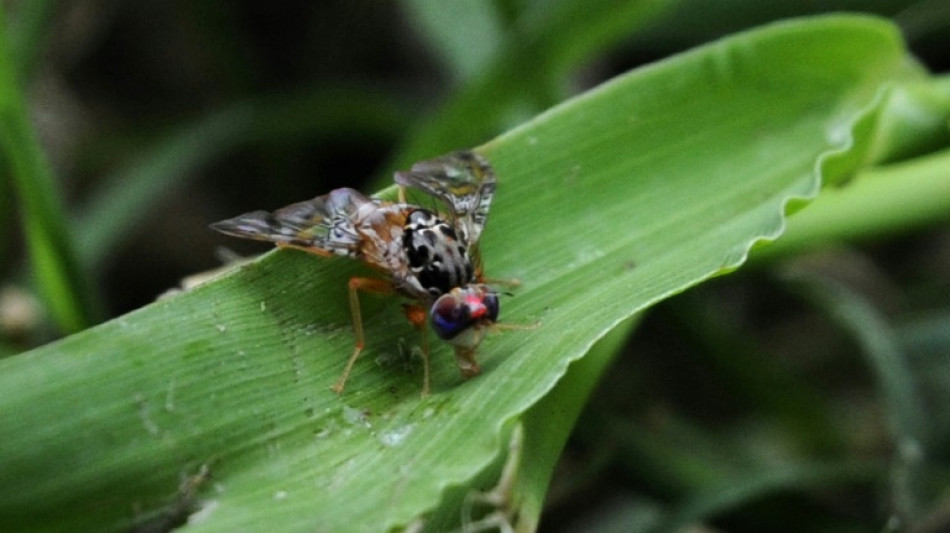
Smog a major buzzkill for insect mating / Photo: © AFP/File

 Hushing and hedging: US companies retreat on climate

 Springboks to face Fiji before 2027 Rugby World Cup

 Nigeria miners struggled to breathe in cell before 37 died: survivors

 McIlroy on the charge at PGA Championship as Reed withdraws

 McIlroy on the charge at PGA Championship

 Crisis-wracked Volkswagen warns of 10-bn-euro hit to profits

 Costa Rica's Grynspan tops third informal poll for UN chief: diplomat

 Stock markets retreat after central bank rate hikes

 Russia labels director of Cannes Grand Prix winner a 'foreign agent'

 Macron warns of Russian 'hybrid' threat after meeting presidential hopefuls

 UN holds third informal poll for new chief

 Kulusevski return can spark Spurs: De Zerbi

 Shakira to cap off world tour with Madrid 12-gig run

 Isolated Syrian-Druze city blames Damascus for shortages

 Isolated Syrian-Druze city shortages

 Dutch drop Depay for Germany match in Xavi's first pick

 Ronaldo named in Portugal squad for Nations League

 Stock markets diverge after central bank rate hikes

 Anti-Assad music star makes triumphant return to Syria

 In-form Fernandez included in Spain Nations League squad

 Arteta buries hatchet with Hurzeler ahead of Brighton clash

 Alexander-Arnold and Palmer return to England squad for Nations League

 Russians vote as Ukraine war drags on for fifth year

 Backpackers fret over Australian visa crackdown

 Most Asian stocks track Wall St rally, yen drops after BoJ rate hike

The rigours and rituals of mating among fruit flies are challenging under the best of circumstances, but add ozone-laden smog into the mix and things really fly apart, according to a study published on Tuesday.
Even moderate air pollution from industry and traffic not only causes males to lose their sex appeal, it also leaves them unable to discriminate between he-flies and she-flies, researchers reported in Nature Communications.
In experiments with ozone levels typically found in major cities, males engaged other males in courtship dances as much as females.
The findings could be a previously unrecognised driver of accelerating decline that has been affecting nearly half of all insect species in recent decades, the scientists suggested.
"We're talking about millions of species," contributing author Markus Knaden of the Max Planck Institute for Chemical Ecology told AFP.
The radical changes in mating behaviour stem from a breakdown of the scent signals, or pheromones, used to attract sexual partners.
In experiments, the type of ozone emitted from vehicle tailpipes and factories neutralised pheromones after they were released, leading to mating mayhem.
Males zeroing in on potential partners couldn't recognise other males, and females shunned the advances of males because the latter's come-hither chemicals could no longer be detected.
Sexual communication was affected in nine out of 10 other fly species tested.
But the critical role of pheromone isn't limited to flies.
"Moths, butterflies, ants, bees, wasps -- they all use pheromones," said Knaden.
- Taking the blame -
Breakdown of the sex-signalling chemicals in pheromones is triggered by the oxidising effect smog has on so-called integral carbon bonds and lasts for several days, the study showed.
The pheromone released by male fruit flies serves as a female aphrodisiac. The more of the compound the male possesses, the more attractive he appears.
During intercourse, the male fly transfers the compound to the female fly to ensure his paternity -- his odour acts as a shield, repulsing other males.
In fruit flies, pheromones only need to travel a few centimetres (inches) but for other species such as moths and beetles, the chemicals must attract potential partners hundreds of metres (yards) away.
This, the scientists speculated, would make them even more vulnerable to ozone's oxidising effects.
Before industrialisation, naturally occurring ozone levels averaged around 40 parts per billion (ppb) globally. In cities and industrial areas, ozone levels can easily reach 210 ppb, about five times more.
The study showed that even short-term exposure to ozone levels of 100 ppb resulted in significant degradation of the pheromones. The higher the ozone concentration, the greater the impact.
"Things were great until we came along," said Knaden of humans. "We have to fully take the blame."
The researchers said impacts are likely to be "even higher than we observed" in polluted cities because of the presence of other pollutants, such as nitric oxides, that oxidise at even faster rates.
Field experiments underway in England run by scientists at the University of Reading -- measuring the impact of diesel exhaust and ozone pollution on pheromones in a range of insects -- could confirm whether other flying and crawling bugs are similarly affected.
Social insects such as ants use the chemical cues to identify members of their colony.
O.Krause--BTB