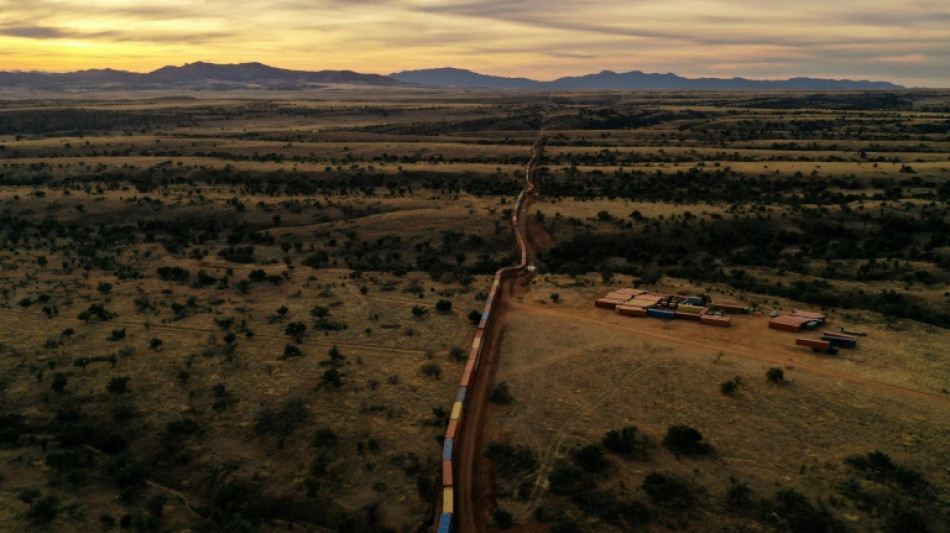
Arizona to remove shipping container wall on US-Mexico border / Photo: © AFP

 Stock markets retreat after central bank rate hikes

 Russia labels director of Cannes Grand Prix winner a 'foreign agent'

 Macron warns of Russian 'hybrid' threat after meeting presidential hopefuls

 UN holds third informal poll for new chief

 Kulusevski return can spark Spurs: De Zerbi

 Shakira to cap off world tour with Madrid 12-gig run

 Isolated Syrian-Druze city blames Damascus for shortages

 Isolated Syrian-Druze city shortages

 Dutch drop Depay for Germany match in Xavi's first pick

 Ronaldo named in Portugal squad for Nations League

 Stock markets diverge after central bank rate hikes

 Anti-Assad music star makes triumphant return to Syria

 In-form Fernandez included in Spain Nations League squad

 Arteta buries hatchet with Hurzeler ahead of Brighton clash

 Alexander-Arnold and Palmer return to England squad for Nations League

 Russians vote as Ukraine war drags on for fifth year

 Backpackers fret over Australian visa crackdown

 Most Asian stocks track Wall St rally, yen drops after BoJ rate hike

 Russians begin voting in controlled election as war drags on

 Trump 'clearly' wants dialogue with Pyongyang: South Korean President

 Bank of Japan hikes rates to 31-year high to battle inflation

 Thailand's Muslim separatists vow to fight to the end

 Mideast turmoil, AI set to dominate UN gathering of world leaders

 Australia to detain tourists who overstay visa, minister says

 Championship rivals brace for renewal of bitter feuds

Arizona agreed Wednesday to dismantle a wall of shipping containers at the Mexican border that critics said was an expensive, ecologically damaging political stunt that did nothing to keep migrants out of the United States.
The state's Republican Governor Doug Ducey spent $90 million of taxpayers' money lining up rusting boxes in what he said was a bid to stem the flow of people crossing into the country.
The corrugated containers, which snake for four miles (seven kilometers) through federal lands like a huge stationary cargo train, divide an important conservation area that is home to vulnerable species, but which is so difficult to traverse that people traffickers routinely avoid it.
Now Ducey, who leaves office early next year, will have to get rid of the 915 containers from the Coronado National Forest.
In an agreement reached Wednesday with the federal government, Ducey's administration said it will "remove all previously installed shipping containers and associated equipment, materials, vehicles, and other objects from the United States' properties on National Forest System lands within the Coronado National Forest."
- Biodiversity -
From close up, the double-stacked container wall looks like the clumsy handiwork of a giant playing with building blocks.
Its presence is so jarring that, in addition to the federal court case, it was also the subject of two lawsuits by the Center for Biological Diversity, an environmental organization that has been active in the area for three decades.
"The biodiversity of this region is off the charts," Russ McSpadden, a member of the organization, told AFP.
"It's one of the most important conservation areas in the entire United States."
Arizona shares around 370 miles (600 kilometers) of border with Mexico, including environmental preservation areas, national parks, military zones, and indigenous reservations.
Until the 2017 arrival in the White House of Donald Trump -- who was propelled to power on his pledge to "Build That Wall" -- there was very little in the way of a physical barrier separating it from Mexico.
Now vast stretches of the border have a fence that towers up to nine meters high.
Before the containers arrived in the Coronado National Forest -- an area that can only be reached by dirt roads -- the border here was demarcated by a wire fence.
That meager barrier was more than equal to the task of keeping people at bay, says McSpadden, whose cameras have picked up jaguars, and who has worked with teams collecting data on ocelots.
"I've never captured migrant traffic on any of the remote cameras," he said.
"It's an incredibly wild valley. There's no real urban population anywhere nearby. It's a very difficult part of the border for migrants to cross."
And even if this were a heavily trafficked route, a casual observer can see that the shipping containers would not be very effective.
In several places that AFP visited, the boxes do not line up because of the uneven terrain, leaving gaps easily large enough for a person to walk through.
Others have holes rusted in them, and in some spots, it appears to have been impossible for workers to find a place stable enough to put a container.
A viral video shows a determined climber scaling the six-meter-high barrier in a matter of seconds, gaining easy purchase on the textured box walls.
But what the shipping containers do block is a waterway and the migration routes of the animals McSpadden studies.
"Jaguars know no borders," he says.
"Southern Arizona, northern Mexico, it's the same for them."
With males known to range hundreds of miles, it's easy for animals that came north to hunt to get trapped away from breeding populations south of the border.
"Jaguars want to move back and forth freely," he says.
"This is their range, and the border wall bisects the jaguars' home."
O.Krause--BTB



