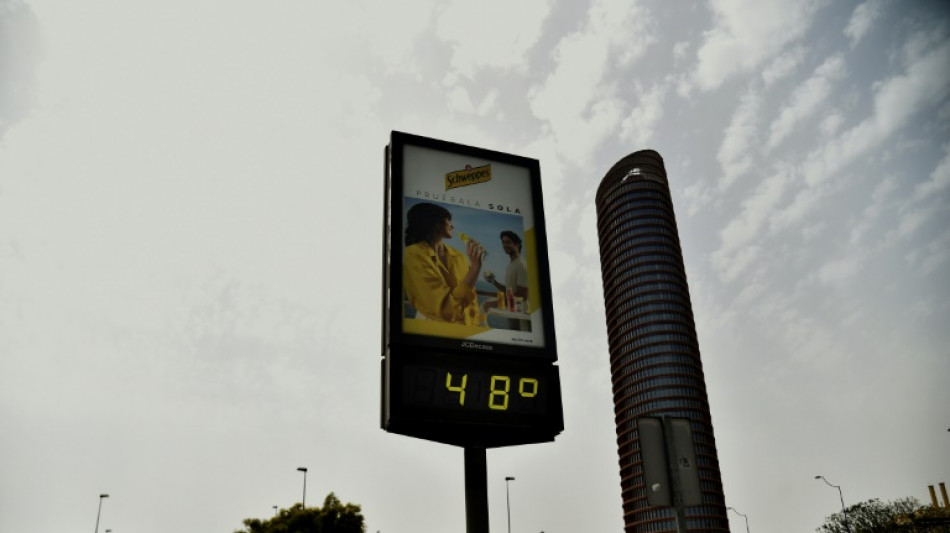
Climate deniers use past heat records to sow doubt online
/ Photo: © AFP/File

 Inside the Venezuelan prison meant to 'drive you insane'

 UK king braces as memoir by Diana's brother goes on sale

 No green light to lift EU sanctions on Russian oligarchs, talks to resume

 UK agrees support for Saudi in struggle with Houthis: reports

 EU foreign policy chief calls for continued sanctions on Russia

 Flights scrapped, evacuations urged as Typhoon Dujuan wallops Japan

 Fonseca to take break from tennis

 A Cuban zoo, and its animals, in epic battle for survival

 Infantino proposes consulting federations to reform FIFA

 El Nino weather pattern enters record territory: scientist

 OpenAI calls for US to lead global effort on AI standards

 South African ostriches plucked alive for luxury fashion: report

 US networks halt Trump coverage in revolt over White House ban

 Paramount settles with US states to clear Warner Bros. mega-merger

 Climate crisis a job for world leaders, not just activists: UK FM

 US networks halt Trump coverage over White House ban

 French singer accuses Miley Cyrus of plagiarism

 EU fines Google 403 mn euros for location data breach

 'Best is yet to come,' says De la Fuente after Spain extension

 Why diesel prices are rising more than crude oil

 COP31 host says AI's climate footprint to be a summit priority

 Renewables hit record in 2025, but world must move faster: report

 US media outlets to sue Trump administration after White House ban

 Global stocks rally on lower oil prices, US-China hopes

 EU proposes energy rating for data centres

With Europe gripped by successive heatwaves, climate-change deniers are spreading scepticism by publishing data on social media on extreme temperatures allegedly recorded decades ago to imply scientists are exaggerating global warming.
But experts say the figures cited from the past are often incorrect or taken out of context -- and even if accurate do not change the fact that heatwaves are becoming more frequent and intense.
The posts typically include heat records from almanacs or newspaper reports from the past, arguing that they are similar to the record highs set during this year's heatwaves in Europe.
One post that has gone viral on Facebook includes a screen grab of a brief article published in the New York Times on June 23, 1935, which said the mercury had hit 127 degrees Fahrenheit (52.7 degrees Celsius) in Zaragoza, in northeastern Spain, the day before.
That temperature is much higher than the record for the highest temperature in Spain of 47.6 degrees Celsius recorded on August 14, 2021 by national weather office Aemet at the La Rambla meteorological station in the southern province of Cordoba.
Contacted by AFP Fact Check, Aemet spokesman Ruben del Campo said the highest temperature recorded in Zaragoza that day in 1935 was just 39 degrees Celsius.
"The figure of over 52 degrees in incorrect. It is not a figure that is in our climate database, and in fact, there is no log of a temperature above 50 degrees Celsius," he said.
And "even if the figure was correct, which I stress it is not, that is not proof that climate changes does not exist", he added.
- 'Warmer now' -
Spanish daily newspaper La Vanguardia in 1935 also reported that temperatures had hit the low 50s in Zaragoza but explained that the measurement was taken "in the sun".
Scientists recommend a series of strict criteria to ensure an accurate temperature reading.
"Sensors must be protected from the sun and the rain, and the temperature inside the weather station must be the same as what it is outside," said Aemet meteorologists Ricardo Torrijo.
Another post that has gone viral on Facebook, Telegram and Twitter since last June shows a front page of Spanish weekly magazine El Espanol from August 1957 with the headline: "The hottest summer of the century".
It referred to a reading of a temperature of 50 degrees Celsius in central Spain, which was also taken in the sun.
Isabel Cacho, a climate expert at the University of Barcelona, said that "in the hypothetical case" that the mercury soared above 50 degrees Celsius, "this would not be an argument to question that it is warmer now".
- 'Not change trend' -
Climate scientists overwhelmingly agree that carbon emissions from humans burning fossil fuels are heating the planet, raising the risk, length and severity of heatwaves and other extreme weather events.
"These figures of high temperatures (in the past) do not discredit the existence of climate change," said Jose Luis Garcia, a climate change expert at Greenpeace in Spain.
"They are unrelated. One thing is one-off temperature data and another very different thing is the tendency towards an increase in the average temperature."
Pedro Zorrilla, a Spanish expert in climate change, said the "anomaly" of a very high temperature recorded in 1935 would have a "very small effect" on average temperatures.
"It does not change the trend," he added.
Records show heatwaves are occurring with greater frequency in the Iberian Peninsula, said Mariano Barriendos, a geography and history professor at the University of Barcelona.
"It is relatively usual for a hot air mass to enter the peninsula from the Sahara Desert. What is worrying is that heatwaves are happening more often," he said.
J.Fankhauser--BTB