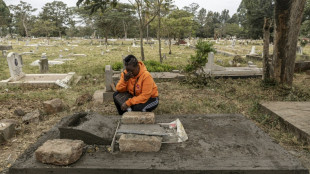
Much-hyped Alzheimer's drugs do not help patients, review finds / Photo: © AFP/File

 Global stocks rally on lower oil prices, US-China hopes

 EU proposes energy rating for data centres

 Schoolgirl Yu scorches to second gold as doping case rocks Games

 Putin's party secures record score in Russia election

 Haupt Koleksiyonu: Paranın Biz İnsanlar Hakkında Anlattıkları

 Spanish PM says unregulated AI could be 'devastating'

 Yu, 13, smashes record again with second Asian Games gold

 Switzerland to play without Xhaka over fake Covid certificate

 From Korean Chipmakers to Leveraged Semiconductor ETFs: STARTRADER Launches 49 New 24/7 Stock and ETF CFDs

 Thai badminton player first doping case at Asian Games: testers

 Колекція Гаупта: Що гроші розповідають про нас, людей

 German far-right AfD poll winner says Merz 'twilight' has begun

 Flights scrapped, evacuations urged as Typhoon Dujuan nears Japan

 China confirms Xi to visit US this week for Trump talks

 مجموعة هاوبت: ما يكشفه المال عنا نحن البشر

 Colecția Haupt: Ce ne dezvăluie banii despre noi, oamenii

 Sisters of jailed Pakistan ex-PM Imran Khan arrested

 African players in Europe: Semenyo brace helps City top table

 'For my family': India boxer beats hardship, injury to go for Games gold
 Indonesia doing 'everything' but still struggling to curb fires

 Once decried as 'human cockfighting', MMA wants Olympic spot

 China's Yu, 13, great for swimming says multiple Olympic medallist

 Putin's party set to retain power after Russia vote hit by cyberattacks, drones

 Germany's Merz under pressure after bruising state election losses

 Messi, Miami frustrated in 2-2 draw with San Diego
Drugs once hailed as a breakthrough in the fight against Alzheimer's disease do not meaningfully help patients, a major review found Thursday, however some experts criticised the research.
The review by the Cochrane organisation -- which is considered the gold standard for analysing existing evidence -- looked at drugs that target a plaque called amyloids which builds up in the brains of Alzheimer's patients.
Researchers have long sought a way to eliminate this plaque, believing it could be the cause of the most common form of dementia which affects millions of elderly people every year.
After decades of costly yet unsuccessful research, two anti-amyloid drugs called lecanemab and donanemab were initially hailed as gamechangers that finally offered a way to slow the progress of the debilitating disease.
Both drugs were approved by the United States and European Union over the last few years.
However concerns about their effectiveness, cost and side effects including an increased risk of brain swelling and bleeding have since prompted caution. State-run health services in the UK and France have refused to cover the drugs.
The new Cochrane review combined data from 17 clinical trials that included a total of more than 20,000 people with mild cognitive impairment or early dementia.
The trials, which took place over roughly 18 months, studied seven different anti-amyloid drugs.
Only one of the trials examined donanemab -- sold under the name Kisunla by US pharma giant Eli Lilly -- while one studied lecanemab, sold as Leqembi by Biogen and Eisai.
While early trials suggested these drugs made a statistically significant difference, this did not translate into "something clinically meaningful for patients," lead study author Francesco Nonino of Italy's IRCCS institute told a press conference.
Brain scans showed that the drugs successfully removed amyloids, the researchers emphasised.
This means "the idea that removing amyloids will benefit patients was refuted by our results," said study co-author Edo Richard of Radboud University Medical Centre in the Netherlands.
- 'Not delivering on promise' -
Richard, who has previously expressed scepticism about anti-amyloid drugs, said he hopes efforts targeting other mechanisms that potentially cause Alzheimer's lead to more effective drugs in the future.
British biologist John Hardy, who first developed the amyloid hypothesis in the 1990s, criticised the review for lumping together data about lecanemab and donanemab along with drugs that are known to be ineffective, therefore dragging down the overall average.
"This is a silly paper which should not have been published," Hardy told AFP, disclosing that he has consulted for Eli Lilly, Biogen and Eisai.
In response to such questions, Richard said that while the drugs included in the study may work in different ways, they all have the same target: amyloid beta proteins.
Australian neuroscientist Bryce Vissel, who was not involved in the research, said it "does not prove amyloid has no role in Alzheimer's, and it does not rule out future amyloid-directed therapies that may yet help patients".
"But it does show that the current generation of anti-amyloid drugs is not delivering the promise that has surrounded it."
G.Haefliger--VB