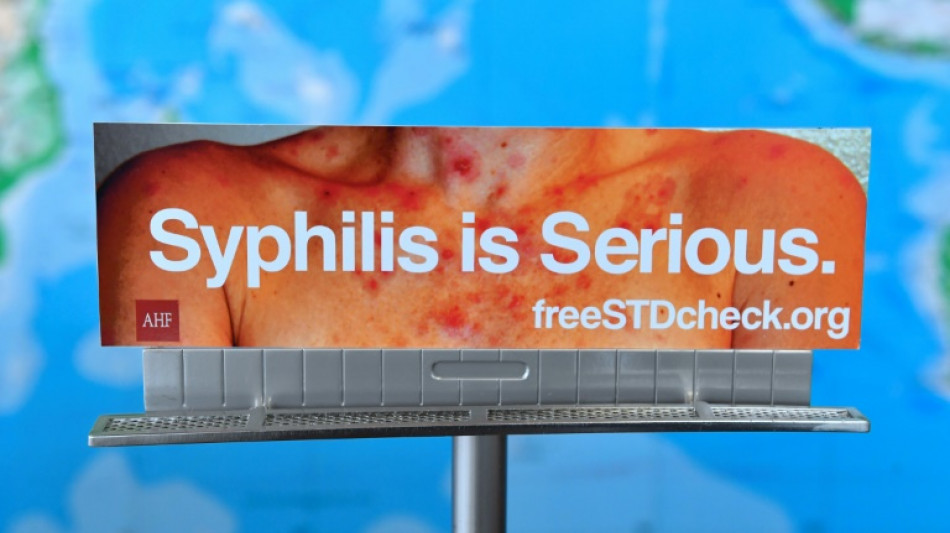
Antibiotic taken after sex drastically reduces STDs: study / Photo: © AFP/File

 Inside the Venezuelan prison meant to 'drive you insane'

 UK king braces as memoir by Diana's brother goes on sale

 No green light to lift EU sanctions on Russian oligarchs, talks to resume

 UK agrees support for Saudi in struggle with Houthis: reports

 EU foreign policy chief calls for continued sanctions on Russia

 Flights scrapped, evacuations urged as Typhoon Dujuan wallops Japan

 Fonseca to take break from tennis

 A Cuban zoo, and its animals, in epic battle for survival

 Infantino proposes consulting federations to reform FIFA

 El Nino weather pattern enters record territory: scientist

 OpenAI calls for US to lead global effort on AI standards

 South African ostriches plucked alive for luxury fashion: report

 US networks halt Trump coverage in revolt over White House ban

 Paramount settles with US states to clear Warner Bros. mega-merger

 Climate crisis a job for world leaders, not just activists: UK FM

 US networks halt Trump coverage over White House ban

 French singer accuses Miley Cyrus of plagiarism

 EU fines Google 403 mn euros for location data breach

 'Best is yet to come,' says De la Fuente after Spain extension

 Why diesel prices are rising more than crude oil

 COP31 host says AI's climate footprint to be a summit priority

 Renewables hit record in 2025, but world must move faster: report

 US media outlets to sue Trump administration after White House ban

 Global stocks rally on lower oil prices, US-China hopes

 EU proposes energy rating for data centres

An antibiotic taken after sex without a condom can drastically reduce the rate of three bacterial STDs among high-risk groups, data from a clinical study showed Wednesday.
The research was presented at the 24th International AIDS conference in Montreal, where it was hailed as a major development.
"This has the capacity to change the guidelines" on clinical practice, Steven Deeks, an HIV expert at the University of California, San Francisco (UCSF), who was not involved in the study, told AFP.
Doxycycline reduced rates of gonorrhea and chlamydia by more than 60 percent among men who have sex with men (MSM), and also appeared highly effective against syphilis, but there weren't enough cases to reach statistical significance.
The trial was halted early because researchers found the drug was undeniably working and it would have been unethical to continue testing.
The study comes amid rising rates of these diseases, particularly among MSM, whose use of condoms has declined since the advent of effective HIV pre-exposure prophylaxis (PrEP) pills.
A previous trial by French researchers, which used doxycycline as a post-exposure prophylaxis (PEP), showed it was effective against syphilis and chlamydia among MSM, but not for gonorrhea.
For the new study, researchers recruited around 500 people, mostly MSM but also some transgender women and gender diverse people, at sites in San Francisco and Seattle.
Some were taking HIV PrEP, while others were living with HIV.
In both of the groups, around two-thirds received doxycycline, while a third did not. They were followed to monitor their outcomes every three months.
The pill, dosed at 200 milligrams, was given within three days of exposure. Participants could continue to take it as needed depending on how much sexual contact they were having.
The intervention reduced the incidence of STDs by 62 percent in the group living with HIV, and 66 percent in the group on HIV PrEP.
Side effects were mild and adherence levels remained high.
"We now have two studies that support the use of doxycycline as PEP in men who have sex with men," study lead Annie Luetkemeyer of UCSF told reporters at the AIDS conference.
"I really think we're at a place where we need to think very strongly about rolling this out and how to incorporate this into guidelines."
She stressed, however, that right now the data supports the treatment as targeted intervention among high risk groups that have a high prevalence of STDs -- not everyone.
More study is also needed to better understand the potential impacts on antibiotic resistance, the authors said.
Researchers want to know if it could increase resistance from STDs -- which is thought more possible for gonorrhea than chlamydia and syphilis -- from so-called "bystander" bacteria that live on the body and in the throat.
They also want to probe the potentially disruptive impact on the gut microbiome.
S.Keller--BTB