Toxic threat from 'forever chemicals' sparks resistance in Georgia towns / Photo: © AFP

 Colombia declares three days mourning for quake victims

 44 lives lost after ferry capsizes on Zimbabwe's Lake Kariba

 WallStreetPR Releases Report on China’s Gold Purchases and African Mining Investment
 Former Chinese premier Zhu Rongji dies aged 97

 Markets steady awaiting US inflation data

 WHO says Trump vaccine shake-up goes against evidence

 Eclipse chasers flock to Spain for 'breathtaking' experience

 'To make the civilians leave': Russia pummels Ukraine's petrol stations

 Japan brushes off Australian PM's melon drama

 Rod Stewart cancels tour dates after heart surgery

 How Britain's mapmakers track climate change

 Australian delivery drivers win 'world-leading' pay rise

 Meta meets its own 'tobacco' moment in court

 Art or medicine? Japan's cosmetic tattoo artists in limbo
 Rybakina ousts Osaka to book Toronto semi-final against Gauff

 Colombia rescuers find woman alive as quake death toll passes 240

 Charges dropped against Bondi Beach attack hero

 Parched and desperate for rain, Kazakhstan turns to cloud-seeding

 The perfect storm that turbocharged Venezuela's twin quakes

 2.4 million girls banned from Afghan schools since Taliban return: UNESCO
 Colombians dig through rubble as quake death toll surpasses 240

 New Zealand's ruling party meets to decide PM Luxon's fate

 Total solar eclipse to spellbind Europe

 Jodar, Nakashima to make Masters semis debuts in Montreal

 Chilean veteran Sanchez signs with MLS club Montreal

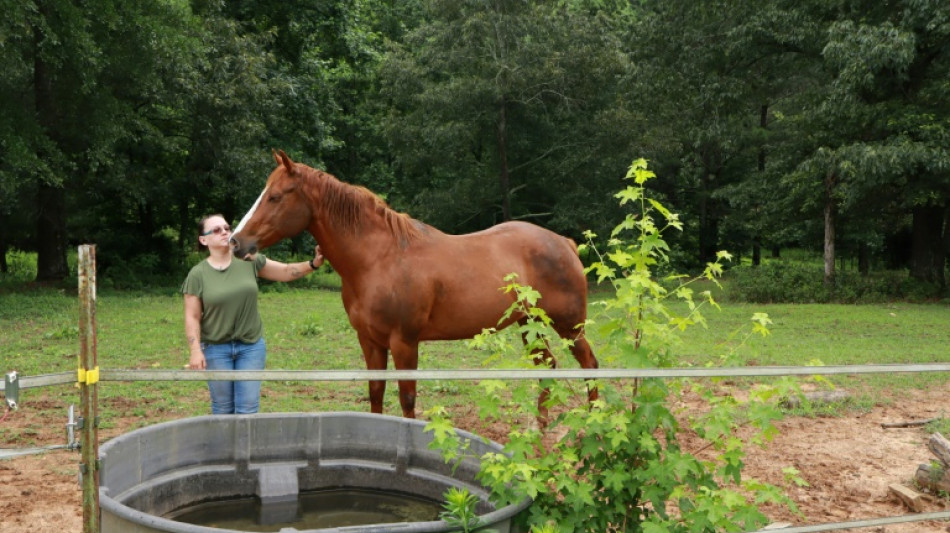
Sasha and Jamie Cordle thought their small farm in rural Georgia would be a ladder out of working-class struggle, and a gift for their children and grandchildren.
Instead, it may be poisoning them.
Tests show their spring water is laced with toxic "forever chemicals" at levels tens of thousands of times above federal safety guidelines, likely from nearby carpet factories.
"It scares us," said Sasha, a 38-year-old dispatcher whose husband drives long hauls across the country. She's worried about their five children, two-year-old granddaughter, and a grandson due in October.
PFAS -- or per- and polyfluoroalkyl substances -- are a group of more than 10,000 human-made chemicals that repel heat, water, oil, and stains.
Developed in the 1940s, they're still used in nonstick pans, firefighting foams and stain-proof carpets, yet are now linked to hormonal disruption, immune suppression and cancers.
Their ultra-tough carbon-fluorine bonds take millennia to break down in the environment, linger in bodies for years, and are now found in the blood of nearly every living creature on Earth.
– 'Carpet capital of world' –
Here in Dalton, Georgia, which calls itself the "Carpet Capital of the World," mills run by giants Mohawk Industries and Shaw Industries are widely blamed for making the region one of America's most PFAS-laden.
They're accused of spewing the chemicals into the air, flushing them into sewers unequipped to remove them, and indirectly contaminating farmland through sludge byproducts later spread as fertilizer.
The Cordles have joined other landowners in suing the carpet makers, seeking damages to "remediate" their properties -- a process they estimate could cost about $1 million per acre -- plus punitive damages.
Mohawk, Shaw, and chemical giant 3M declined to comment on the complaint. Chemical maker Chemours, another chemical maker and defendant, says it has no factories in Georgia and denies culpability.
In a complex web of lawsuits, Dalton Utilities, which manages the local water system, has also sued the carpet makers, while Mohawk has sued 3M over the same issue.
The Biden administration last year enacted the first enforceable national drinking water standards for six PFAS chemicals.
But under President Donald Trump, the federal government has since rolled back limits on four of the chemicals and delayed the compliance deadline for the remaining two.
- Test cases -
Meanwhile, the Cordles have seen alarming signs, in both humans and animals.
Sasha, who moved to the property after marrying Jamie in 2020, soon developed two autoimmune conditions, as well as high blood pressure and chronic fatigue.
"Sometimes getting out of bed, I feel like I'm 80," she said.
Her grown children also report various ailments -- and some goat kids didn't survive their birth defects.
Attorney Ben Finley is leading a wave of damages claims, recruiting new clients at buoyant town halls.
So far, his firm has filed suits for 18 lead plaintiffs.
"We're drawing a direct line between contamination, lost property value and cleanup cost," Finley said.
– Entering the food web –
While the lawyers work the crowds, water expert Bob Bowcock takes water, soil and dust samples to help build the scientific case behind the legal one.
"We've got springs emitting into ponds that are discharging to creeks at over 180,000 parts per trillion," he said. The national guideline for drinking water is just four parts per trillion, and local creeks are often seen frothing with pollution.
PFAS in the soil move up the protein chain and into the food web -- contaminating eggs, milk, beef, and leafy greens that find themselves on store shelves nationwide.
The carpet makers are the area's main economic lifeline, yet many are now turning against them.
Mary Janet Clark, 62, toiled for the carpet makers, had her ovaries removed after cancer, and now has a tumor in her brain.
"We helped them build their business and make all that money," said her son, David Wray, 40. "It's just cruel."
– Lost dreams –
Others share similar grief.
Human-resources manager Teresa Ensley, 57, lost her brother, father and husband to cancer in just a few years.
Studies have linked PFAS to elevated colon cancer rates, the disease that killed her brother and husband. She and her 81-year-old mother both suffer severe thyroid problems and have had hysterectomies.
Even for those not yet sick, the toll is palpable.
Greg and Sharon Eads hoped to retire on farmland they bought in 2019, but it has since tested hot for PFAS, unraveling their dream.
They own $50,000 worth of cattle now off-limits for milk or meat.
It's become "basically a petting zoo," said Greg. "I can't do anything with them, not in good conscience."
During a recent visit, the couple led AFP through bucolic pastures where the herd huddled around a healthy newborn calf -- a welcome moment of hope after several others were lost to deformities.
A.Zbinden--VB