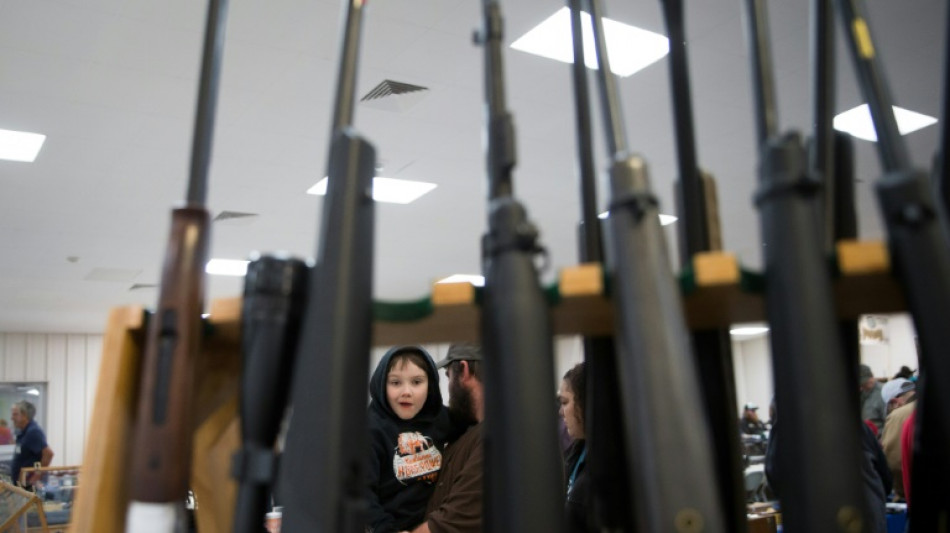
Looser gun laws tied to thousands more US child shooting deaths / Photo: © AFP/File

 Spieth among five sharing Memphis lead as PGA playoffs open

 Boats rescue tourists as forest fire flames threaten Greek beaches

 Good vibes powering Djokovic return to Cincinnati

 Britain's Hunt wins 200m for European sprint double

 Draper dumped as Norrie saves face for Britain in Cincinnati

 England opener Gay out for duck in Pakistan warm-up

 Europe swelters under fresh wave of extreme heat

 French Olympic gold medallist Florent Manaudou announces retirement

 Tourists rescued by boat as forest fire threatens Greek beaches

 Indicted Raul Castro reappears after months out of public view

 Italian teen Curtis breaks women's 50m backstroke world record for second time

 Taulagi steps out of 'comfort zone' with code switch to French Top 14 new boys

 Leicester's Thai owners put troubled club up for sale: reports

 Stocks steady as US inflation worries ease, oil slips

 Porsche to end production of flagship electric car: report

 Twitch sparks gamers' wrath with Amazon AI sharing deal

 Blaze forces families to abandon Turkish tour boat

 'If you can, move!' say Rome's viral dancing seniors

 Zambia voters weigh Hichilema's economic record

 SBCFX to Showcase Trading Innovation, Regional Growth Strategy, and Future Vision at iFX EXPO Asia 2026

 Hodgkinson sets up Werro showdown after Euro 800m drama

 'How many will die?': the mysterious ailment killing Kenyan elephants

 Arteta coy over Lewis-Skelly's Arsenal future after 'emotional' celebration

 Romania shuts down nuclear plant as Danube drops

 German steel giant Thyssenkrupp weighs options as Rhine drops

US states that loosened their gun laws following a landmark court ruling saw thousands more childhood firearm deaths than they otherwise would have -- the vast majority homicides and suicides -- according to a study published Monday.
Jeremy Faust, an emergency physician at Brigham and Women's Hospital in Boston and lead author of the paper in JAMA Pediatrics, told AFP he was drawn to the topic as a father wondering whether today's world is safer for children than when he was growing up.
"Mortality from car accidents has fallen dramatically, but at the same time, firearm mortality rose and replaced car accidents as the leading cause of death in children over the age of one," he said -- a trend unique among peer nations.
To probe this shift, Faust and his colleagues analyzed state-level data before and after McDonald v Chicago, the 2010 Supreme Court decision that extended the Second Amendment to state and local governments.
The ruling sparked a wave of legislation, some tightening gun laws but much of it loosening them.
The team grouped states into three categories -- most permissive, permissive, and strict -- and used Centers for Disease Control data on firearm deaths among children aged 0–17.
They ran an "excess mortality analysis," comparing actual deaths from 2011 to 2023 against projections based on prior trends from 1999 to 2010 and population growth.
The results were stark: more than 7,400 excess pediatric firearm deaths in states that loosened gun laws -- including over 6,000 in the most permissive group of states.
By contrast, the eight strictest states overall saw no excess deaths. The model predicted 4,267 fatalities, while 4,212 were recorded -- a near-match that bolstered confidence in the analysis.
"The biggest thing people always want to know is, what's the intent behind these?" said Faust.
"And I think what surprises most people is that accidents are a very small number of these deaths -- it's mostly homicide and suicide."
While the study showed strong associations, it cannot prove causation -- a key limitation.
But in a test of whether broader increases in violence might explain the trend, rather than changes to the law, the team analyzed non-firearm homicides and suicides and found no similar rise, a result that makes the findings "pretty compelling," said Faust.
Black children saw the steepest increases. While the reasons are unclear, the authors speculated that disparities in safe firearm storage could play a role.
There were some exceptions. Deaths rose in Illinois and Connecticut despite tighter laws -- though in the latter case, the spike was entirely attributable to the 2012 Sandy Hook mass shooting at an elementary school.
"Big picture, we have a major problem in this country," said Faust.
"But we also have a handful of states that are resisting these increases and, in fact, turning the other direction."
L.Stucki--VB