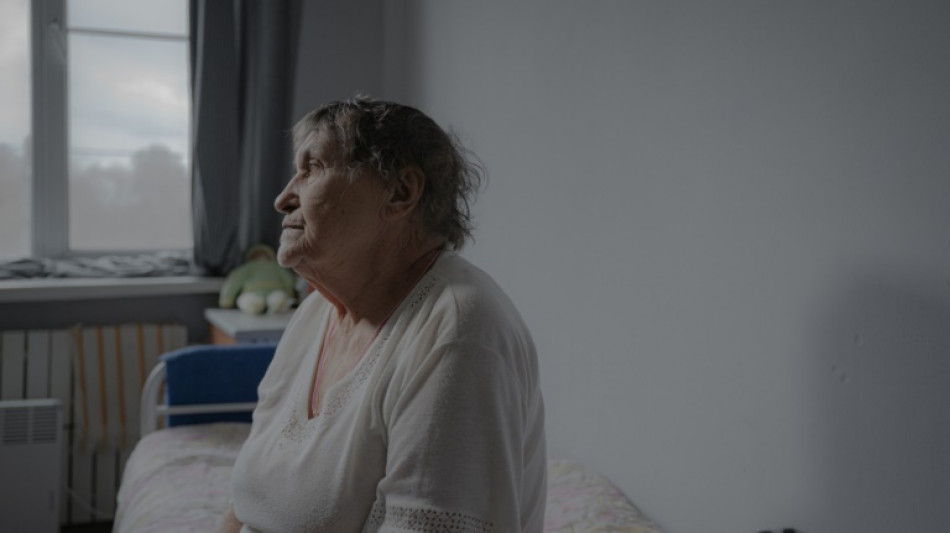
As war grinds on, Ukraine's seniors suffer / Photo: © AFP

 Canada's Carney stands up to Trump, despite risks

 Lens hammer Auxerre thanks to Thauvin penalty double

 No singles for Serena, but she joins Alcaraz for US Open
 Joao Pedro extends Chelsea stay with new long-term deal
 Yamaguchi to face An in hunt for fourth badminton world crown

 Norris clinches pole for Dutch GP
 Norris clinches pole for Dutch Grand Prix

 Pope Leo calls for courage in Rimini visit after stop in tiny San Marino
 Man Utd must learn from 'frustrating' defeat at Hull: Carrick

 Yamaguchi on course for fourth badminton world crown
 Man Utd humiliated by Hull in dismal start to Premier League season

 Anthropic market debut could break SpaceX IPO record: media

 Pope's 'couturier of the sacred' fueled by faith
 Duplantis locked in on 'grinding' for big bars
 Stokes says decision to leave Headingley off Ashes roster 'shambolic'

 New arrival Rodri to miss Elche opener: Barca's Flick

 Atletico's Alvarez to return against Villarreal: Simeone

 Dozens of civilians killed, kidnapped as jihadists clash in Nigeria
 Former envoys urge joint French, UK action on Palestinian territories
 Australia lead by 101 in 2nd Bangladesh Test as 18 wickets fall on day one

 'Aura' battles leap from social media to Latin America streets

 US, Canada fail to reach trade pact to avert Trump tariffs
 Sudan farms lie barren as El Nino leaves Nile banks dry
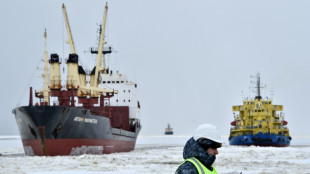 Arctic shipping a daunting prospect in hotly contested region

 In US, rare earths extracted from coal mine wastewater
Like thousands of senior citizens in Ukraine, Zinaida Gyrenko was spending the sunset years of her life in a shelter, her retirement upended by Russia's invasion.
Her memory was foggy but the moment Russia struck her village in the northeast of the country, sending her sprawling, was crystal clear.
"It was so loud. Everyone fell to the ground. I was lying there. Then I opened my eyes again, and I thought: I'm still alive," Gyrenko, born in 1939, told AFP.
The invasion launched by the Kremlin more than three years ago has disproportionately affected Ukraine's seniors.
A quarter of Ukraine's people are older than 60, but they accounted for nearly half of civilian deaths near the front last year, according to the United Nations.
The elderly are often the last to leave frontline territories, saying they lack money or strength to relocate -- or the will to part with their homes.
Gyrenko lived in the village of Zaoskillya in the eastern Kharkiv region until last May. Russia has been advancing on the nearby town of Kupiansk further west, raining down bombs on settlements nearby.
She now stays at a dormitory-turned-shelter for senior citizens called Velyka Rodina, meaning Big Family, in Kharkiv city further north.
Gyrenko was grateful to her carers for looking after what she called the "second-hand" residents. She said she could no longer remember her age: "I'm from '39. You do the maths."
She said she had worked in the rail industry her whole life.
"I've loved the railways very, very much, ever since I was a child," she said, her blue eyes welling up with tears.
- Dignity in retirement -
The shelter's founder Olga Kleytman said the needs of elderly people were immense.
In Kharkiv alone, she estimated that 32,000 seniors who had fled their homes needed help.
There are only eight public retirement homes in the Kharkiv region -- not enough to meet demand, she said.
Authorities have not provided financial support to her establishment, which had 60 residents at the end of March and depends solely on private donations, she added.
"They have worked all their lives, and they deserve a decent old age," the 56-year-old said.
"This is about our dignity."
An architect by profession, Kleytman told AFP she had plans to expand.
Since most of the seniors come from rural areas, she wants to create a large vegetable garden with animals to reproduce village "smells and sounds".
One of the residents, 50-year-old Sergiy Yukovsky, who had both legs amputated after an accident at work, used to live in the countryside with his younger brother.
His brother was killed by a mine while "fetching wood" near the village of Kochubeivka, also in the Kharkiv region.
"I don't even know where he is buried," Yukovsky said. For a year, he lived alone before being evacuated to Kharkiv city.
The future is bleak, he confessed, but added: "Ukraine will have it all, and Putin is an asshole."
- Hopes for future -
In another room 84-year-old Yuri Myagky lay in bed facing a window.
He was from Saltivka, a Kharkiv suburb that was bombed heavily when Russian forces were attempting to capture the city at the start of the invasion.
"Has Ukraine been divided?" Myagky asked, confused -- like so many others -- by the twists and turns of the conflict.
Since September 2024, Gyrenko has been sharing a room with Olga Zolotareva, 71, who grumbled when her roommate lost the thread of their conversation.
For 28 years, Zolotareva looked after people with learning disabilities in the town of Lyptsi, not far from the Russian border.
When the invasion began, they were evacuated, but Zolotareva stayed.
In May 2024, when Russia launched a new offensive on the Kharkiv region, she was in her house when "there was a strike".
A shard "from I don't know what" broke her right leg, she said, showing her scar.
As well as peace, she hopes to be able to walk normally again.
That, Zolotareva said, and to have "the smell of a man" around her. She misses it a lot, she told AFP.
Gyrenko said she remained optimistic, despite everything.
"Happiness, as I understand, means not being hungry, not being without clothes and not being shoeless," she said.
"I'm not those things."
R.Kloeti--VB