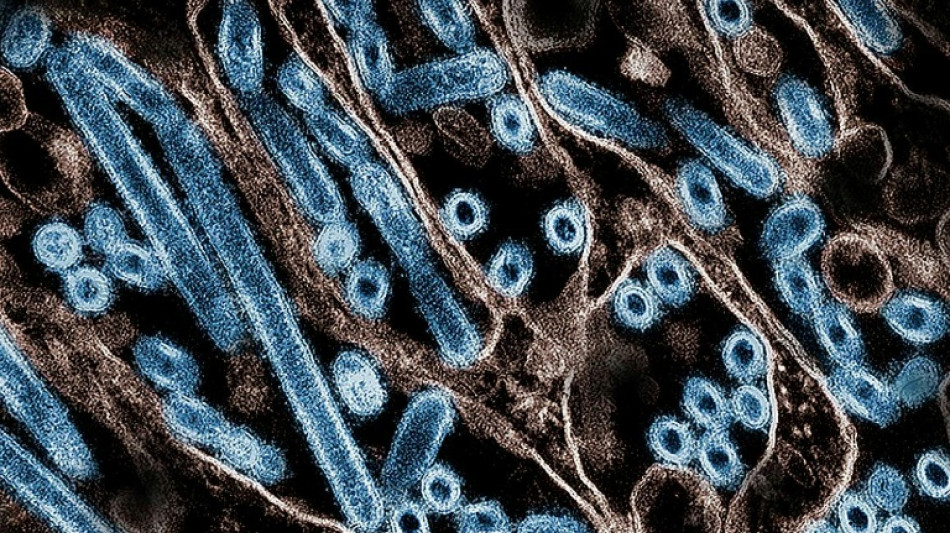
Bird flu mutated inside US patient, raising concern / Photo: © National Institute of Allergy and Infectious Diseases/AFP/File

 'South Park' changes name in dig at Trump

 OpenAI says AI solved one of math's hardest problems in days

 Nearly 1,100 flights cancelled after UK air traffic control glitch

 Sabalenka holds off Noskova to keep US Open three-peat bid alive

 Rein in social media not children, say over 130 groups, experts

 Hong Kong's first post-colonial leader Tung Chee-hwa dies aged 89

 Rangers captain Shankland sidelined for up to four months

 NY failed to disclose what it knew on 'toxic air' after 9/11

 What we learned from 'lacerating' four-hour Musk documentary

 UK, France, Canada to ban imports from Israeli settlements

 Pakistan's drastic squad upheaval 'news' to skipper Babar Azam

 Hurricane Lowell lashes Hawaii's western islands

 Argentina files lawsuit against oil firms operating off Falklands

 Root wants Pietersen to pull no punches on England return

 Spain declassifies intelligence reports into Ceuta migrant rush

 Octrado introduces its proprietary trading offering: "Your Skill. Our Capital"

 Mac Allister 'very sad' at lack of new Liverpool deal

 Barca star Yamal says will not beg for Ballon d'Or

 Houthis report Saudi reprisals after oil sites set ablaze in wave of strikes

 Could gas prices return to 2022 highs on US-Iran war?

 Totti turns down Italy and Roma to join basketball club

 South Africa economy shrinks ahead of local elections

 CapTLX Expands Institutional-Oriented Platform for Access to U.S. Capital Markets

 UK's Prince George starts at Eton College

 French far right keeps guarded silence over AfD Germany triumph

The bird flu virus found in a severely ill patient hospitalized in the United States has mutated to become better adapted to human airways, though there is no evidence it has spread beyond the individual, authorities said.
Earlier this month, officials announced an elderly Louisiana patient was in "critical condition" with a severe H5N1 infection.
An analysis posted by the Centers for Disease Control and Prevention (CDC) on its website Thursday found that a small percentage of the virus detected in the patient's throat had genetic changes that may lead to "increased virus binding" to certain "cell receptors found in the upper respiratory tract of humans."
Importantly, these changes have not been found in birds, including in the backyard poultry flock thought to have infected the Louisiana patient initially.
Instead, the CDC stated that the mutations were "likely generated by replication of this virus in the patient with advanced disease," adding that no transmission of the mutated virus to other humans has been identified.
Experts contacted by AFP said it was too early to determine whether these changes would make the virus spread more easily or cause more severe disease in humans.
The particular mutation "is one step that is needed to make a more efficiently transmissible virus," said Angela Rasmussen, a virologist at the University of Saskatchewan in Canada. "But I do want to point out that it's not the only step."
She explained that while the mutation might mean the virus can more easily enter cells, this would need to be confirmed through further testing on animals. Moreover, similar mutations have been found in severely ill patients in the past without triggering wider spread among humans.
"It's good to know that we should be looking out for this," she said, "but it doesn't actually tell us, 'Oh, we're this much closer to a pandemic now.'"
Another expert, Thijs Kuiken of Erasmus University Medical Center in the Netherlands, agreed with Rasmussen.
"Efficient attachment to human upper respiratory tract cells is necessary, but not sufficient, for more efficient transmissibility between people," he said, "because the attachment process is but one of several steps in the virus replication cycle in a human cell."
Rasmussen expressed greater concern about the overall level of bird flu currently circulating rather than this specific case.
The CDC has reported 65 confirmed human cases of bird flu in the United States in 2024, with more likely going undetected among dairy and poultry workers.
This, Rasmussen explained, increases the chances of bird flu "reassortment" with seasonal flu, which could lead to "rapid evolutionary leaps in a short period of time," similar to the processes that caused the 1918 and 2009 pandemics.
J.Sauter--VB