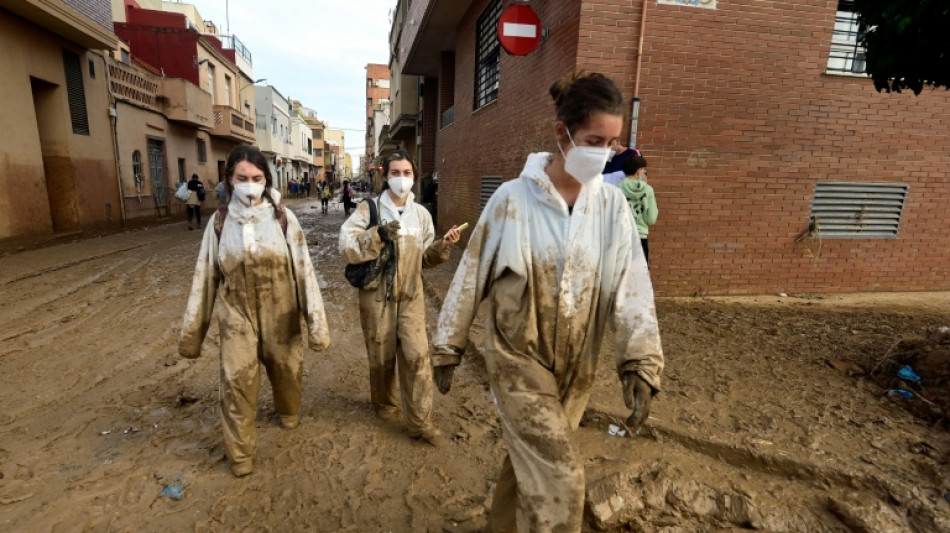
Reeking mud sparks health fears in Spain flood epicentre / Photo: © AFP

 J-VISIONS Vol. 4 Now Online: Read English Articles on Japanese Corporate IR

 In DR Congo streets, ex-hoods get tough on litter -- and locals

 Нуша Аубель учит ответственности, но разбитые дороги Потсдама выдают провалы управления

 Surfer hospitalised after shark attack in Western Australia

 South Korea says 'serious shortage' of rooms with Asian Games days away

 Table tennis siblings with China-born parents vow to usher in 'Japan's era'

 Bougainville leader says violence won't stop Panguna mine re-opening

 South Korea aims to save seniors lost in digital age

 Russia's Stalin-admiring provincial leader waging an ultra-conservative crusade

 Marcelo Gallardo appointed as new Ecuador head coach

 'Widow's Bay' and 'The Pitt' tipped for success at Emmy Awards

 For club and comfort: Rodman makes it to Shelton's US Open final

 Houthis say Saudi Arabia launched over 50 strikes against them in 24 hours

 'Fed up': Thousands march against Sinaloa Cartel violence

 Controversial Zverev: from tennis nearly-man to multiple Grand Slam winner

 Swedish left-wing cheers far-right decline amid tight election race

 Yamal double helps Barca beat Levante, Atletico triumph

 Sassuolo stun Juve, Lobotka eases pressure on Allegri with Napoli winner

 Bills beat Texans and Ravens roll Colts in NFL openers

 US fight off spirited France to win 12th World Cup

 Drivers give cool reception to new Madring circuit

 Maresca makes flawless Man City start to leave Man Utd trailing

 Dozens arrested in major anti-LGBTQ raids in Turkey

 Leftwing opposition seen leading Sweden election, far-right losing ground

 Senegal goalkeeper Mendy retires from international football

The sea of mud and stagnant water submerging Spanish towns more than 10 days after the country's worst floods in decades has sparked a sickening stench and health fears.
"That's the rotten meat," said Toni Marco, pointing to a destroyed supermarket in the devastated town of Sedavi from which a disgusting odour wafted when AFP visited.
The meat was only removed recently, well after the floods cut the refrigerators' electricity supply, added Marco, a 40-year-old employee of a private cleaning company.
The nearby town of Catarroja also remains a mud bath after the October 29 disaster that has claimed 219 lives, with a powerful reek compounding the woes of survivors.
The diversity of matter decomposing under the mud produces a spectrum of smells ranging from the mildly unpleasant to the outright repulsive.
"Each decomposition of an element smells differently," which explains why the odours vary from street to street, said Angel Aldehuela, a 51-year-old firefighter from the southern Seville region.
Dead animals may also lie buried under the mud, he told AFP.
When the mud dries, the organic matter decomposes without oxygen and "that's where those smells we're not used to start to appear," explained Miguel Rodilla, a biologist at Valencia's Polytechnic University.
"There aren't necessarily bodies nearby, but simply organic matter decomposing."
- Smell 'will get worse' -
In scenes reminiscent of the Covid-19 pandemic, rescuers, volunteers and residents have worn facemasks and gloves during the clean-up, while some people have complained of the stink causing headaches and dizziness.
Breathing in the pestilential miasma "isn't ideal for health", but "higher concentrations" of decomposing matter would be necessary to make it toxic, said Rodilla.
Stagnant water can trigger gastrointestinal disorders or pneumonia, Health Minister Monica Garcia told public radio RNE, but she ruled out the possibility of an "outbreak".
The health board of the Valencia region, particularly crippled by the floods, has also reported no outbreak of infectious diseases or a major threat to public health.
Even so, regional health authorities have asked local councils to apply measures to control and prevent the proliferation of mosquitoes and other insects capable of spreading diseases.
Aldehuela warned that the foetid fumes enveloping Catarroja "will get worse, without a doubt", predicting they would linger for up to a week more.
But in towns where the muck has been cleared swiftly, an aroma of bread or fruit has replaced the stench, the head of the army's emergencies unit Javier Marcos said on Friday.
A.Zbinden--VB