Wounded soldiers treated at night as Bakhmut battle rages / Photo: © AFP

 Hurricane Polo strengthens to top category 5 off Mexico

 11 hurt as teen opens fire outside school in western Turkey

 UN chief says 'Big Oil' treats atmosphere as open sewer

 Tunisia says 2026 summer hottest on record
 England's Rashid out of Sri Lanka ODIs with hand injury

 Houthis accuse Saudi Arabia of deadly strikes as thousands flee

 Stocks climb as oil slides, AI buzz returns
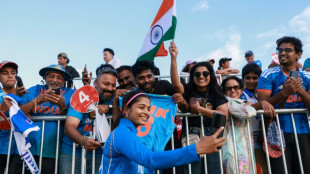 India cricketers win in style as Afghan savours 'special' Games silver

 La Liga president hits out at Real Madrid refereeing 'conspiracy' claims

 MEXC Launches “Real Stocks, Real Friends” with Rewards for Bringing Friends to Wall Street

 Mbappe continues media push for Ballon d'Or recognition

 Stocks rise on AI buzz, oil prices cool
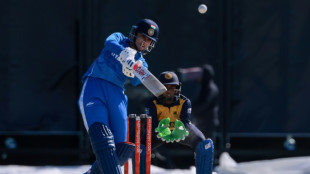
 India narrowly survive huge scare against minnows Japan

 Missing F-35 fighter parts 'not sensitive', says Australia minister
 Cambodia showcases scams crackdown with global conference
 Afghan cyclist who disguised herself as man wins Asian Games silver
 Typhoon Dujuan leaves four dead in Japan, 45,000 houses without power

 G7 leaders condemn Houthi strikes on Saudi Arabia
 Google data centre sparks protests in Austria

 Shin Ohashi: Junk food-loving teen and Japan's next big swimming hope
 Stocks rise on AI buzz, drop in oil prices
 China's robot dancers limber up for America's Got Talent final

 Despite military might, Saudi struggles to crush the Houthis
 Trump to tout deals, defend Iran war in UN speech
 Sri Lanka to issue verdict in landmark Easter attack trial
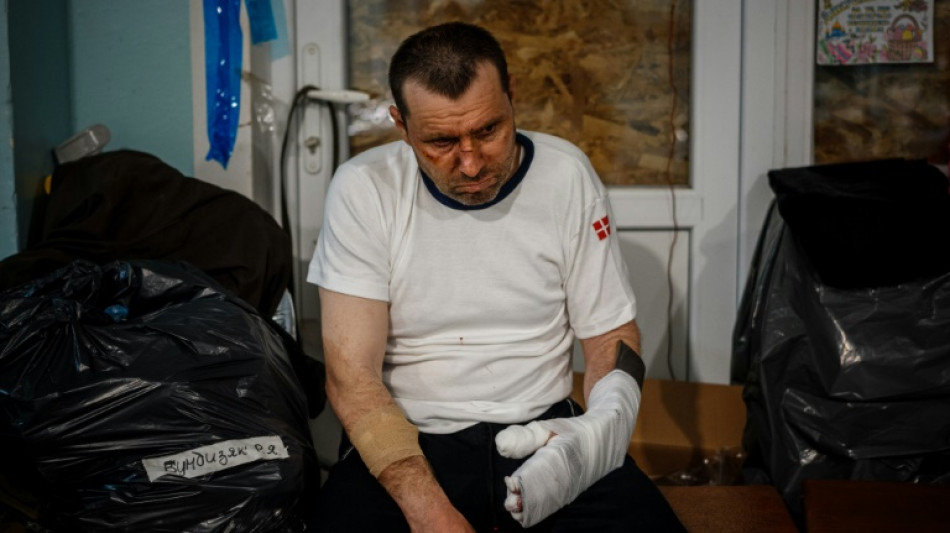
Deep inside the wound, the Ukrainian soldier's heart is beating. It is 9:00 pm and he has just been brought into a field hospital from the battle for Bakhmut.
A bullet went through the young man's left arm, crossed his chest and lodged itself into his right arm.
Some 15 doctors, nurses and assistants work around the soldier and five other wounded fighters brought in to this first aid point of the 93rd mechanised brigade.
The facility is located in a village around 15 kilometres (nine miles) from Bakhmut -- the epicentre of the fighting between Ukrainian and Russian forces.
"It's been tough for the past month," said Volodymyr Pikhulevskiy, a 38-year-old surgeon and a member of the 15-strong medical team at the facility.
"On some days there are 100 wounded, other days 50 or 60," Pikhulevskiy said. "Everything depends on what is going on in Bakhmut."
"It's very difficult for our guys there. I can't imagine how it is there. It is terrifying," he said.
The first aid point was initially based in Bakhmut but was forced to leave in December as Russian troops advanced further into the Ukrainian city.
They tried to return in January but were forced back because of the intensive shelling.
Four doctors from the unit have been killed since the Russian invasion of Ukraine began more than a year ago.
- Wounded moved at night -
Once he has been treated, the soldier is quickly despatched to a hospital in the nearest city -- like the other fighters who arrived with him.
The facility is one of the stabilisation units located between the front line and hospitals in the big cities.
Each Ukrainian army brigade has its own centres.
"Our aim is to save lives and send the wounded to a hospital," Pikhulevskiy said.
Just as the first batch of wounded soldiers of the night left, another arrived at around 10:30 pm -- all of them with shrapnel wounds.
The majority were in trenches near Bakhmut.
The soldiers look exhausted. Some were injured in the morning or during the day but are only moved to the first aid facility at night since Russian forces regularly shell the roads during the day.
"The wounded are only evacuated when it's dark," said Lyudmyla Symchenko, a 55-year-old anaesthetist.
The driver of an armoured car has his hand covered in blood. The ends of his fingers have been blown off.
Another soldier in his twenties received a shrapnel wound behind his head, close to his backbone. The doctors say it is too difficult and risky to try and pull the metal out.
Two others have shrapnel in their backs. They wince in pain as the doctors remove the metal.
- 'State of shock' -
Symchenko adopts a stern tone to tell one of the patients to stretch out his arm for an injection.
"Many soldiers are traumatised from the shelling and so they do not understand immediately," she explained.
"Yesterday, for example, we had trouble taking an axe out of a man's hand. He was in shock and would not let go of the axe. It is a reaction to stress," she said.
Lightly wounded at the shoulder by some shrapnel, 25-year-old Denis is waiting to be taken to hospital.
He is a member of a paratrooper unit not linked to the 93rd brigade. He was digging a trench south of Bakhmut when he was hit by mortar fire.
He said his unit lacked resources and had suffered "many losses".
"There were 124 fighters at the start of the war. Now, there are fewer than 80," he said.
Just after midnight, calm returns to the medical unit.
All the wounded have been taken to hospitals far from the front and there are no more arrivals.
The doctors say they have treated 70 soldiers over a 24-hour period.
Sitting in silence, the staff stare at their phones.
"Our only distraction is the phone. We don't go out. We're here all the time. We sleep here, we eat here, we work here," said Symchenko, her eyes red with exhaustion.
"In a month, I've only been out once to the dentist and the hairdresser to cut my hair shorter so it would dry quicker."
N.Fournier--BTB