Fleeing jihadist violence, Niger pupils return to school / Photo: © AFP

 Colombian judge bans strikes on guerrillas if minors are present

 Khachanov shocks ailing Auger-Aliassime, Swiatek and Osaka advance at US Open

 Lone juror blocking verdict in US mother's child murder trial: defense

 'Kinda chic' - Williams sisters set to launch US Open doubles bid

 Volkswagen says cutting 100,000 jobs by end of decade

 Russia slaps curfew on charity director over army criticism
 Ailing Auger-Aliassime upset by Khachanov at US Open

 Richarlison omitted from Tottenham's Premier League squad

 How El Nino is choking the Panama Canal

 Hamilton drives his Ferrari dream at Monza

 Senegal has an IMF loan, now what?

 Auger-Aliassime upset by Khachanov at US Open

 Hugging Face, the French start-up that became AI's warehouse
 World Cup winner Llorente retires from Spain team at 31

 Osaka squeezes into US Open third round

 Apple faces £2 bn lawsuit in UK over app privacy feature
 Former champ Swiatek eases into US Open third round

 DR Congo latest to promise moving Israel embassy to Jerusalem

 War criminal Mladic's body returns to Serbia with military honours

 Pierre Cardin museum brings designer's futurist style to Venice

 Slovenian rookie Omrzel triumphs as Mas extends Vuelta lead
 British, French leaders talk migrants, EU relations
 Heading for Ferrari's home race, Leclerc still dreams of world title
 Cafe at centre of Israel culture clash agrees to shut on Sabbath

 Spacecraft bound for Mercury begins 'tricky' arrival
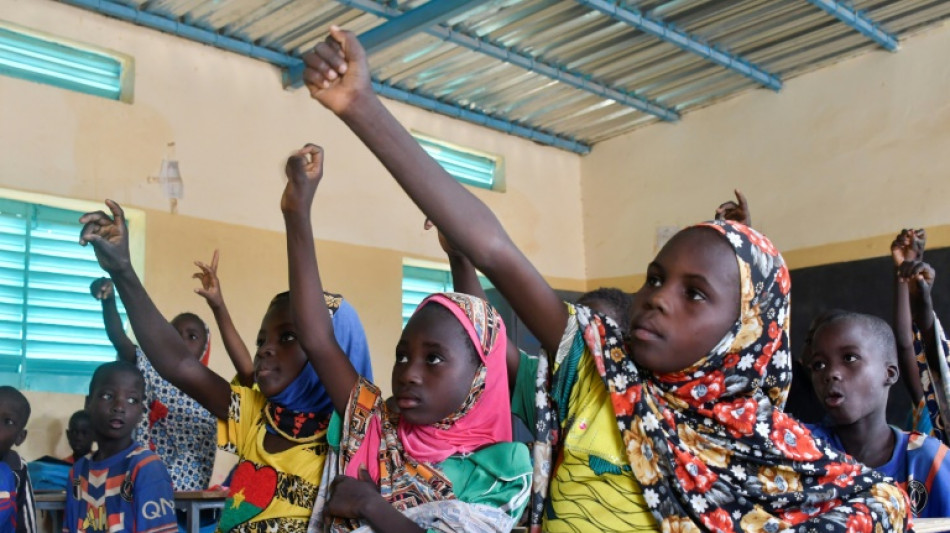
With blue schoolbags bouncing off their backs, hundreds of schoolchildren hurtle down small sand dunes eager to attend class again.
But these boys and girls are survivors of suffering and trauma that few children of their age could conceive.
Their new school is in the town of Ouallam in southwestern Niger, a region that for five years has been plagued by attacks unleashed by groups linked with Al-Qaeda and the Islamic State group.
The pupils come from 18 villages near Mali whose inhabitants fled to the relative safety of Ouallam in 2021 after jihadist killings that also forced the closure of schools.
The UN children's agency UNICEF says 817 schools with 72,421 pupils -- including 34,464 girls -- have closed in Niger, mostly in the Tillaberi, the border region where Ouallam is located.
In Ouallam alone, around one hundred schools have had to shut their doors.
The chronic insecurity has prompted the authorities to create dedicated educational centres where displaced children can resume their schooling, Mahamadou Illo Abarchi, an education official in Ouallam, told AFP.
Some 17,000 pupils have already re-entered the school system and another 55,300 are set to follow suit, enrolling in around 20 centres for displaced children across southwestern Niger, the government says.
- 'Killed by the bandits' -
In Ouallam, almost 1,600 schoolchildren -- some of whom had not attended class for three years -- are registered with three centres built near a site for displaced people.
The sites offer free canteens, a vital resource for families who have escaped violence in a nation that, by the UN's human development index, is the poorest in the world.
Lessons take place in shelters or classrooms equipped with tables and benches provided by NGOs. But in others, the pupils must learn on the floor.
Fatima and Aissa, two young girls from Ngaba, a settlement near Mali, expressed their delight at returning to school as they clutched their slate boards.
But the euphoria of returning to school cannot wipe out the painful memories.
"My uncle was a village chief, he was killed by the bandits in front of our eyes," said Mariama, who also lived in Ngaba. "There was a lot of blood."
Nassirou, Malick, Hasane, Abdou and their parents fled their village of Adabdab on foot after a series of jihadist attacks, the last of which on October 22 claimed the lives of 11 civilians.
"It was the bandits who chased us away, they killed many men," Nassirou said quietly in the playground.
Moussa, who hails from a hamlet in the same area, said: "I'm not afraid anymore, I no longer hide when I hear the sound of motorcycles" often used by jihadists to attack villages.
- 'Encouraging results' -
When they first arrived at the new centres, many children showed "signs of distress and trauma, others were very aggressive", said education official Morou Chaibou.
He spoke of how some pupils recounted harrowing memories -- including seeing their parents being shot.
Adamou Dari, the regional director of the centres, said they also offered the children psychological and social support to give them some stability after their traumatic experience.
"Now they concentrate in class and the results are encouraging," said a teacher as she played in the courtyard with some of her pupils.
Absenteeism is minor but a source of worry, Dari said, explaining that some pupils played truant to work in the town and feed their families.
Harlem Desir of the International Rescue Committee, who recently visited the site for displaced people in Ouallam, said impoverished families often put their children to work or marry their daughters at a young age.
In 2021, Amnesty International warned that boys aged between 15 and 17 were filling the ranks of armed groups, especially the Al-Qaeda-affiliated GSIM, in the Torodi region near Burkina Faso -- with the blessing of their parents.
Y.Bouchard--BTB