Millions sit China's high-stakes university entrance exam / Photo: © AFP

 Colombian judge bans strikes on guerrillas if minors are present

 Khachanov shocks ailing Auger-Aliassime, Swiatek and Osaka advance at US Open

 Lone juror blocking verdict in US mother's child murder trial: defense
 'Kinda chic' - Williams sisters set to launch US Open doubles bid

 Volkswagen says cutting 100,000 jobs by end of decade

 Russia slaps curfew on charity director over army criticism

 Ailing Auger-Aliassime upset by Khachanov at US Open

 Richarlison omitted from Tottenham's Premier League squad

 How El Nino is choking the Panama Canal

 Hamilton drives his Ferrari dream at Monza

 Senegal has an IMF loan, now what?

 Auger-Aliassime upset by Khachanov at US Open

 Hugging Face, the French start-up that became AI's warehouse
 World Cup winner Llorente retires from Spain team at 31

 Osaka squeezes into US Open third round
 Apple faces £2 bn lawsuit in UK over app privacy feature
 Former champ Swiatek eases into US Open third round

 DR Congo latest to promise moving Israel embassy to Jerusalem

 War criminal Mladic's body returns to Serbia with military honours

 Pierre Cardin museum brings designer's futurist style to Venice

 Slovenian rookie Omrzel triumphs as Mas extends Vuelta lead

 British, French leaders talk migrants, EU relations

 Heading for Ferrari's home race, Leclerc still dreams of world title

 Cafe at centre of Israel culture clash agrees to shut on Sabbath

 Spacecraft bound for Mercury begins 'tricky' arrival
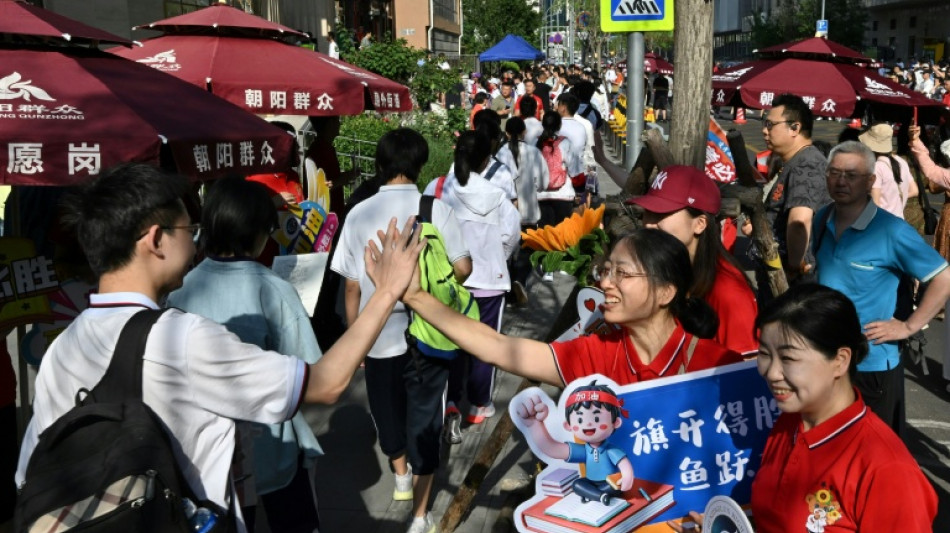
Hopeful parents accompanied their teenage children to the gates of a busy Beijing test centre on Saturday, among millions of high school students across China sitting their first day of the highly competitive university entrance exam.
Nationwide, 13.35 million students have registered for the multi-subject "gaokao" series this year, according to the Ministry of Education, down from last year's record-high 13.42 million test takers.
Outside the central Beijing secondary school, a proud parent who gave her name as Chen said "12 years of hard work have finally led to this moment" -- as she waved a fan in front of her daughter while the student reviewed her notes one last time before the test.
"We know our kids have endured so much hardship," Chen told AFP, adding that she was not nervous.
"I'm actually quite excited. I think my child is excellent, and I'm sure she will get the best score," she said.
China's gaokao requires students to use all their knowledge acquired to this point, testing them on subjects including Chinese, English, mathematics, science and humanities.
The exam results are critical for gaining admission to university -- and determining whether they will attend a prestigious or more modest institution.
While teachers and staff offered students their support, holding up signs of encouragement, some test takers, dressed in school uniforms, appeared panicked, including a girl with tears in her eyes.
"There's no need for us parents to add pressure. The children are already under a lot of it," said a woman named Wang, whose son had just entered the exam hall.
Like many mothers, she wore a traditional Chinese qipao in hopes of bringing good luck.
"I hope my son achieves immediate success and gets his name on the (list of high-scoring candidates)," Wang said with a smile.
Higher education has expanded rapidly in China in recent decades as an economic boom pushed up living standards -- as well as parents' expectations for their children's careers.
But the job market for young graduates remains daunting.
As of April, 15.8 percent of people aged 16 to 24 living in urban areas were unemployed, according to the National Bureau of Statistics.
Due to this pressure, many Chinese students prepare for the gaokao from a young age, often with extra lessons after the regular school day.
- 'Safe gaokao' -
And every year education authorities are on guard against cheating and disruptions during the exam.
This week, China's Vice Premier Ding Xuexiang called for a "safe gaokao", stressing the importance of a rigorous campaign against cheating.
Areas around exam centres are closely guarded by police, with road lanes closed to traffic and several cities banning motorists from honking their horns so as not to disrupt the concentration of students.
In some schools, facial recognition is even used to prevent fraud.
While the university admission rate for gaokao test takers has exceeded 80-90 percent in recent years, many students disappointed with their results choose to repeat the exam.
As there is no age limit for the test, some have become notorious for attempting the exam dozens of times, either after failing it or not getting into their top-choice university.
One teacher at the Beijing school where parents saw off their children on Saturday estimated that only about 10 of the approximately 600 final-year students there would earn a place at one of the capital's top universities.
Jiang, a final-year high school student who only gave one name, said he dreamt of attending a Beijing university, and was remaining calm shortly before his Chinese exam.
"Even though the pressure is intense, it's actually quite fair," he told AFP.
"I feel like all the preparations that needed to be made have been made, so there's really no point in being nervous now, right?
"Whatever happens, happens. It's truly not something I can completely control."
F.Wagner--VB