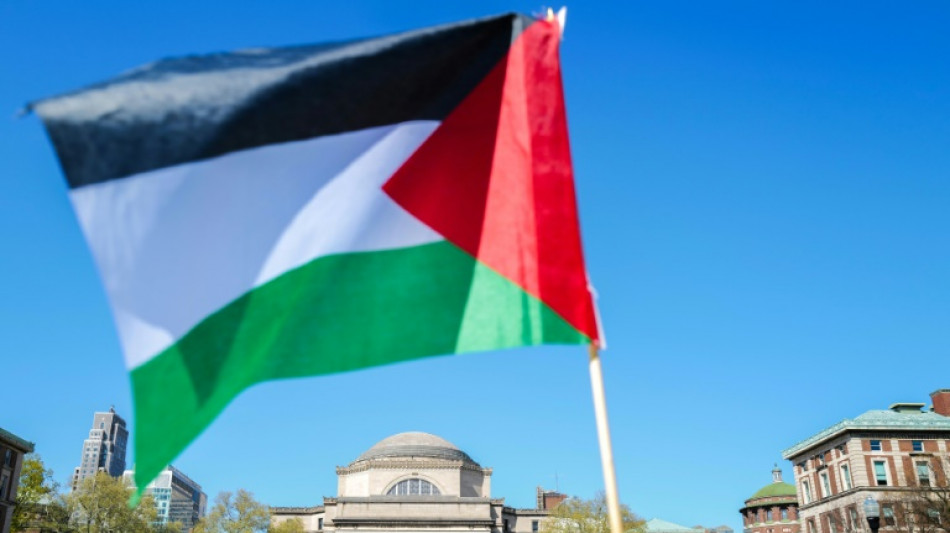
US student protesters dig in as Israel-Hamas war grinds on / Photo: © AFP

 Colombian judge bans strikes on guerrillas if minors are present

 Khachanov shocks ailing Auger-Aliassime, Swiatek and Osaka advance at US Open

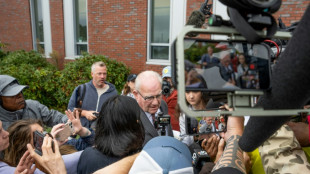 Lone juror blocking verdict in US mother's child murder trial: defense

 'Kinda chic' - Williams sisters set to launch US Open doubles bid

 Volkswagen says cutting 100,000 jobs by end of decade

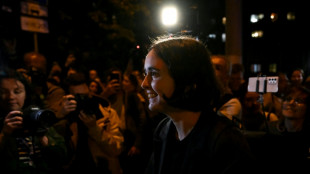 Russia slaps curfew on charity director over army criticism
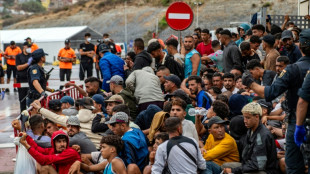
 Ailing Auger-Aliassime upset by Khachanov at US Open

 Richarlison omitted from Tottenham's Premier League squad

 How El Nino is choking the Panama Canal

 Hamilton drives his Ferrari dream at Monza

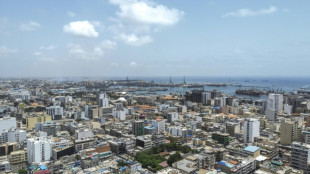 Senegal has an IMF loan, now what?

 Auger-Aliassime upset by Khachanov at US Open

 Hugging Face, the French start-up that became AI's warehouse
 World Cup winner Llorente retires from Spain team at 31

 Osaka squeezes into US Open third round

 Apple faces £2 bn lawsuit in UK over app privacy feature

 Former champ Swiatek eases into US Open third round

 DR Congo latest to promise moving Israel embassy to Jerusalem

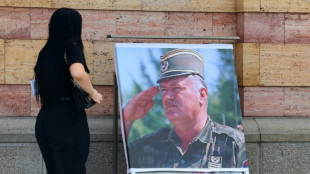 War criminal Mladic's body returns to Serbia with military honours

 Pierre Cardin museum brings designer's futurist style to Venice

 Slovenian rookie Omrzel triumphs as Mas extends Vuelta lead
 British, French leaders talk migrants, EU relations
 Heading for Ferrari's home race, Leclerc still dreams of world title

 Cafe at centre of Israel culture clash agrees to shut on Sabbath

 Spacecraft bound for Mercury begins 'tricky' arrival
Yazen has slept on Columbia University's south lawn almost every night for more than a week now, one of several dozen students living at the prestigious school's "Gaza Solidarity Encampment."
The 23-year-old Palestinian-American has been splitting his days between his medical studies at Columbia's historic Butler Library, adjacent to the smooth green lawn, and the upkeep of the colorful tents on the school's main campus, in the heart of New York City.
Since last Monday, dozens of students and alumni have come together to express solidarity with Palestinians in Gaza, where Israel is waging war against militant group Hamas.
They are demanding Columbia divest from companies with ties to Israel -- and the demonstrations are spreading to other campuses around the United States.
A burgeoning number of protesters now keep vigil daily at Colombia, though numbers ebb and flow from the dozens to the hundreds as students join just for the day, leave to study -- or, in Yazen's case, go home to feed his cat.
"Millions of Palestinians in Gaza are sleeping out in the cold every single night without access to food and shelter," said Yazen, who did not give his surname.
"We have tents, they don't have tents," he said.
He's determined to stay, even after the university last week called in the police, leading to the arrest and suspension of more than 100 students.
"As a Palestinian, is it my responsibility to be here and show my solidarity with the people in Gaza? Absolutely," Yazen said.
- School 'made it worse' -
Universities have become the focus of intense cultural debate in the United States since Hamas's October 7 attack and Israel's overwhelming military response, as a humanitarian crisis grips the Palestinian territory of Gaza.
The protest at Colombia has hosted speakers and music performances, Islamic prayers and seder meals for the Jewish holiday of Passover, which began Monday.
But the Middle East conflict is inflammatory in the United States, and as the death toll in Gaza rises -- and university authorities up the pressure on the demonstrators to dismantle the encampment -- the mood on campus has become uneasy.
This week, in-person classes at Columbia were cancelled.
University authorities are caught between condemning anti-Semitism while allowing the protesters to exercise free speech.
But it is a thin line. Tensions reached their peak last week when university authorities called in the police, but it is not just the demonstrators who are feeling the heat.
Melissa Saidak, a Jewish graduate student at Columbia's School of Social Work, said the protest has also drawn throngs of more aggressive and often violent outsiders to Colombia's gates.
"A person was yelling at me, screaming at me, calling me a Zionist and a murderer. They were banging a pot or something," said Saidak, who wears a dog tag in solidarity with Israeli hostages in Gaza and Star of David around her neck.
"It was causing me a lot of physical pain, this was just me trying to get home."
She thinks Columbia is not doing enough to protect Jewish students -- particularly with being transparent and explicit about the harm done to them.
"School has continued to make it a lot worse," she said.
- 'What's necessary' -
University president Minouche Shafik had set a deadline of midnight Tuesday to resolve the unrest.
Immediately after that announcement, which came near midnight, hundreds more people flocked to the protest, their numbers spilling over the sidewalks and another lawn.
In a frenzied confusion, demonstrators rushed to clear the camp, carrying half-disassembled tents and bags of supplies away.
But then the deadline was extended for another 48 hours. By Wednesday morning the encampment had returned to regular programming.
For now -- despite the new looming deadline -- it shows no sign of letting up.
D.P., a 22-year-old student who only gave her initials and works security for the encampment, is among those who've decided to stay.
"It seems clear to me that it's what's necessary for this right now," she said.
"I can't stand the thought of not being at camp," she said. "I think that this whole place is only working because everyone is putting everything they have into it."
I.Stoeckli--VB