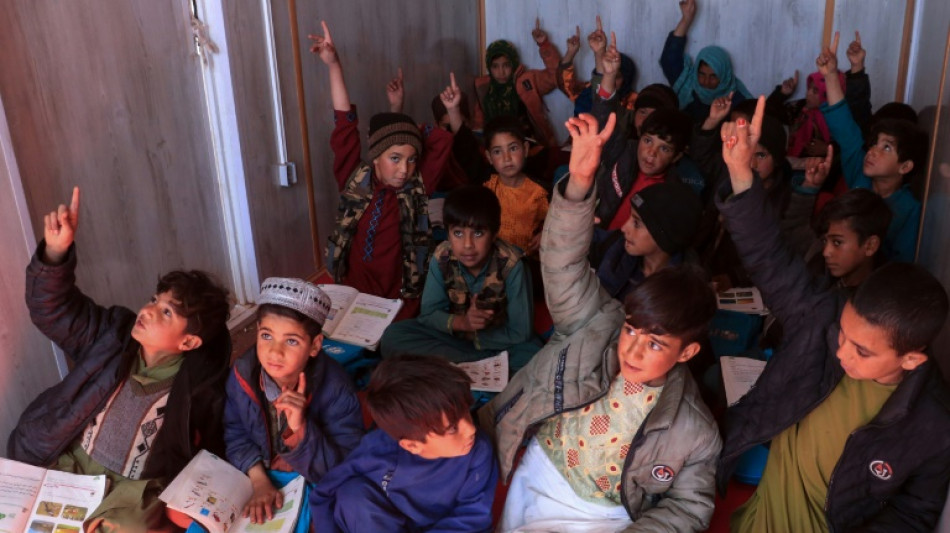
Afghan kids learn in makeshift schools six months after major quake / Photo: © AFP

 Colombian judge bans strikes on guerrillas if minors are present

 Khachanov shocks ailing Auger-Aliassime, Swiatek and Osaka advance at US Open

 Lone juror blocking verdict in US mother's child murder trial: defense

 'Kinda chic' - Williams sisters set to launch US Open doubles bid

 Volkswagen says cutting 100,000 jobs by end of decade

 Russia slaps curfew on charity director over army criticism

 Ailing Auger-Aliassime upset by Khachanov at US Open

 Richarlison omitted from Tottenham's Premier League squad

 How El Nino is choking the Panama Canal

 Hamilton drives his Ferrari dream at Monza

 Senegal has an IMF loan, now what?

 Auger-Aliassime upset by Khachanov at US Open

 Hugging Face, the French start-up that became AI's warehouse
 World Cup winner Llorente retires from Spain team at 31

 Osaka squeezes into US Open third round

 Apple faces £2 bn lawsuit in UK over app privacy feature
 Former champ Swiatek eases into US Open third round

 DR Congo latest to promise moving Israel embassy to Jerusalem

 War criminal Mladic's body returns to Serbia with military honours

 Pierre Cardin museum brings designer's futurist style to Venice

 Slovenian rookie Omrzel triumphs as Mas extends Vuelta lead
 British, French leaders talk migrants, EU relations
 Heading for Ferrari's home race, Leclerc still dreams of world title
 Cafe at centre of Israel culture clash agrees to shut on Sabbath

 Spacecraft bound for Mercury begins 'tricky' arrival
Children sit shoulder to shoulder crammed in rows on the floor of a shipping container with lesson books in their laps, the remains of their school unrepaired in the six months since a major earthquake devastated their village in western Afghanistan.
Hundreds of schools are still damaged since a series of strong quakes jolted Afghanistan's Herat province in October, with many students returning to lessons in tents and containers in March, according to the Herat education department.
Girls and boys in the village of Nayeb Rafi in Zindah Jan district studied in a packed container tucked between tents and small, blue homes newly built on a barren stretch of land.
"I really want to study, to have a school, and become a teacher to teach my friends," said 11-year-old Siyah Gul.
She wants to make the most of her lessons in the makeshift classroom before she is soon excluded under Taliban government rules which bar girls and women from secondary education and universities.
The October quake killed more than 1,500 people and damaged or destroyed more than 63,000 homes, according to an assessment published in February by the United Nations, the European Union and the Asian Development Bank.
Many people are still living in tents and temporary shelters, the World Health Organization said in February.
Education is the second-most affected sector, the report said, with nearly 300 public schools and other learning centres damaged and 180,000 students facing learning disruptions.
- 'Completely destroyed' -
In the village of Chahak, deep cracks scar the walls and ceilings of its pale blue schoolhouse. Broken windows still hang from their hinges and piles of dust fill the corners of classrooms.
"Chahak village was completely destroyed by the earthquake and we still haven't been provided with permanent shelters," said teacher Mohammad Naseem Nasrat.
"Our school too, which was wrecked by the earthquake, has not been restored so far. I don't know if there are plans to or not," said the 25-year-old, adding that the village's children "face an uncertain future" without proper schools.
Decades of conflict have devastated Afghanistan's education system, with an estimated 3.7 million children out of school, 60 percent of them girls, according to the UN children's agency UNICEF.
Poverty and access to schools in remote areas are major hurdles, while cultural norms often prevent girls from attending school.
One in five children aged between five and 17 are engaged in child labour, according to the United Nations, in a country facing deep economic, humanitarian and climate crises.
Eleven-year-old Sefatullah's school in Kashkak village was destroyed by the recent quakes.
"We don't have books and notebooks to study and write in," he said.
Four children were killed when the school collapsed, said teacher Mohammad Dawood, who now gives lessons in a framed tent with a large UNICEF logo on the outside.
The makeshift school serves two villages, six classes and has only one teacher -- Dawood.
"On days when it is windy or raining, we are in big trouble, we can't carry on with this situation for much longer," he said.
C.Stoecklin--VB