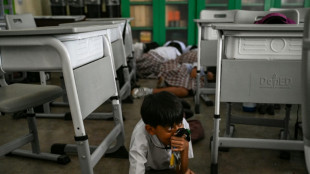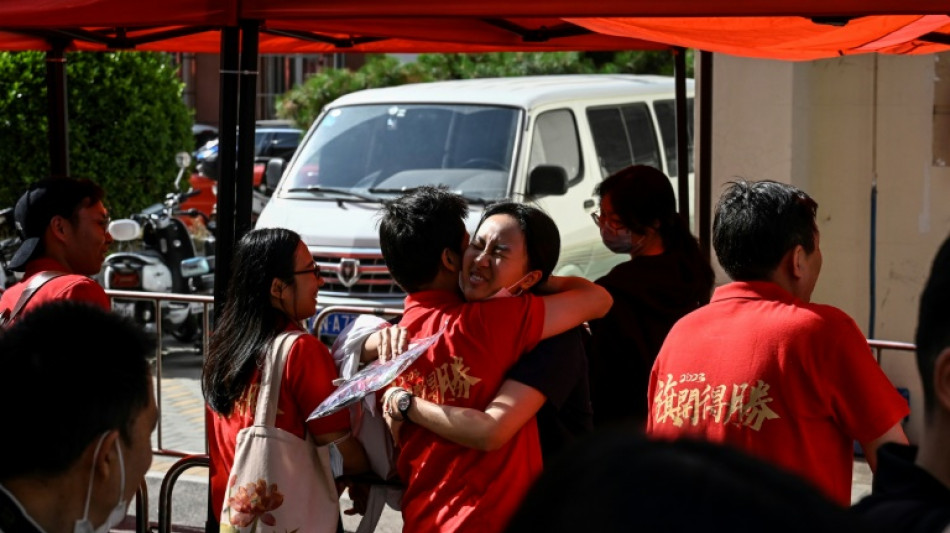
Millions of Chinese students sit gruelling college entrance exams / Photo: © AFP

 Colombian judge bans strikes on guerrillas if minors are present

 Khachanov shocks ailing Auger-Aliassime, Swiatek and Osaka advance at US Open

 Lone juror blocking verdict in US mother's child murder trial: defense
 'Kinda chic' - Williams sisters set to launch US Open doubles bid

 Volkswagen says cutting 100,000 jobs by end of decade

 Russia slaps curfew on charity director over army criticism

 Ailing Auger-Aliassime upset by Khachanov at US Open

 Richarlison omitted from Tottenham's Premier League squad

 How El Nino is choking the Panama Canal

 Hamilton drives his Ferrari dream at Monza

 Senegal has an IMF loan, now what?

 Auger-Aliassime upset by Khachanov at US Open

 Hugging Face, the French start-up that became AI's warehouse
 World Cup winner Llorente retires from Spain team at 31

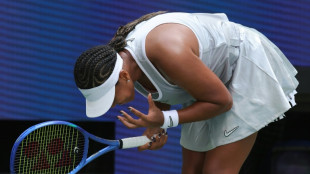 Osaka squeezes into US Open third round
 Apple faces £2 bn lawsuit in UK over app privacy feature
 Former champ Swiatek eases into US Open third round

 DR Congo latest to promise moving Israel embassy to Jerusalem

 War criminal Mladic's body returns to Serbia with military honours

 Pierre Cardin museum brings designer's futurist style to Venice

 Slovenian rookie Omrzel triumphs as Mas extends Vuelta lead

 British, French leaders talk migrants, EU relations

 Heading for Ferrari's home race, Leclerc still dreams of world title

 Cafe at centre of Israel culture clash agrees to shut on Sabbath

 Spacecraft bound for Mercury begins 'tricky' arrival
Millions of Chinese students sit for notoriously tough college entrance exams on Wednesday, the first since the country lifted zero-Covid rules that forced classes online for months on end.
China's education ministry says a record nearly 13 million students are registered to take the exams -- known as "gaokao" -- this year.
"I've been waking up at 4 am every day, except on Sundays, to study for the past four years," Jesse Rao, a 17-year-old high school senior in Shenzhen, told AFP.
"I've done everything I can, but I still feel a bit nervous."
In Beijing, nervous parents gathered around exam halls as their children knuckled down, many wearing red for good luck.
Zhang Jing, a mother in her forties, compared herself to Bai Suzhen, a character in Chinese folklore who is locked in a tower until her son passes an important test.
"My son is quite relaxed, I think I am more nervous than him," Jing, sporting a red qipao, a traditional Chinese dress, told AFP.
"I have been accompanying my son and instructing his study from the first grade of elementary school to the first year of high school," she explained.
"After the exam, I'll be completely relaxed."
- 'I struggled' -
Testing high school students on their Chinese, English, mathematics and other science or humanities subjects of their choice, the exams are critical to landing coveted spots at China's top universities.
Many parents shell out hundreds of dollars a month on cram schools or hire graduate students to sit with their children while they study late into the night.
Adding to the stress, this year's exam-takers have spent the bulk of their high school years under pandemic restrictions, which abruptly ended in December.
"I struggled to follow online lessons last year," Katherina Wang, a high school student from Shanghai who has been through two snap lockdowns in the past two years, told AFP.
"Our teachers held extra classes in the evenings and on weekends and helped us to catch up!"
The high stakes have led to elaborate attempts at cheating, from parents hiring graduate students to take the test on behalf of their children to exam-takers carrying electronic devices to communicate with experts outside.
Several provinces this year have installed scanners with facial-recognition capabilities to ensure that candidates do not hire proxies to take the test on their behalf, the state-run Global Times reported.
The scanners will also detect "electronic equipment such as (hidden) cell phones, earpieces and electronic watches" that can be used for cheating, the newspaper said.
- 'I will try again' -
Exams can last up to four days, depending on the province, taking between 60 to 150 minutes per subject.
The maximum score is 750, with over 600 required for a place at the country's top-tier universities -- for years a ticket to personal and professional success in China.
Very few make the cut: Last year, only three percent of exam-takers in the country's most populous province of Guangdong scored over 600.
And for students with more modest ambitions, scores still play a critical role in securing spots in universities and what subjects can be taken.
For those that do not get the results they need, there is always next year -- in 2021, 17 percent of students nationwide retook their gaokao.
"If I don't get the results I want, I will try again," Benjamin Zhu, a high school senior from Guangzhou, told AFP.
T.Bondarenko--BTB