Russia's Asia pivot spurs boom in Chinese classes / Photo: © AFP

 Colombian judge bans strikes on guerrillas if minors are present

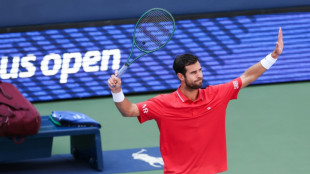
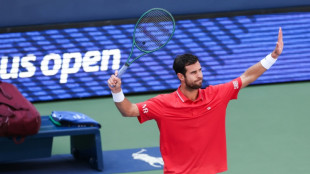 Khachanov shocks ailing Auger-Aliassime, Swiatek and Osaka advance at US Open

 Lone juror blocking verdict in US mother's child murder trial: defense
 'Kinda chic' - Williams sisters set to launch US Open doubles bid

 Volkswagen says cutting 100,000 jobs by end of decade

 Russia slaps curfew on charity director over army criticism

 Ailing Auger-Aliassime upset by Khachanov at US Open

 Richarlison omitted from Tottenham's Premier League squad
 How El Nino is choking the Panama Canal

 Hamilton drives his Ferrari dream at Monza

 Senegal has an IMF loan, now what?

 Auger-Aliassime upset by Khachanov at US Open
 Hugging Face, the French start-up that became AI's warehouse
 World Cup winner Llorente retires from Spain team at 31

 Osaka squeezes into US Open third round

 Apple faces £2 bn lawsuit in UK over app privacy feature

 Former champ Swiatek eases into US Open third round

 DR Congo latest to promise moving Israel embassy to Jerusalem

 War criminal Mladic's body returns to Serbia with military honours

 Pierre Cardin museum brings designer's futurist style to Venice

 Slovenian rookie Omrzel triumphs as Mas extends Vuelta lead

 British, French leaders talk migrants, EU relations

 Heading for Ferrari's home race, Leclerc still dreams of world title

 Cafe at centre of Israel culture clash agrees to shut on Sabbath

 Spacecraft bound for Mercury begins 'tricky' arrival

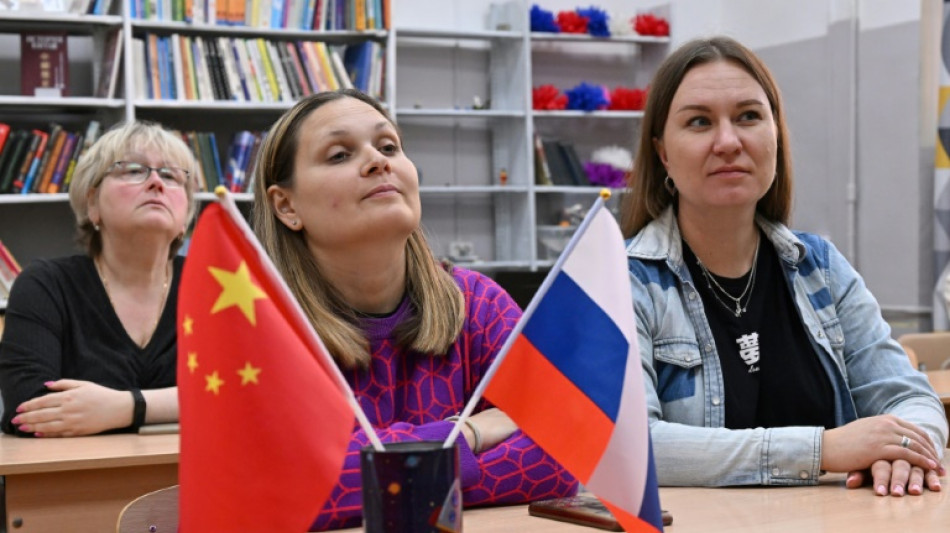
Every Sunday, Chinese tutor Kirill Burobin begins work in the early morning and is kept busy until midnight.
As Russia seeks to tighten ties with China amid Moscow's military campaign in Ukraine, the number of Burobin's students has tripled over the past year.
"Sunday is the busiest," 20-year-old Burobin, who makes a good living with his online lessons, told AFP.
"I have 16 hours of classes virtually without a break."
The boom in demand for Chinese lessons in Russia illustrates the country's pivot towards Asia as tensions build between Moscow and the West.
Chinese President Xi Jinping's three-day visit to Russia beginning Monday aims to deepen what the two countries have called a "no-limits" relationship, which is increasingly important for Russia as its international isolation deepens.
Pummelled by multiple rounds of Western sanctions, Russia's economic and technological development is becoming more dependent on China.
Natalia Danina, a manager at HeadHunter, the country's top online recruitment company, said that last year there were nearly 11,000 vacancies requiring knowledge of the Chinese language, a 44 percent increase compared to 2021.
Over the same period, the number of jobs for Chinese speakers in Russia has doubled in sales, transport and logistics, said Danina, pointing to an "accelerated transition" to Chinese-made equipment and spare parts.
Demand for Chinese speakers in energy jobs has tripled, she added.
- 'Just the start' -
Burobin, who also studies Eastern civilisations at a top Moscow university, said that he was happy to help his students learn more about "a whole new world".
"Russians are taking up Chinese because Beijing has become our main partner for decades to come," he said.
"And this is just the beginning."
In August, Avito, Russia's leading online classified ads platform, reported a 138 percent increase in requests for Chinese lessons in Moscow in one year.
The same figure stood at 350 percent for the far eastern city of Vladivostok.
The popularity of Chinese classes might be starting to catch up with demand for English lessons in the country.
Alina Khamlova, 26, who teaches both languages, said she had only three English language students this year, compared to 12 who are learning Chinese.
One of her students is Maria, a 22-year-old designer who dreams of travelling to China to make her clothes there because it is "cheaper than in Russia".
Another student is a 25-year-old gym coach, Ivan, who wants to work in China because Europeans "are paid very well" there.
Khamlova also said that many young people in Russia hope to study in Chinese universities now that many European establishments had become "inaccessible to them".
While English still retains a dominant position, the number of high school students who chose Chinese as a foreign language during their final school exams has doubled in one year to 17,000, according to the state education watchdog Rosobrnadzor.
- 'No one will defeat us' -
Russia's growing isolation from the West has prompted many language schools to revise their curricula and invite teachers of the Chinese language.
Founded in 2017, the ChineseFirst language centre has seen twice as many registrations this year, said its co-founders, Wang Yinyu, 38, and his Russian wife Natalia, a 33-year-old Chinese speaker.
Wang's family business is booming, and he is planning to open two new branches and a kindergarten in Moscow.
In Russia, "many companies have rushed to Chinese factories to order goods that have become unavailable in Russia due to sanctions," he told AFP in Russian.
And Chinese entrepreneurs, who are interested in exporting to Russia, are looking for bilingual employees.
Wang is glad that China and Russia are becoming closer.
"China has powerful industry and Russia is rich in resources, which means that our two countries can build their own internal economy," he said.
"If we stand back-to-back, no one will defeat us."
G.Schulte--BTB