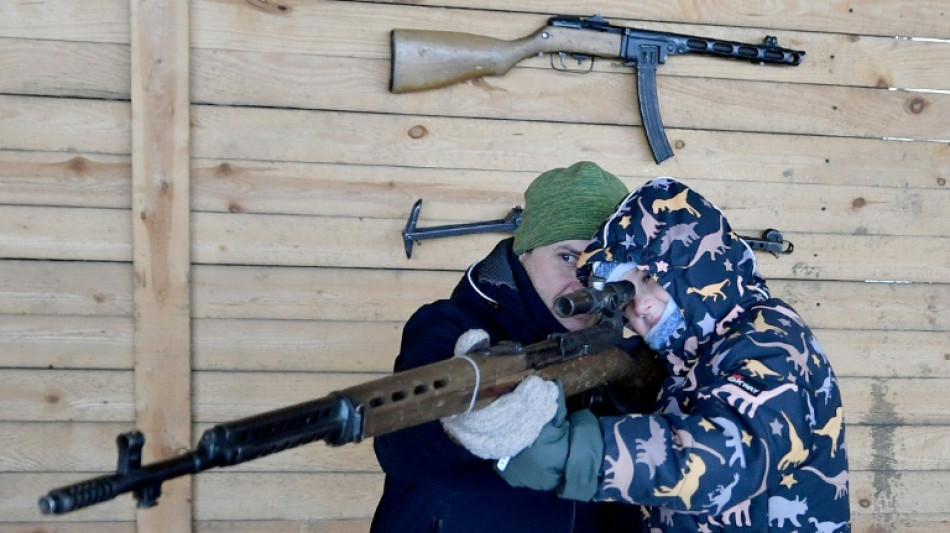
'Existential war': Putin steels Russia for long conflict / Photo: © AFP

 Colombian judge bans strikes on guerrillas if minors are present
 Khachanov shocks ailing Auger-Aliassime, Swiatek and Osaka advance at US Open
 Lone juror blocking verdict in US mother's child murder trial: defense
 'Kinda chic' - Williams sisters set to launch US Open doubles bid
 Volkswagen says cutting 100,000 jobs by end of decade
 Russia slaps curfew on charity director over army criticism
 Ailing Auger-Aliassime upset by Khachanov at US Open
 Richarlison omitted from Tottenham's Premier League squad
 How El Nino is choking the Panama Canal
 Hamilton drives his Ferrari dream at Monza
 Senegal has an IMF loan, now what?

 Auger-Aliassime upset by Khachanov at US Open
 Hugging Face, the French start-up that became AI's warehouse
 World Cup winner Llorente retires from Spain team at 31
 Osaka squeezes into US Open third round

 Apple faces £2 bn lawsuit in UK over app privacy feature
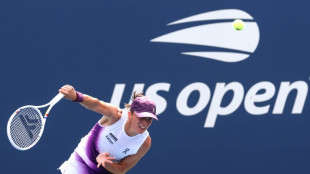 Former champ Swiatek eases into US Open third round
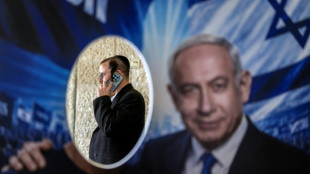
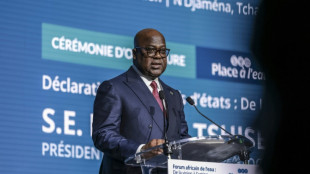 DR Congo latest to promise moving Israel embassy to Jerusalem
 War criminal Mladic's body returns to Serbia with military honours

 Pierre Cardin museum brings designer's futurist style to Venice
 Slovenian rookie Omrzel triumphs as Mas extends Vuelta lead
 British, French leaders talk migrants, EU relations
 Heading for Ferrari's home race, Leclerc still dreams of world title

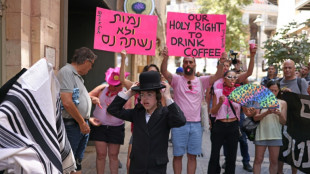 Cafe at centre of Israel culture clash agrees to shut on Sabbath
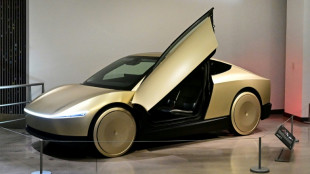
 Spacecraft bound for Mercury begins 'tricky' arrival
When Russia introduced patriotism classes in primary and secondary schools last September, Tatyana Chervenko decided she was not going to peddle Kremlin "propaganda" to her eighth-grade students in Moscow.
The 49-year-old used some of the classes to teach maths instead and ignored talking points pushed by the Kremlin about the conflict raging in Ukraine.
Chervenko was motivated by her concern that authorities were using Soviet-style tools to foster patriotism and militarise society -- just weeks before the Kremlin announced the first army call-up since World War II.
Her act of protest did not go unnoticed.
The school administration formally reprimanded her twice, and in October masked men showed up at her work, bundled her into a police vehicle and detained her for several hours.
In December, after resisting mounting pressure from her employers, Chervenko was fired.
"They want to produce little soldiers. Some little soldiers will go to war, other little soldiers will make ammunition and a third group will develop software to support those efforts," Chervenko told AFP.
"They are playing a long game."
- 'Radical transformation' -
Political analysts and sociologists say that one year after Russian President Vladimir Putin ordered troops into Ukraine, the Kremlin is putting society on a war footing and digging in for a years-long conflict.
Putin delivered his New Year's Eve address this year surrounded by uniformed personnel, and rallied Russians behind the offensive in Ukraine and confrontation with the West.
Sociologist Grigory Yudin said the Kremlin was preparing Russians for a "major, existential war" and the education system was being leveraged to meet that goal.
"We are talking about a radical, complete transformation of education to mobilise Russian youth for war," Yudin told AFP.
"Right now education has two functions -- propaganda and basic military training."
The patriotism classes -- dubbed "Important Conversations" -- combine World War II revisionism, lessons on Russian values and the Kremlin's narrative about Moscow's troops "protecting" compatriots in Ukraine.
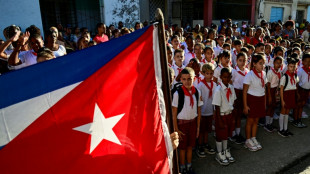
Schools have also been ordered to play the national anthem and hoist the flag at the start of each week.
The education ministry is expected in September to introduce courses in high schools and universities on handling Kalashnikov assault rifles and grenades, in an echo of Soviet times when these were curriculum staples.
Across Russia, schoolchildren are also being encouraged to send letters to Russian soldiers in Ukraine and make camouflage nets and candles for the trenches.
The government's sweeping campaign to boost patriotism within society is targeting adults, too.
Billboards hailing Russian soldiers and the letter Z -- Moscow's symbol for the assault -- are omnipresent across the country.
Putin has ordered cinema screenings of documentaries dedicated to the offensive in Ukraine.
And military journalists working for state media have gained celebrity status. One was selected to sit on the Kremlin's human rights council.
- 'Death cult' -
For years, Putin used World War II as a rallying cry for his political agenda, giving the Soviet Union's victory over Nazi Germany a cult-like status.
Now, state television and the Orthodox Church are building on that army pride and taking it to new heights.
"There is a glorification of war and elements of a death cult," Yudin said.
In September -- when Putin called up hundreds of thousands of reservists -- the head of the Russian Orthodox Church, Patriarch Kirill, said during a sermon that dying in Ukraine "washes away all sins".
One of the country's leading propagandists, Vladimir Solovyov, told Russians to stop fearing death.
"Life has been greatly overrated," he said on state television in January. "Why fear what's inevitable?"
For Andrei Kolesnikov, a senior fellow at the Carnegie Endowment for International Peace, these developments point to Russia's creeping return to totalitarianism.
The Kremlin's logic, Kolesnikov told AFP, is that "future generations should obediently implement the will of the state".
"This is no longer just an authoritarian state," he warned.
Sociologists say that the Kremlin's patriotic push is winning over many Russians, despite government plans to slash social spending and allocate an estimated third of the budget to defence and security this year.
- 'Military way of life' -
Putin supporter Nikolai Karputkin says he backs "the special military operation" in Ukraine, the Kremlin's official name for the conflict.
"We are at war with the West, with Western values, which they are trying to impose on us," Karputkin told AFP at a military-themed leisure park outside Saint Petersburg.
The 39-year-old -- who brought his family to the park, where children and their parents can ride battle tanks and handle weapons -- said he was also in favour of basic military training in schools.
"We have to boost patriotism," he said. "This is a good thing."
"We have to defend the traditional values and the sovereignty of our motherland."
Yudin, the sociologist, said Russian authorities would promote military and patriotic sentiment as long as they deemed necessary.
"The military way of life will last as long as Putin and his team are in the Kremlin," said Yudin.
"If they stay there for 20 years, then Russia will fight for 20 years."
W.Lapointe--BTB