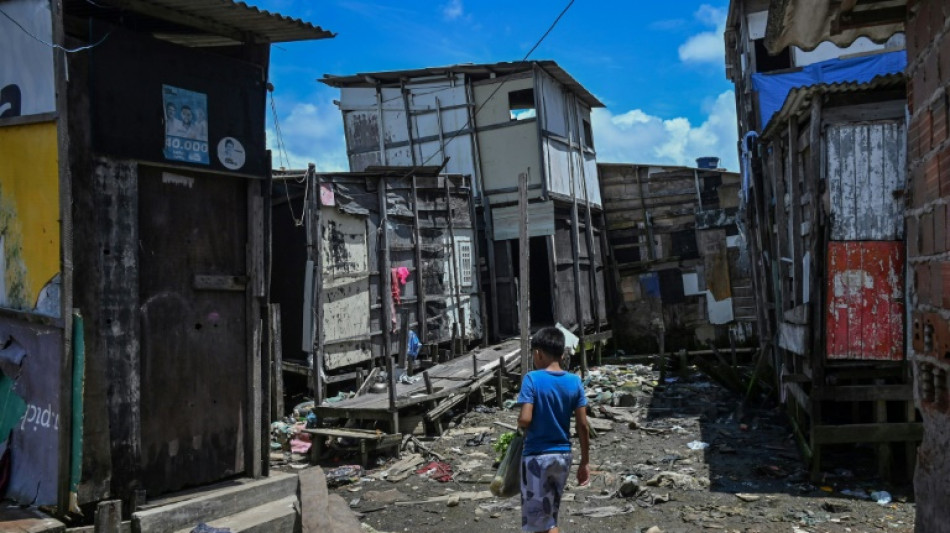
Extreme poverty rising in Latin America: UN / Photo: © AFP/File

 Penrith Panthers Face Backlash Over Decision to Disband Pantherettes Cheerleading Squad

 Make-A-Wish Announces 2026 Starblazer Award Honorees; Allied World Becomes First Corporate Founder

 Lee-Trump Golf Diplomacy Faces Diplomatic Dilemma Ahead of G20 Summit

 Mavericks Defeat Jazz 112-100 Behind Washington’s 26 Points and Second-Half Surge

 BingX: Major Announcement of Far-Reaching Significance

 James Blunt Scores First Number One Album in 19 Years; Wife Sofia Wellesley Celebrates

 UCLA Stays Unbeaten With Ty Dieffenbach's Heroic Return Against Illinois

Extreme poverty is likely to affect 82 million people in Latin America in 2022, an increase spurred by a slow pandemic recovery and high inflation, the UN economic commission for the region said Thursday.
"It has not been possible to reverse the impacts of the pandemic in terms of poverty and extreme poverty," said Jose Manuel Salazar-Xirinachs, executive secretary of the UN Economic Commission for Latin America and the Caribbean (ECLAC).
The figure represents 13.1 percent of the region's population, an increase from 12.9 percent in 2021.
Overall, 12 million more people are facing extreme poverty since 2019, before the Covid-19 pandemic.
Salazar-Xirinachs pointed to a "cascade of external shocks," namely a slowdown in economic growth, the weak recovery of the jobs market, and rising inflation.
The Santiago-based UN body said the extreme poverty figures were a "setback of a quarter of a century" for the region.
In October, the agency predicted higher-than-expected growth of 3.2 percent in the region. However, this is expected to halve in 2023 with a projected growth of 1.2 percent.
The UN body also highlighted the severe consequences the pandemic had on education in Latin America and the Caribbean, with an average of 70 weeks of school closures compared to 41 weeks elsewhere in the world.
The number of youths aged 18-24 who are not studying or working rose from 22.3 percent in 2019 to 28.7 percent in 2020.
R.Adler--BTB

