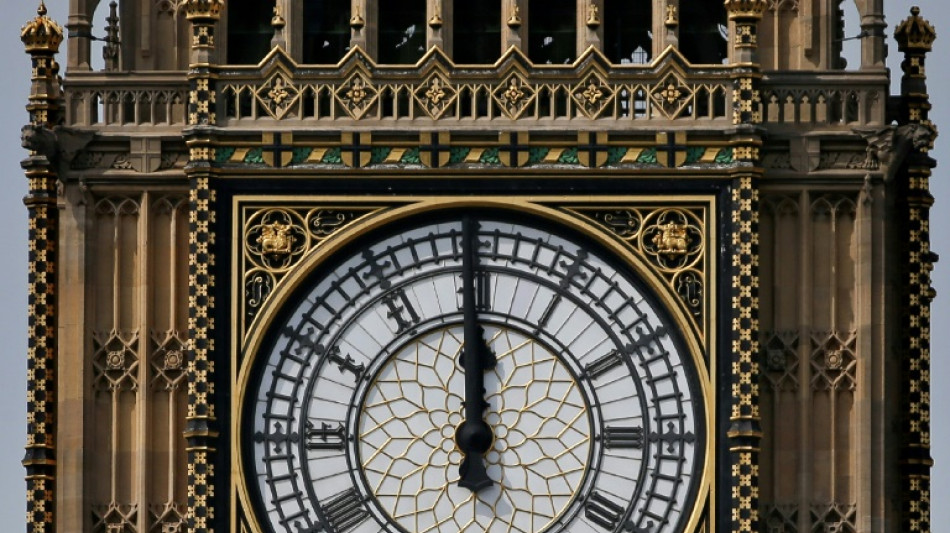
Global timekeepers vote to scrap leap second by 2035 / Photo: © AFP/File

 Japanese 11-year-old wins Asian Games eSports gold

 TikTok agrees to teen limits in US settlement following Meta

 Venezuela's oil cradle pins hopes on US energy deals

 US, China buy time with trade truce as pressure builds

 'Leo, Leo': Young Catholics give pope rockstar welcome in France

 Lula bans sports betting days ahead of Brazil's election

 Guatemala ensures survival of vulnerable 'fossil' fish

 Mancini finds positives in Italy loss, accepts fans' jeers

 Alcaraz helps Europe into Laver Cup lead

 Six missing after building collapses in historic Athens district

 Mbappe scores but suffers knee injury as Zidane gets debut France win
 Mancini's Italy return spoiled by Belgium defeat

 Rodri confident in Man City innocence despite reported charges

 Jay-Z rape accuser says she made 'false accusations'

 Senegal draw first match under Vieira and Nigeria survive scare

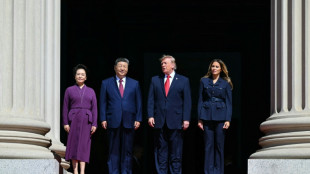
 Trump, Xi end summit long on pomp, but short on progress

 Russia not preparing for conflict with Europe, Putin says

 Trump's photo of Xi greeting carries signs of AI

 Six missing after building blast in historic Athens district

 Millions in US northeast brace for powerful storm
 Assefa seeks 'better than my best' at Berlin marathon

 US court refuses to overturn Pentagon ban on Anthropic

 Verstappen and Norris blame slow cars as Mercedes tops qualifying

 Crowds cheer pope in Paris after AI 'paradise of machines' warning

 Teen swimmer makes Games history as Thai, Chinese sprinters win gold

Scientists and government representatives meeting at a conference in France voted on Friday to scrap leap seconds by 2035, the organisation responsible for global timekeeping said.
Similar to leap years, leap seconds have been periodically added to clocks over the last half century to make up for the difference between exact atomic time and the Earth's slower rotation.
While leap seconds pass by unnoticed for most people, they can cause problems for a range of systems that require an exact, uninterrupted flow of time, such as satellite navigation, software, telecommunication, trade and even space travel.
It has caused a headache for the International Bureau of Weights and Measures (BIPM), which is responsible for Coordinated Universal Time (UTC) -- the internationally agreed standard by which the world sets its clocks.
A resolution to stop adding leap seconds by 2035 was passed by BIPM members and others at the 27th General Conference on Weights and Measures, which is held roughly every four years at the Versailles Palace west of Paris.
The head of BIPM's time department, Patrizia Tavella, said the "historic decision" would allow "a continuous flow of seconds without the discontinuities currently caused by irregular leap seconds".
"The change will be effective by or before 2035," she told AFP via email.
"The connection between UTC and the rotation of the Earth is not lost, UTC remains related to Earth," she said, adding that "nothing will change" for the public.
- A leap minute? -
Seconds were long measured by astronomers analysing the Earth's rotation, however the advent of atomic clocks -- which use the frequency of atoms as their tick-tock mechanism -- ushered in a far more precise era of timekeeping.
The problem is that Earth's slightly slower rotation means the two times are out of sync.
To bridge the gap, leap seconds were introduced in 1972, and 27 have been added at irregular intervals since -- the last in 2016.
Under the proposal, leap seconds will continue to be added as normal for the time being.
From around 2035, the difference between atomic and astronomical time will be allowed to grow to a larger value than one second, Judah Levine, a physicist at the US National Institute of Standards and Technology, told AFP.
"The larger value is yet to be determined," said Levine, who spent years helping draft the resolution alongside Tavella.
Negotiations will be held to find a proposal by 2035 to determine that value and how it will be handled, according to the resolution.
The breakdown of which countries voted for the resolution was not yet known, but the United States and France have been among those leading the way for the change.
Levine said it was important to protect UTC time because it is run by "a worldwide community effort" in the BIPM, which has 59 member states and consults with other nations.
GPS time, a potential UTC rival governed by atomic clocks, is run by the United States military "without worldwide oversight", Levine said.
A possible solution to the problem could be letting the discrepancy between the Earth's rotation and atomic time build up to a minute.
It is difficult to say exactly how often that might be needed, but Levine estimated anywhere between 50 to 100 years.
Instead of then adding on a leap minute to clocks, Levine proposed a "kind of smear", in which the last minute of the day takes two minutes.
"The advance of a clock slows, but never stops," he said.
C.Meier--BTB