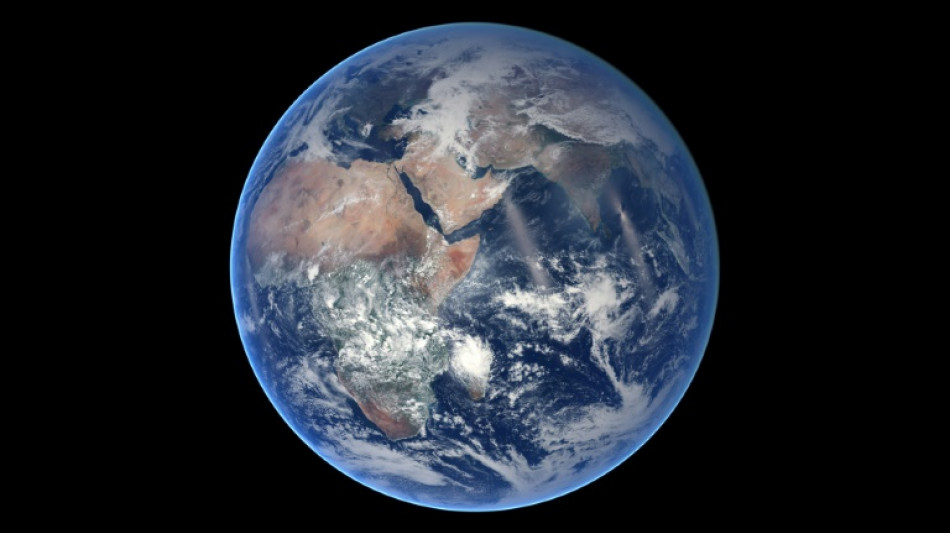
Earth now weighs six ronnagrams: New metric prefixes voted in / Photo: © NASA/AFP/File

 Japanese 11-year-old wins Asian Games eSports gold
 TikTok agrees to teen limits in US settlement following Meta

 Venezuela's oil cradle pins hopes on US energy deals

 US, China buy time with trade truce as pressure builds

 'Leo, Leo': Young Catholics give pope rockstar welcome in France

 Lula bans sports betting days ahead of Brazil's election

 Guatemala ensures survival of vulnerable 'fossil' fish
 Mancini finds positives in Italy loss, accepts fans' jeers

 Alcaraz helps Europe into Laver Cup lead

 Six missing after building collapses in historic Athens district

 Mbappe scores but suffers knee injury as Zidane gets debut France win
 Mancini's Italy return spoiled by Belgium defeat
 Rodri confident in Man City innocence despite reported charges

 Jay-Z rape accuser says she made 'false accusations'

 Senegal draw first match under Vieira and Nigeria survive scare

 Trump, Xi end summit long on pomp, but short on progress
 Russia not preparing for conflict with Europe, Putin says

 Trump's photo of Xi greeting carries signs of AI

 Six missing after building blast in historic Athens district
 Millions in US northeast brace for powerful storm
 Assefa seeks 'better than my best' at Berlin marathon

 US court refuses to overturn Pentagon ban on Anthropic

 Verstappen and Norris blame slow cars as Mercedes tops qualifying

 Crowds cheer pope in Paris after AI 'paradise of machines' warning

 Teen swimmer makes Games history as Thai, Chinese sprinters win gold
Say hello to ronnagrams and quettametres: International scientists gathered in France voted on Friday for new metric prefixes to express the world's largest and smallest measurements, prompted by an ever-growing amount of data.
It marks the first time in more than three decades that new prefixes have been added to the International System of Units (SI), the agreed global standard for the metric system.
Joining the ranks of well-known prefixes like kilo and milli are ronna and quetta for the largest numbers -- and ronto and quecto for the smallest.
The change was voted on by scientists and government representatives from across the world attending the 27th General Conference on Weights and Measures, which governs the SI and meets roughly every four years at Versailles Palace, west of Paris.
The UK's National Physical Laboratory, which led the push for the new prefixes, confirmed that the resolution had passed in a statement.
The prefixes make it easier to express large amounts -- for example, always referring to a kilometre as 1,000 metres or a millimetre as one thousandth of a metre would quickly become cumbersome.
Since the SI was established in 1960, scientific need has led to a growing number of prefixes. The last time was in 1991, when chemists wanting to express vast molecular quantities spurred the addition of zetta and yotta.
A yottametre is a one followed by 24 zeroes.
But even the mighty yotta is not enough to handle the world's voracious appetite for data, according to Richard Brown, the head of metrology at the UK's National Physical Laboratory.
"In terms of expressing data in yottabytes, which is the highest prefix currently, we're very close to the limit," Brown told AFP.
"At the bottom end, it makes sense to have a symmetrical expansion, which is useful for quantum science, particle physics -- when you're measuring really, really small things."
- New weight of the world -
The new prefixes can simplify how we talk about some pretty big objects.
"If we think about mass, instead of distance, the Earth weighs approximately six ronnagrams," which is a six followed by 27 zeroes, Brown said.
"Jupiter, that's about two quettagrams," he added -- a two followed by 30 zeros.
Brown said he had the idea for the update when he saw media reports using unsanctioned prefixes for data storage such as brontobytes and hellabytes. Google in particular has been using hella for bytes since 2010.
"Those were terms that were unofficially in circulation, so it was clear that the SI had to do something," he said.
However metric prefixes need to be shortened to just their first letter -- and B and H were already taken, ruling out bronto and hella.
"The only letters that were not used for other units or other symbols were R and Q," Brown said.
Convention dictates that the larger prefixes end in an A, and the smaller ones in an O.
And "the middle of the words are very, very loosely based on the Greek and Latin for nine and 10," Brown said.
The new prefixes should "future proof the system" and satisfy the world's need for higher numbers -- at least for the next 20 to 25 years, he added.
W.Lapointe--BTB