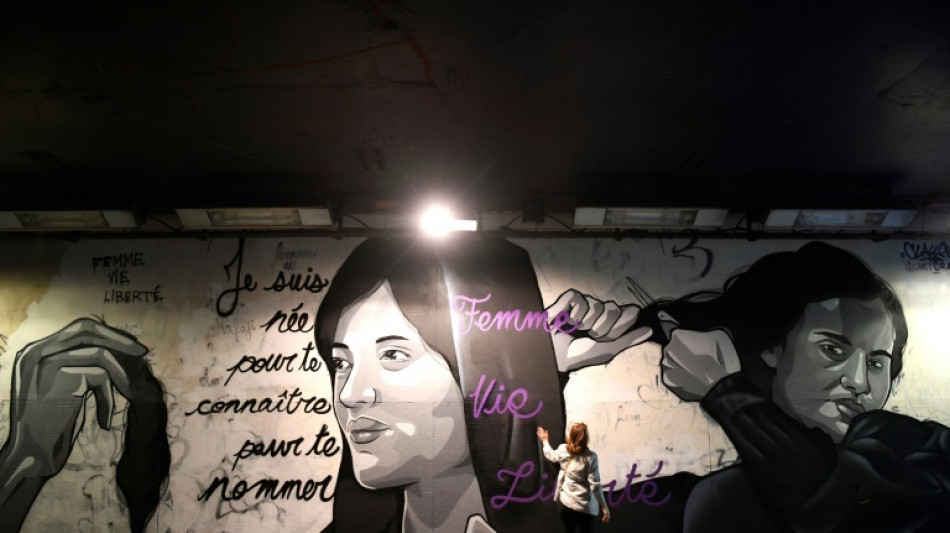
Iran's 'civil war' warning may presage bloodier crackdown: analysts / Photo: © AFP/File

 Japanese 11-year-old wins Asian Games eSports gold
 TikTok agrees to teen limits in US settlement following Meta
 Venezuela's oil cradle pins hopes on US energy deals
 US, China buy time with trade truce as pressure builds
 'Leo, Leo': Young Catholics give pope rockstar welcome in France

 Lula bans sports betting days ahead of Brazil's election
 Guatemala ensures survival of vulnerable 'fossil' fish
 Mancini finds positives in Italy loss, accepts fans' jeers
 Alcaraz helps Europe into Laver Cup lead
 Six missing after building collapses in historic Athens district
 Mbappe scores but suffers knee injury as Zidane gets debut France win
 Mancini's Italy return spoiled by Belgium defeat

 Rodri confident in Man City innocence despite reported charges

 Jay-Z rape accuser says she made 'false accusations'
 Senegal draw first match under Vieira and Nigeria survive scare
 Trump, Xi end summit long on pomp, but short on progress
 Russia not preparing for conflict with Europe, Putin says
 Trump's photo of Xi greeting carries signs of AI
 Six missing after building blast in historic Athens district
 Millions in US northeast brace for powerful storm
 Assefa seeks 'better than my best' at Berlin marathon
 US court refuses to overturn Pentagon ban on Anthropic
 Verstappen and Norris blame slow cars as Mercedes tops qualifying

 Crowds cheer pope in Paris after AI 'paradise of machines' warning

 Teen swimmer makes Games history as Thai, Chinese sprinters win gold
Iran has accused foreign foes of trying to spark "civil war" by stoking the protests over Mahsa Amini's death -- harsh language that, analysts warn, could presage an even bloodier crackdown.
Fears that Iran is sliding into deeper violence have grown since Wednesday, when assailants on motorcycles gunned down nine people -- including a woman and two boys aged nine and 13 -- in two mysterious attacks.
Officials in Iran were quick to accuse "terrorists" backed by its Western enemies of being behind the attacks in the southern cities of Izeh and Isfahan, which authorities said also left dead two security personnel.
It was the second attack the authorities have blamed on what they labelled terrorists since the protests erupted, after at least 13 people were killed at a shrine in Shiraz, another city in southern Iran, on October 26.
Analysts say however that, regardless of who carried out the latest attacks, they could result in an even bloodier response to the protests that erupted after Amini's death on September 16, following her arrest for an alleged breach of Iran's dress code for women.
"We don't have a good sense of what happened in Izeh and Isfahan -- was it a terrorist group, or potentially the regime itself?" said Henry Rome, an Iran expert at the Washington Institute.
"Either way, the government will probably use the attacks to send the message that the protests are undermining national security and opening the door for Western-backed terrorism," he told AFP.
"The government is likely attempting to tap into fears that Iran could be on the path to civil war and that stronger action is needed."
- 'Regime to exploit attacks' -
Following Wednesday's twin attacks, Iran's Foreign Minister Hossein Amir-Abollahian accused Israel and its Western allies of plotting a "civil war" in the Islamic republic.
Security services, Israel and Western politicians had "made plans for a civil war and the destruction and disintegration of Iran", he tweeted, adding that they "must know that Iran is not Libya or Sudan".
Fars news agency, which is affiliated with Iran's powerful Islamic Revolutionary Guard Corps, said Wednesday's attacks showed "those who want to dismantle the country are aiming to incite a civil war".
At least 342 people, including 43 children and 26 women, have been killed in the crackdown since Amini's death, the Norway-based group Iran Human Rights said Wednesday.
Protesters had been killed in 22 of Iran's 31 provinces, it said, including 123 in Sistan-Baluchistan and 32 in Kurdistan -- among the few provinces with a Sunni Muslim majority in the predominantly Shiite country.
The regime's crackdown in the wake of the attack in Izeh, a city in ethnically diverse Khuzestan province, "follows a broader trend line of greater police brutality in historically restive provinces, particularly those with large populations of marginalised ethnic minorities", said Kita Fitzpatrick, an Iran analyst at the Critical Threats Project of the American Enterprise Institute.
"Groups like the Islamic State -- which the regime blamed for the Izeh attack -- may very well be attempting to capitalise on protests to carry out attacks within Iranian borders," she told AFP.
But, she added, "some analysts are observing inconsistencies between recent attacks in Iran and typical IS attacks.
"The regime will likely seek to exploit these attacks, regardless, and leverage them to justify cracking down on ongoing unrest."
- 'Anger and rage' -
By adopting an even bloodier response, the regime risks radicalising a protest movement that until now has been led by women and has remained largely peaceful.
This week has seen an uptick in protesters fighting back, with an increasing number of videos posted on social media showing them clashing with security forces and torching their vehicles and bases.
"It's the state security forces that start the violence, but increasingly people respond... and try to defend themselves," said Omid Memarian, senior Iran analyst at Democracy for the Arab World Now (DAWN).
"The government's strategy has been to create an environment of fear and terror so that people go back home," he told AFP.
"They use violence on the streets and harsh sentences through the judiciary to stop the protests," but that approach had "intensified the anger and rage" of the people, Memarian said.
Independent researcher Mark Pyruz said the attacks on security forces on motorbikes, mob beatings of pro-government Basij paramilitary forces and close-quarter stoning of police officers "reminds me of the initial phase of the Syrian civil war".
"We don't have enough info yet on what's taking place in Iran" with respect to the shootings in Izeh and Isfahan, he said, adding however that "it's something to watch for, closely, during days ahead".
L.Dubois--BTB