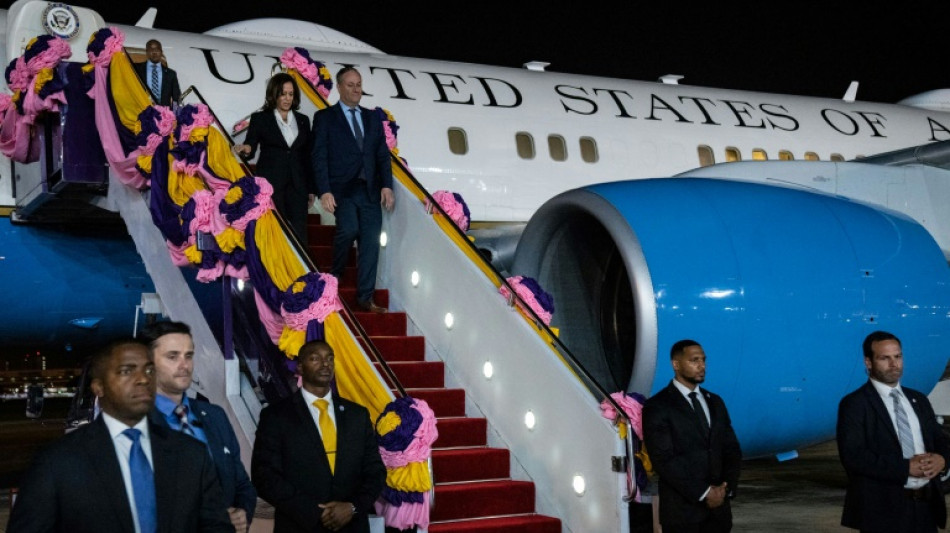
VP Harris tells Asia the US is 'here to stay' / Photo: © POOL/AFP

 Penrith Panthers Face Backlash Over Decision to Disband Pantherettes Cheerleading Squad

 Make-A-Wish Announces 2026 Starblazer Award Honorees; Allied World Becomes First Corporate Founder

 Lee-Trump Golf Diplomacy Faces Diplomatic Dilemma Ahead of G20 Summit
 Mavericks Defeat Jazz 112-100 Behind Washington’s 26 Points and Second-Half Surge

 BingX: Major Announcement of Far-Reaching Significance
 James Blunt Scores First Number One Album in 19 Years; Wife Sofia Wellesley Celebrates

Vice President Kamala Harris told Asian leaders on Friday that the United States is committed to the region for the long haul, rejecting doubts about its engagement as China expands its clout.
Addressing a summit in Bangkok, Harris called the United States a "proud Pacific power" and said that the longstanding US network of security alliances has allowed Asia to prosper.
"The United States is here to stay," Harris told business leaders on the sidelines of the Asia-Pacific Economic Cooperation (APEC) summit, also attended by Chinese President Xi Jinping.
"Our message is clear: The United States has an enduring economic commitment to the Indo-Pacific, one that is measured not in years, but in decades and generations," she said, using the preferred US term for the Asia-Pacific region.
President Joe Biden's administration has focused on rallying behind allies and Harris will head from Thailand to the Philippines, where she will visit an island near waters increasingly contested by Beijing.
While the United States has taken a firm tone on China, some Asian officials have questioned the level of US economic engagement.
Biden has largely followed his predecessor Donald Trump in turning the page on the era of free-trade agreements, seeing them as unpopular among working-class US voters.
Harris insisted that economic partnerships in Asia were "a top priority" for the Biden administration and pointed out that the US private sector invests around $1 trillion a year in the region.
"America is a strong partner to the economies and companies of this region because America is and will remain a major engine of global growth, reinforced by our administration's approach," she said.
She said that goal had bipartisan support, with Washington set for greater gridlock after the rival Republican Party won control of the House of Representatives in elections last week.
Biden on a trip to Tokyo earlier this year launched the Indo-Pacific Economic Framework, which brings together countries to set common standards on technology and trade in the face of China's rapid advances but stops short of lifting tariffs like a traditional free-trade deal.
"We are all feeling the discomfort and the anxiety of the global economy today," US Trade Representative Katherine Tai told reporters Thursday.
"We need different outcomes, and that means that we also need to be innovating in how we engage each other in trade and economics and across the board," she said.
Despite US vows of engagement, Biden skipped the APEC summit to attend his granddaughter's wedding at the White House on Saturday.
He attended two other summits in Asia over the past week, however, in Cambodia and Indonesia.
C.Kovalenko--BTB