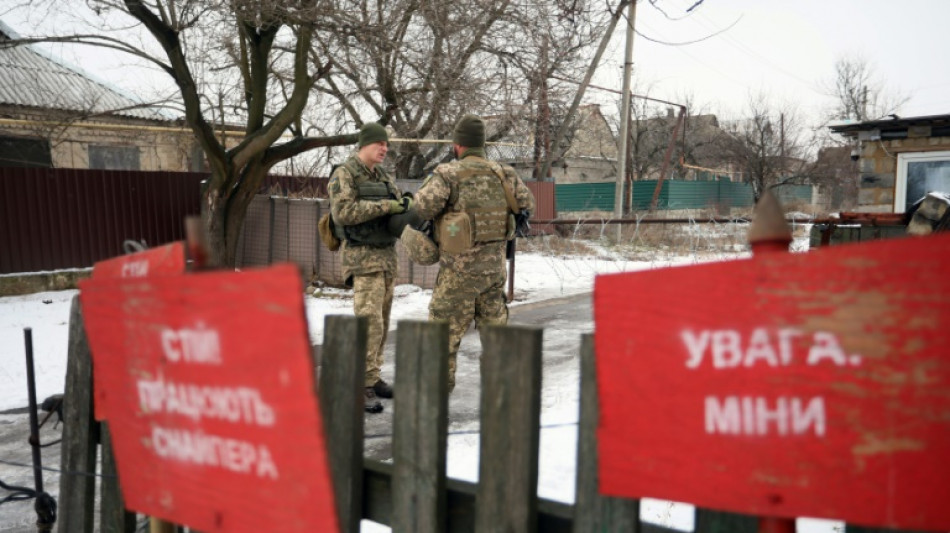
Russian mines in Ukraine 'greatest challenge' to landmark ban treaty / Photo: © AFP/File

 Japanese 11-year-old wins Asian Games eSports gold

 TikTok agrees to teen limits in US settlement following Meta

 Venezuela's oil cradle pins hopes on US energy deals

 US, China buy time with trade truce as pressure builds

 'Leo, Leo': Young Catholics give pope rockstar welcome in France

 Lula bans sports betting days ahead of Brazil's election

 Guatemala ensures survival of vulnerable 'fossil' fish
 Mancini finds positives in Italy loss, accepts fans' jeers

 Alcaraz helps Europe into Laver Cup lead

 Six missing after building collapses in historic Athens district

 Mbappe scores but suffers knee injury as Zidane gets debut France win

 Mancini's Italy return spoiled by Belgium defeat

 Rodri confident in Man City innocence despite reported charges

 Jay-Z rape accuser says she made 'false accusations'

 Senegal draw first match under Vieira and Nigeria survive scare
 Trump, Xi end summit long on pomp, but short on progress

 Russia not preparing for conflict with Europe, Putin says

 Trump's photo of Xi greeting carries signs of AI

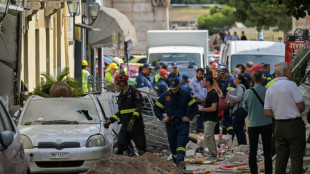 Six missing after building blast in historic Athens district

 Millions in US northeast brace for powerful storm

 Assefa seeks 'better than my best' at Berlin marathon

 US court refuses to overturn Pentagon ban on Anthropic

 Verstappen and Norris blame slow cars as Mercedes tops qualifying

 Crowds cheer pope in Paris after AI 'paradise of machines' warning

 Teen swimmer makes Games history as Thai, Chinese sprinters win gold
Russia's use of newly-produced landmines in Ukraine poses the greatest challenge to a landmark global ban treaty forged 25 years ago, a monitor said Thursday.
Moscow has developed new anti-personnel mines and used ones made as recently as 2021 in Ukraine, the Landmine Monitor said.
It said the use of landmines by Russia -- and by Myanmar -- marred the 25th anniversary of the Mine Ban Treaty, a pioneering accord struck in Ottawa in 1997.
The monitor's annual report identified 277 civilian casualties of mines and explosives in Ukraine in the first nine months of 2022 -- a near fivefold rise on the 58 in 2021.
"At least seven types of antipersonnel mines have been used by Russian forces in Ukraine since Russia invaded the country on February 24," it said.
The monitor said it had confirmed evidence that Russian troops had planted "victim-activated booby-traps and improvised explosive devices in Ukraine... prior to retreating and abandoning their positions".
"Scatterable mines" appear to have been used in several regions, many of which were under Russian control, it said.
"The greatest challenge to the emerging norm against these weapons can be seen in new use," it said.
"Landmines continue to kill and injure civilians, destroy livelihoods, deny land use, and disrupt access to essential services in more than 60 countries and territories."
A total of 164 countries are bound by the ban treaty and have jointly destroyed more than 55 million stockpiled anti-personnel mines.
Russia is not a signatory to the Mine Ban Treaty, while Ukraine is.
In 2021, at least 5,544 casualties were reported across 50 territories, of which 2,182 were fatal, it said.
The number of casualties was however down on the 7,073 recorded in 2020.
The all-time low of 3,456 was registered in 2013.
"Casualties from landmines and ERW (explosive remnants of war) have been disturbingly high for the past seven years," the report said.
"This trend is largely the result of increased conflict and contamination by improvised mines observed since 2015."
- Syria, Afghanistan worst-hit -
Syria witnessed the highest number of casualties in 2021 for the second straight year at 1,227.
It was closely followed at 1,074 by Afghanistan, which has had more than 1,000 annual casualties for over a decade.
Colombia, Iraq, Mali, Nigeria and Yemen also recorded more than 100 casualties last year.
Where the age, combat status and gender of victims were known, 76 percent of casualties were civilians -- of whom half were children. Males made up 81 percent of the victims.
Besides their use by the armed forces of Russia and Myanmar, landmines were deployed in 2021 by non-state armed groups in the Central African Republic, Colombia, the Democratic Republic of Congo, India and Myanmar.
The monitor said 11 countries were still producing anti-personnel mines: China, Cuba, India, Iran, Myanmar, North Korea, Pakistan, Russia, Singapore, South Korea and Vietnam.
This is one fewer than last year, following a US decision to prohibit their development, production, and acquisition.
There are approximately 45 million anti-personnel mines stockpiled worldwide.
Russia has the largest stockpile at 26.5 million, followed by fellow treaty non-signatories Pakistan with an estimated six million, India, China, and the United States, which has three million.
- 60 territories still mined -
Nearly 133 square kilometres (51 square miles) of land were cleared of landmines last year -- more than half of which were in Cambodia and Croatia.
Over 117,000 anti-personnel mines were destroyed, the report said.
But at least 60 territories are still riddled with anti-personnel mines, with only Sri Lanka and Zimbabwe currently seeming on target to meet clearance deadlines.
Assistance for victims was also inadequate, the report said.
"In 2021, healthcare and rehabilitation activities remained under-funded and faced increasing and numerous challenges," it said, adding that global support for demining decreased by seven percent to $598.9 million in 2021.
The 24th annual report was produced by the Landmine and Cluster Munition Monitor, the research and monitoring arm of the International Campaign to Ban Landmines and the Cluster Munition Coalition NGOs.
M.Odermatt--BTB