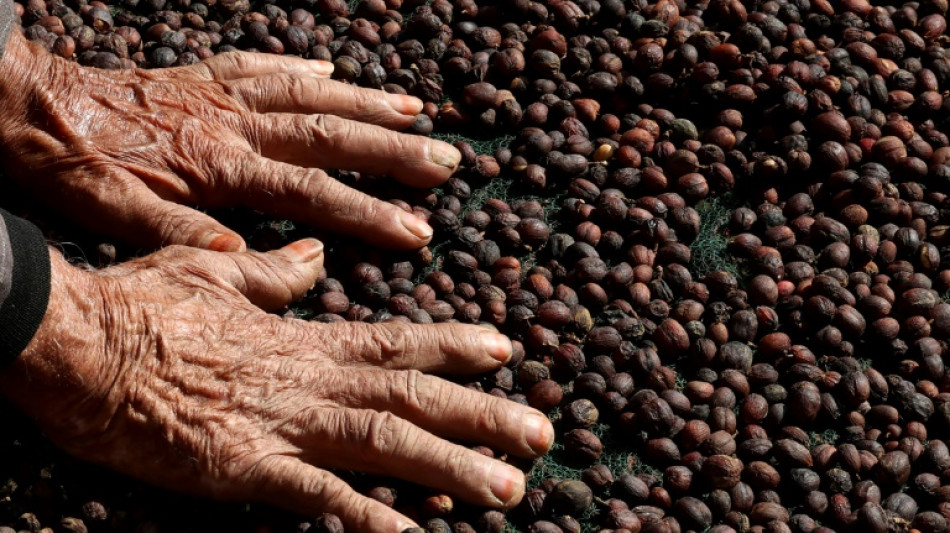
Saudi coffee legacy percolates through the generations / Photo: ©

 Germany's Merz vows to stay course despite new vote losses

 Man City outgun Sunderland despite Brobbey hat-trick, Man Utd rescue Fulham draw

 Mourinho blames ref committee for Real Madrid derby defeat

 Maresca craves a 1-0 win after eight-goal Man City thriller
 Atletico Madrid beat Real Madrid in tense derby clash
 Reusser retains world time-trial title

 Man City outgun Sunderland despite Brobbey hat-trick, Liverpool win at Bournemouth

 Top US, Chinese economic officials meet ahead of Trump-Xi summit

 Erdogan's LGBTQ crackdown 'first step of election campaign': activist
 Mass drone barrage on Moscow kills two

 82-year-old dies after beach fight in Greece over sun lounger

 US warns of rapid escalation in Mideast war

 Iran 'put hearts on the court' to win Asian Games basketball bronze

 School girl Yu helps China dominate in Asian Games swimming openers
 Myanmar win first Asian Games teqball gold as Spain great Puyol watches

 China's 13-year-old Yu scorches to first major gold at Asian Games
 Russians vote on last day of parliamentary elections

 Hong Kong pays final respects to former city leader Tung

 Typhoon put people off Asian Games opening ceremony, official says
 China's 13-year-old Yu cruises as Asian Games swimming begins

 AI 'warning shots' focus Beijing on national security risks

 Philippine tribe in limbo over US-led tech hub

 Leo XIV, first US pope transcends his restrained style

 Singer Ed Sheeran says Gaza situation 'unjustifiable' following controversy

 In 'Tenzing', a Sherpa mountaineer gets his due
For Farah al-Malki, growing coffee plants in Saudi Arabia's southwestern region of Jizan is more than just a profession. It is a family tradition passed down from generation to generation.
The 90-year-old patriarch has a long history with coffee, which spread from Ethiopia to Yemen and then to the rest of the Middle East around the 15th century.
"My father inherited it from his grandfathers, and I took over and passed it down to my sons and then on to my grandchildren," Malki told AFP, as he watched his male relatives prune trees.
Jizan is known for its red Khawlani coffee beans, often blended with cardamom and saffron to give a yellowish hue of coffee -- locally known as ghawa -- and a taste markedly different from the bitter black liquid drunk elsewhere in the Middle East and in the West.
It remains an integral part of Saudi culture, so much so that the government has designated 2022 as "The Year of Saudi Coffee".
Served with dates in homes and royal palaces across the kingdom, breaking barriers of societal hierarchy, ghawa is considered a symbol of hospitality and generosity.
Donning the traditional dress of coffee farmers, a dark "chemise" shirt and ankle-length skirt known as a "wizrah", along with a belt holding a dagger, Malki is still tending to the fields despite his age.
"The biggest issues we used to have were the lack of water and support," said Malki.
But with the kingdom's desire to diversify its economy away from oil, alongside a social shift to transform the country's ultra-conservative image and open up to visitors and investors, the government last month began a campaign to promote its coffee.
It instructed all restaurants and cafes to use the term "Saudi coffee" instead of Arabic coffee.
Saudi Aramco, the largely state-owned oil company, announced plans to establish a coffee centre in Jizan using "advanced irrigation techniques to improve agricultural capacity".
- UNESCO dream -
By the end of 2021, the kingdom had 400,000 coffee trees in 600 farms across the country, producing about 800 tonnes of coffee a year. That is a fraction of what Ethiopia produces but, according to domestic reports, Saudi Arabia plans to plant 1.2 million Khawlani trees by 2025.
Malki has nine sons, all of whom take part in the coffee industry, ranging from agriculture and packaging to transportation and marketing.
On the field every day is his 42-year-old son, Ahmed, who like his father is dressed in traditional farmer's clothing, complete with a headdress made of flowers.
He said he has an intimate knowledge of Khawlani coffee beans, explaining: "All farms are organic and free of chemicals."
They produce about 2.5 tonnes of coffee beans a year, selling for between $27-$40 a kilogram ($12-$18 a pound).
Historian Yahya al-Malki, who is not related to the farm family, told AFP that the "secret" to the Khawlani beans lies in their cultivation in the Jizan region, where it is warm, humid and rainy.
Saudi Arabia has sought to include its cultivation of Khawlani coffee on the list of "intangible cultural heritage of humanity" maintained by the United Nations cultural agency UNESCO.
This, Ahmed said, would be a dream come true.
"It will help in supporting farmers and preserving coffee trees as well as attracting foreign investors to the region," he told AFP.
"I hope to pass this on to my sons and their sons, and pray it be a source of livelihood for them."
T.Bondarenko--BTB