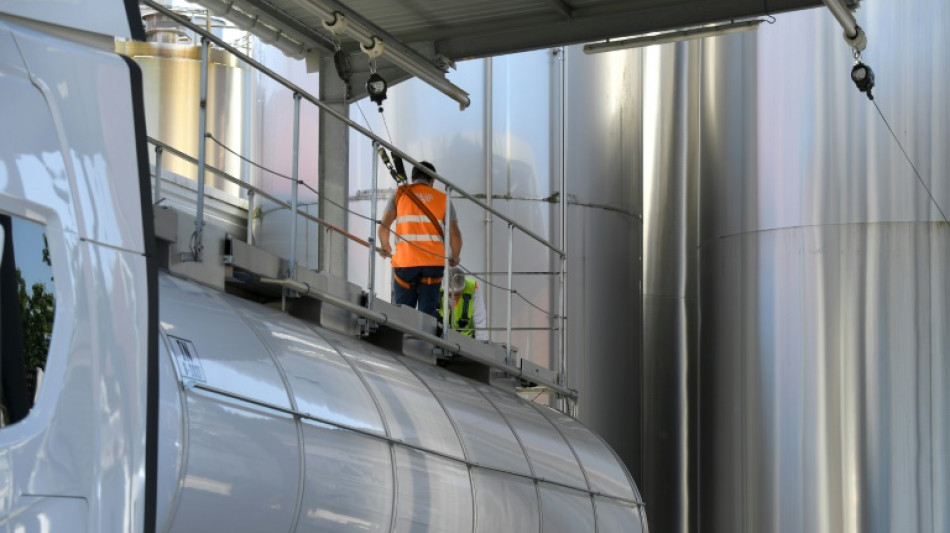
Gas rationing risk means French yoghurt factory faces sour future / Photo: © AFP

 Bijan Robinson destroys Packers in 35-14 win for Falcons
 Harimoto hails new era as Japan dethrone table tennis kings China

 India rape cases turn focus back onto women's safety
 Rebellious Afghan taxi drivers defy ban on music

 Brazil candidates mount digital armies for fierce online campaign

 Nepal PM says floods 'a warning to the world' about climate change

 Trump hosts Xi for state dinner as pomp masks tensions

 Scheffler and Burns give US 3-2 Presidents Cup lead
 Hollywood stars among 100 arrested in NY anti-Netanyahu protest

 Klopp denied on Germany debut as Portugal win in Nations League

 Rich nations should foot climate bill, says Nepal minister

 Wellalage and Mendis star as Sri Lanka level England series in thriller

 Felix gives Portugal win over Wales as Ronaldo misfires

 Wellalage and Mendis star as Sri Lanka level England ODI series

 Guyana urges Venezuela at UN to respect ICJ's ruling on Essequibo region

 Argentina coach says Messi deserves to go out on own terms

 Xi sets red lines for Trump despite lavish White House welcome

 Cowboys, Ravens happy with footing for first Rio NFL clash

 Starbucks to close 250 more cafes in North America

 French actress Marina Vlady dies at 88

 CNN, MS NOW, Politico allowed back in White House after judge's order

 Morocco's ruling coalition dominates low-turnout parliament election
 Napoli hoping to build new stadium, says owner

 What's behind the Pakistani strikes on Afghanistan?

 Hundreds protest for return of Nobel peace laureate Machado to Venezuela

Tanker trucks filled with milk collected from across northern France waited in line to unload their precious cargo at one of the country's biggest yoghurt factories on a recent morning, but this ritual is at risk as the nation considers how to cut energy use.
Like many countries, France plans to shut off businesses first if there is not enough gas or electricity, with European nations facing the prospect of energy shortages this winter following Russia's invasion of Ukraine.
But energy cuts, or even mandated reductions to businesses, risk causing unexpected and surprising economic consequences, such as a halt in the production of French consumers' beloved yoghurt.
The French are big on yoghurt, behind only the Dutch in consumption per capita. It is not only a breakfast staple, but often eaten with lunch or as a snack.
But making yoghurt is an energy-intensive process.
For Patrick Falconnier, director of the Eurial Ultra Fresh factory southeast of Paris, it's quite simple: "No gas" means "no more yoghurt".
The milk from the tanker trucks, after having gone through rigorous quality controls, is transferred into tanks where it is briefly heated to a high temperature to kill bacteria naturally present.
The pasteurised milk is then ready to be transformed into yoghurt or other dairy products, then kept chilled before being quickly shipped off to supermarkets.
"We've been told we could have gas cuts at certain periods this winter, and for us that's really serious," Falconnier told AFP.
If a lack of gas prevents the pasteurisation "we couldn't take deliveries of milk, which means it won't be collected and this will be dramatic for our farmers who will be forced to throw out their milk," said Falconnier, who is also head of the Syndifrais association which unites 22 yoghurt manufacturers responsible for 70 percent of French production.
The impact would be quickly felt within days by consumers as supermarkets receive dairy shipments daily.
"We make products with an average shelf life of 30 days. We make them to be sold the next day," Falconnier said.
"When I shut down a factory, I halt production and I stop sales and I can't supply my clients," he added.
The Eurial Ultra Fresh factory which employs 461 is part of the Agrial agricultural cooperative which has four such facilities.
About 90 percent of their output is sold under brands of major retailers, in France and several other neighbouring European countries.
- 'Can't handle another crisis' -
Falconnier worries that the industry wouldn't be able to survive such disruptions.
The pandemic saw staff worn down by high numbers of people off due to illness.
Since the beginning of the war in Ukraine, the surge in prices of energy , packaging and fruits has added 20 percent to costs.
"We've been weakened. We can't handle another crisis with factory closures. That's just not possible," Falconnier said.
French Prime Minister Elisabeth Borne warned industry leaders at the end of August that energy rationing was a risk this winter and urged them to quickly cut consumption.
Government ministers have begun meeting with industrial federations on how to reduce consumption, with a target of a 10 percent drop within two years.
Falconnier says he has considered moving to methane, a gas which can be produced from the breakdown of organic matter from farms, landfills and wastewater treatment plants.
But he estimates this would take five to 10 years and sees little possibility for a quick reduction in energy use.
"We can't make investments for a term of six months," Falconnier said.
"To stop supplies to a factory from one day to the next, that's shutting it down. We don't how to manage things differently."
J.Horn--BTB