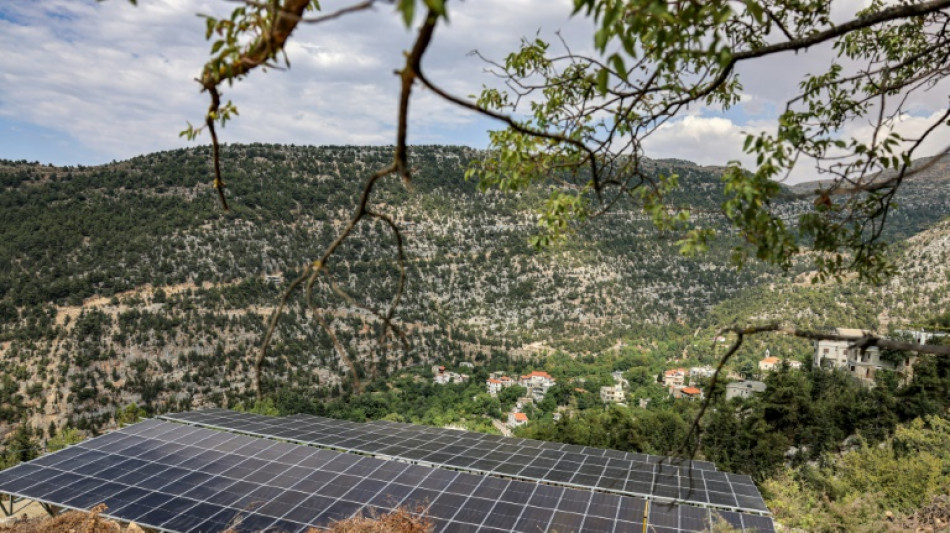
'A necessity': Lebanon's forced conversion to solar / Photo: © AFP

 Bijan Robinson destroys Packers in 35-14 win for Falcons
 Harimoto hails new era as Japan dethrone table tennis kings China

 India rape cases turn focus back onto women's safety
 Rebellious Afghan taxi drivers defy ban on music

 Brazil candidates mount digital armies for fierce online campaign
 Nepal PM says floods 'a warning to the world' about climate change
 Trump hosts Xi for state dinner as pomp masks tensions
 Scheffler and Burns give US 3-2 Presidents Cup lead
 Hollywood stars among 100 arrested in NY anti-Netanyahu protest
 Klopp denied on Germany debut as Portugal win in Nations League

 Rich nations should foot climate bill, says Nepal minister

 Wellalage and Mendis star as Sri Lanka level England series in thriller

 Felix gives Portugal win over Wales as Ronaldo misfires
 Wellalage and Mendis star as Sri Lanka level England ODI series
 Guyana urges Venezuela at UN to respect ICJ's ruling on Essequibo region

 Argentina coach says Messi deserves to go out on own terms
 Xi sets red lines for Trump despite lavish White House welcome

 Cowboys, Ravens happy with footing for first Rio NFL clash
 Starbucks to close 250 more cafes in North America

 French actress Marina Vlady dies at 88

 CNN, MS NOW, Politico allowed back in White House after judge's order

 Morocco's ruling coalition dominates low-turnout parliament election
 Napoli hoping to build new stadium, says owner

 What's behind the Pakistani strikes on Afghanistan?
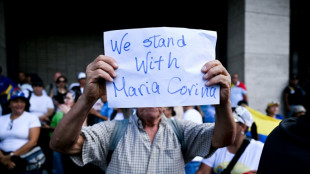 Hundreds protest for return of Nobel peace laureate Machado to Venezuela

Thanks to solar energy, residents of the northern Lebanese village of Toula are finally able to enjoy ice cream again -- a treat in a sun-baked country plagued by power cuts.
Lebanon's economy collapsed in 2019 after decades of corruption and mismanagement, leaving the state unable to provide electricity for more than an hour or two per day.
Last winter, the mountain village of Toula barely had three hours of daily generator-driven electricity.
Solar power now helps keep the lights on for 17 hours, an engineer working on the alternative energy project said.
"For two years the kids have been asking for ice cream, now it's finally time," said Toula mini-market owner Jacqueline Younes, beaming.
"We are waiting for our first order of ice cream to arrive."
While many Lebanese rely on costly generators for electricity, a growing number of homes, companies and state institutions are turning to solar -- not out of environmental concern, but because it's their only option.
Solar panels dot rooftops and parking lots, powering entire villages -- and even Beirut's only functioning traffic lights, thanks to a local NGO.
"Solar energy is no longer an alternative, it's a necessity. If we hadn't installed panels, the village wouldn't have any electricity," said engineer Elie Gereige, standing beside a sea of panels on a hilltop overlooking Toula.
Gereige is part of a team of volunteers who raised more than $100,000 from Toula expatriates to build a solar farm with 185 panels installed on church land.
They worked with the municipality to feed the village generator with solar energy, cutting down on fuel costs while powering the entire community.
- $1.4 million for power -
An hour's drive south of Toula, a branch of Spinneys supermarket is also installing panels in the parking lot and rooftop to slash its generator bills.
"I think we will save around half of our energy costs in Jbeil due to solar panels," said Hassan Ezzeldine, chairman of Gray Mackenzie Retail Lebanon, which owns Spinneys.
The company spends between $800,000 and $1.4 million a month on electricity for its chain of supermarkets, he said, to power generators that run on diesel round-the-clock.
"The cost of generators today is dramatic. It's a disaster."
His company has considered turning to solar energy for years, but after the crisis "we thought... it's something we needed to do, and we needed to do it immediately," he said.
Private individuals are also turning to solar to cut down on generator bills, setting up panels and batteries on balconies and rooftops.
Homemaker Zeina Sayegh installed solar power for around $6,000 for her Beirut apartment last summer, when the state lifted most petrol subsidies.
She was the only one in the building with panels.
This year, nine neighbours have joined her, covering the roof with metal bars connecting dozens of panels.
She has switched completely to solar, limiting power consumption at night. But she has non-stop electricity in the summertime -- a rare luxury.
"I'm more comfortable this way. I feel I'm in control of the electricity and not the other way around," she said.
- Expensive switch -
In a country where poverty is rampant and bank depositors with savings are locked out of their accounts, installing solar power is expensive.
Many Lebanese have resorted to selling a car, jewellery or a plot of land to finance the switch.
Before Lebanon's economy collapsed, only a few companies offered solar power installation services.
But high demand has opened the door "for anyone to start selling solar systems", said Antoine Skayem of solar power company Free Energy.
Demand from cash-strapped municipalities has soared, he said.
But they are vulnerable to political meddling and patronage.
A.Gasser--BTB